
Essays · Modern Art
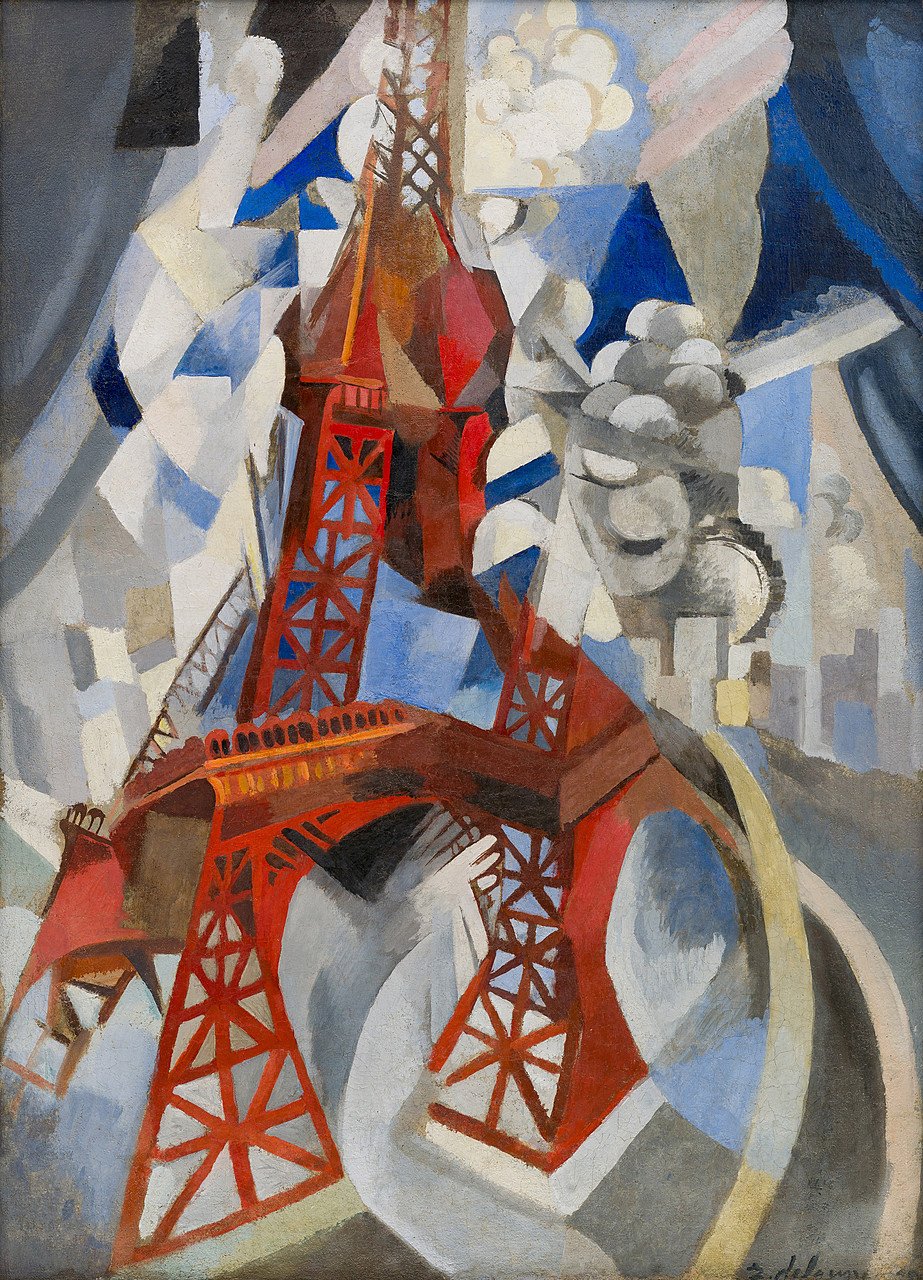
Robert Delaunay. Red Eiffel Tower.
One tower, seen from every side at once.
Solomon R. Guggenheim Museum · Solomon R. Guggenheim Museum
A red tower
Red Eiffel Tower is an upright oil painting, about 125 centimetres high and just over 90 wide. Robert Delaunay painted it across 1911 and 1912. It belongs to the Solomon R. Guggenheim Founding Collection at the Guggenheim Museum in New York.
The tower fills the full height of the picture. It narrows as it rises, and its tip vanishes at the edge of the canvas, as if it carried on somewhere above. It is painted vermilion, a colour that surprises us today. According to the Guggenheim, it recalls how the tower looked at the 1889 World's Fair in Paris, the year it was built.
The body of the tower is not solid. It is made of crossing beams, like triangular lattice or hatching. The huge iron mass looks light, almost as if wind could pass through.
A dismantled gaze
Look at the two front legs and they obey no rule of perspective. The right leg is seen as if we faced its corner, showing two sides. The left leg is seen straight on, a single plane. Two views that cannot coexist, coexist.
The result is a sense of motion. Perhaps we are walking around the tower. Or perhaps the tower itself is walking, its legs twisting toward each other in heavy, uneven steps. The rear legs are only suggested, in softer reds set further back.
Around the tower lies a mosaic of grey, beige and blue. Up close it becomes a city: small rectangles like distant blocks of flats, white and grey clusters like clouds or smoke. In the upper corners, curved bands drop and bend outward like the folds of curtains. The Guggenheim presents this as the first in his series showing the tower and its surroundings as if seen through a curtained window.
The poet Blaise Cendrars, Delaunay's friend, described the method: Delaunay took the tower apart to get inside its structure, cut it short and tilted it, to lay bare all three hundred dizzying metres of its height.
From Cubism to Orphism
The Guggenheim places the painting under Cubism and the School of Paris. It was made just as Paris painters were breaking objects into planes to see them from several sides at once. Delaunay used that breaking, but he cared more for colour and motion than for mass.
In 1912 the poet Guillaume Apollinaire coined the word Orphism for painters moving away from Cubism toward an abstract art that spoke to several senses at once. The name came from Orpheus, the singer of Greek myth whose music could move nature itself. Robert Delaunay, Sonia Delaunay, František Kupka and Francis Picabia are the names tied to it. They wanted to catch the simultaneity of modern life: everything happening at once.
Delaunay's influence travelled fast. The translucent planes of colour in the sky of Marc Chagall's Paris through the Window show what Chagall learned from him. In 1918, in Madrid, Delaunay designed the cover of a slim book of Vicente Huidobro's poem Tour Eiffel, a poem inspired by these very tower paintings.
Why the Eiffel Tower
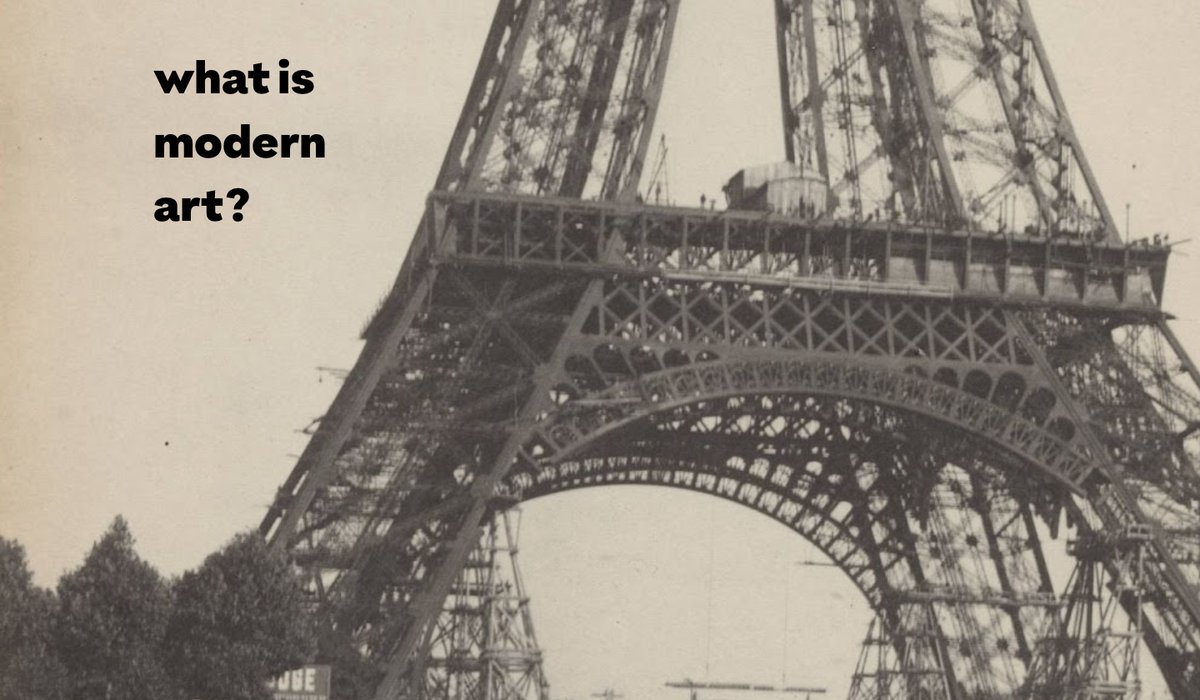
When Delaunay painted it, the tower was barely more than twenty years old. It was an iron structure three hundred metres tall, built for a fair, and many Parisians had found it crude. For Delaunay and his friends it was the clearest image of a new age: iron, speed, height.
He painted it again and again in those years. Each time it tilted differently, broke differently. In this red version it is no longer a fixed monument but something closer to a living thing, trembling among the buildings.
In 2024, during a major Orphism exhibition at the Guggenheim, another of Delaunay's Eiffel Tower paintings in the collection was cleaned, bringing back its subtle colour shifts and sense of movement. More than a century on, his tower still refuses to stand still.
Modern Art