
Essays · Modern Art
Marc Chagall. Paris through the Window.
One window, two places.
Solomon R. Guggenheim Museum · Solomon R. Guggenheim Museum
A room looking onto the city
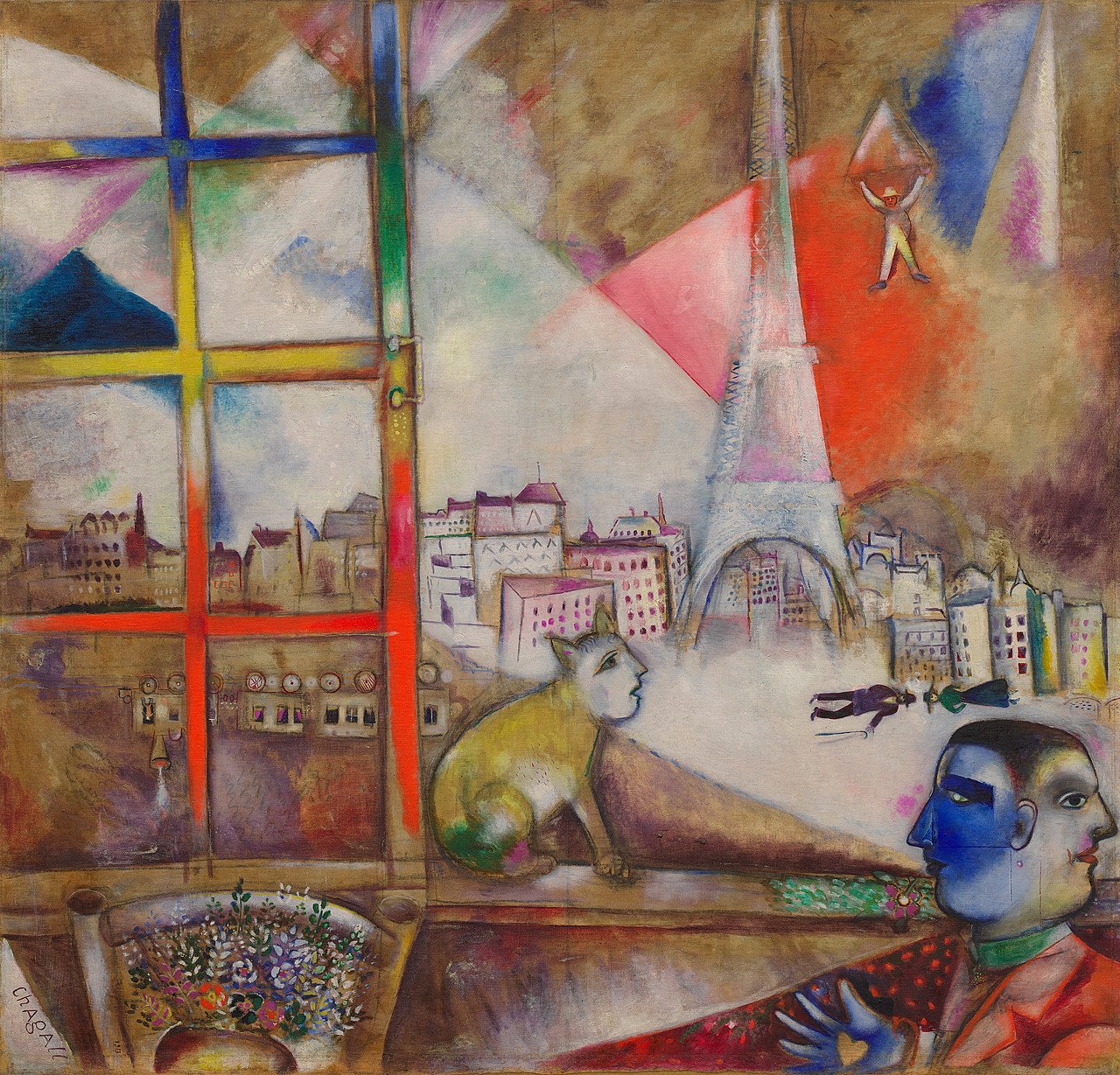
Paris through the Window is a nearly square oil painting, about 136 centimetres high and almost 142 wide. Marc Chagall painted it in Paris in 1913. Today it belongs to the Solomon R. Guggenheim Founding Collection at the Guggenheim Museum in New York.
In the foreground two figures face each other. On the right is a blue human head with two faces, each looking a different way. On the left is a cat with a human face, sitting on the ledge. Beside the cat is a window of eight panes, its frame shifting from red at the bottom to yellow, green, then blue.
Through the window lies Paris. The buildings are drawn in thin plum lines, with a few dabs for windows and roofs. The Eiffel Tower runs up the right edge, so tall that its top leaves the canvas. A pale ivory band cuts diagonally across the picture, like a spotlight falling on whatever it touches.
Things that will not stay still
Look longer and the painting turns strange. Near the base of the tower two small figures, a man in a suit with a cane and a woman in a dress, stand sideways as if gravity had been rotated. Near the top, a figure floats in the sky holding a triangular parachute. Behind it runs a beam that moves from blue to white to red.
In the lower panes a train runs upside down. Its smoke puffs toward the ground. The two-faced man holds a small purple flower in his mouth; a blue hand rests at his chest with an ochre heart in its palm.
The paint is thinned and laid on lightly. Charcoal underdrawing still shows through. On the back of the chair, his name and the year 1913 are written as if they were part of the furniture.
The parachutist may point to something real. According to the Guggenheim, the first successful parachute jump took place in 1912, a year before the painting. Paris then was a city of new things: an iron tower, trains, parachutes, aeroplanes. Chagall set them all inside one view from a window.
From Vitebsk to Paris
Chagall was born in 1887 in Vitebsk, a town in the Russian Empire, into a Jewish community. In 1910 he moved to Paris to become a painter, and his work changed quickly. The translucent planes of colour overlapping in the Paris sky show what he learned from Robert Delaunay, who painted the Eiffel Tower again and again. For both men the tower stood for Paris, and perhaps for modernity itself.
Yet Chagall did not leave home behind. This canvas enlarges the window view in a self-portrait he painted a year earlier, in which he set his birthplace against Paris. The two-faced man is often read as the artist himself: one face turned west to France, the other east to Russia.
Chagall disliked such literal readings. He wanted his pictures taken as poems, not puzzles. The title was given by his friend the poet Blaise Cendrars. Cendrars and Guillaume Apollinaire were his poet friends in those Paris years, and their poems, too, suggested more than they told.
The window as a threshold
Chagall often placed his figures between two worlds: inside and outside, past and present, dream and waking. Paris through the Window does it with a very ordinary object. A window.
The window here is not transparent. It has colour, a frame, divisions. It lets us look out, and it reminds us that we are inside. Whoever sits behind it is someone in between: arrived, but not quite belonging.
In 2024 the Guggenheim placed the painting in a large exhibition on Orphism in Paris, near Delaunay's red Eiffel Tower. More than a century later, the two painters still look at the same tower, each from a window of his own.
Modern Art