
Essays · Modern Art
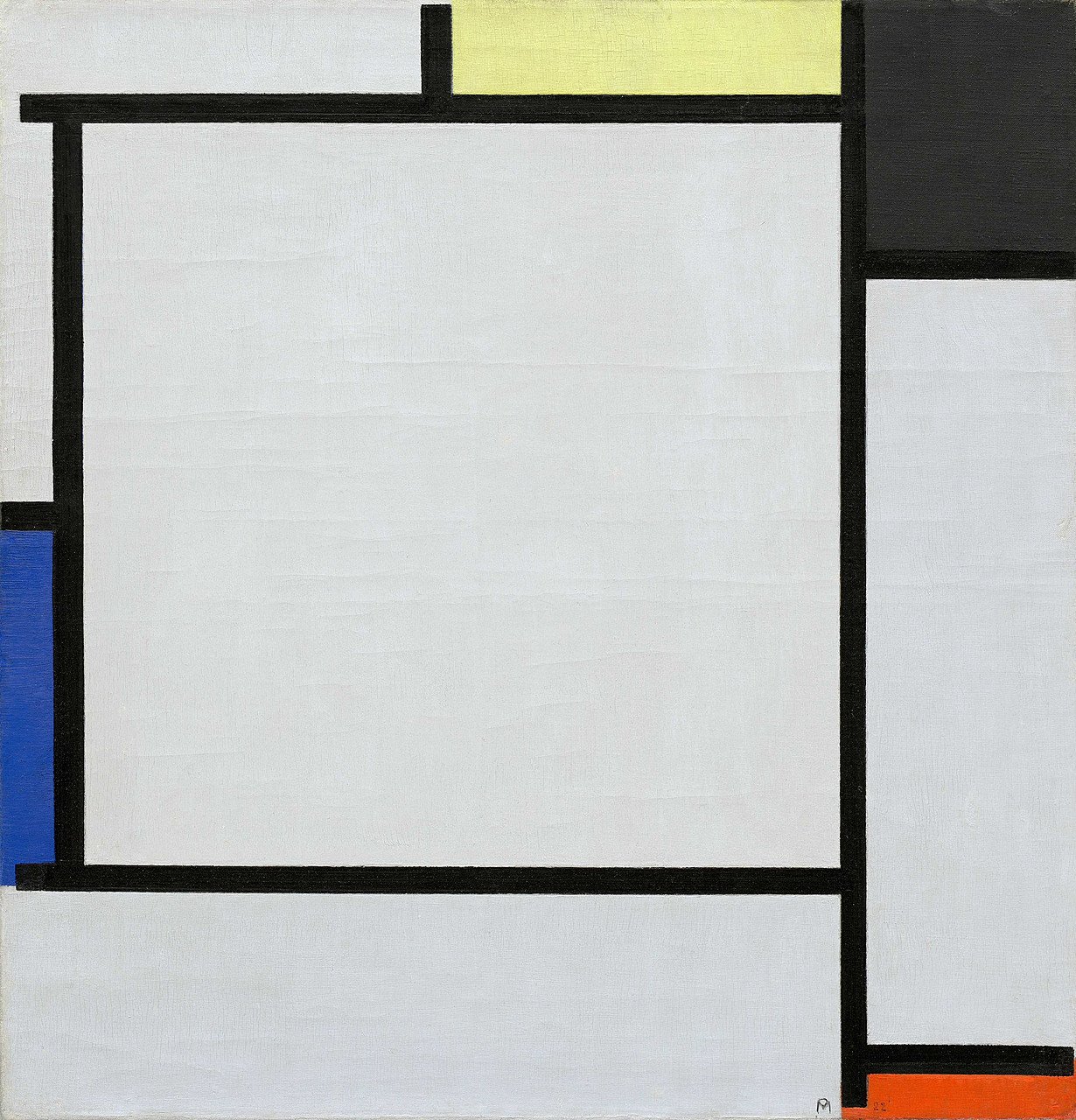
Piet Mondrian. Tableau 2.
Balance is not the same as equal.
Solomon R. Guggenheim Museum · Solomon R. Guggenheim Museum
An almost square canvas
Tableau 2 is a small oil painting, about 56 centimetres high and 53 wide. Almost square, but not quite. Piet Mondrian painted it in 1922, in Paris. Today it is in the collection of the Guggenheim Museum in New York.
On the canvas is a grid of black lines, only horizontals and verticals, meeting at right angles. The lines divide the surface into fields. Some are painted red, yellow, blue. The rest are white and grey.
No figure, no tree, no horizon. Nothing to recognise. Only colour, line, and how they stand beside each other.
The title adds nothing either. Tableau in French simply means painting. Mondrian gave many works names like this, numbered as in a ledger. The Guggenheim itself holds another canvas called Tableau No. 2/Composition No. VII, from 1913, made before he reached the black grid and primary colours.
From trees to straight lines
Mondrian was born in 1872 in Amersfoort in the Netherlands and died in 1944 in New York. He did not begin with squares. In his early years he painted and drew the Dutch landscape: dunes in Zeeland, chrysanthemums, ginger pots on a table. The Guggenheim collection still holds several works from that period.
Then he went to Paris, met Cubism, and began breaking objects into planes. But he went further than those he learned from. Step by step, trees became curves, curves became straight lines, straight lines became a grid. The Guggenheim describes the path as moving ever further from nature, toward a universal essence or spirit behind the appearance of things.
For Mondrian, taking away was not losing. Each time he dropped a detail, he believed he came closer to what does not change.
A language called Neo-Plasticism
Mondrian called his new painting Neo-Plasticism. Its rules were few and strict: only horizontal and vertical lines; only the three primaries red, yellow and blue, with white, black and grey. Everything was built to resist the illusion of depth. The picture is a flat surface and must be seen as one.
He tied this language to De Stijl, Dutch for The Style, a group of artists and architects who wanted abstract art to become a blueprint for modern life: urban, orderly, ever further from nature.
Tableau 2 belongs to the early years of that language, when Mondrian had settled again in Paris and was working steadily with the grid. Looking at a painting like this, we see he was not repeating a formula. Each canvas is another attempt: shift a line, resize a field, see if the whole still holds. In the same vein, Composition C is another attempt with the same three colours.
Why it still rewards looking
Today Mondrian's black grid and three colours are everywhere: on furniture, clothes, hotels, even software. The Guggenheim notes that these ideas have travelled far beyond what he intended. They are easily taken for a decorative pattern.
Standing before an actual painting is different. Tableau 2 is small, at eye level. Look long enough and the balance of the whole canvas appears as something found bit by bit, by eye and hand, not calculated in advance. Move one line a few centimetres and the whole picture would tip.
In late 2024 the Guggenheim opened Piet Mondrian: Ever further, eighteen works from the museum's own holdings, one of the most representative Mondrian collections in the world. Its curator, director Mariët Westermann, wanted visitors to see him as an experimental painter, not only a geometric designer. Tableau 2 is a small piece of evidence for that.
Modern Art