
Essays · Modern Art
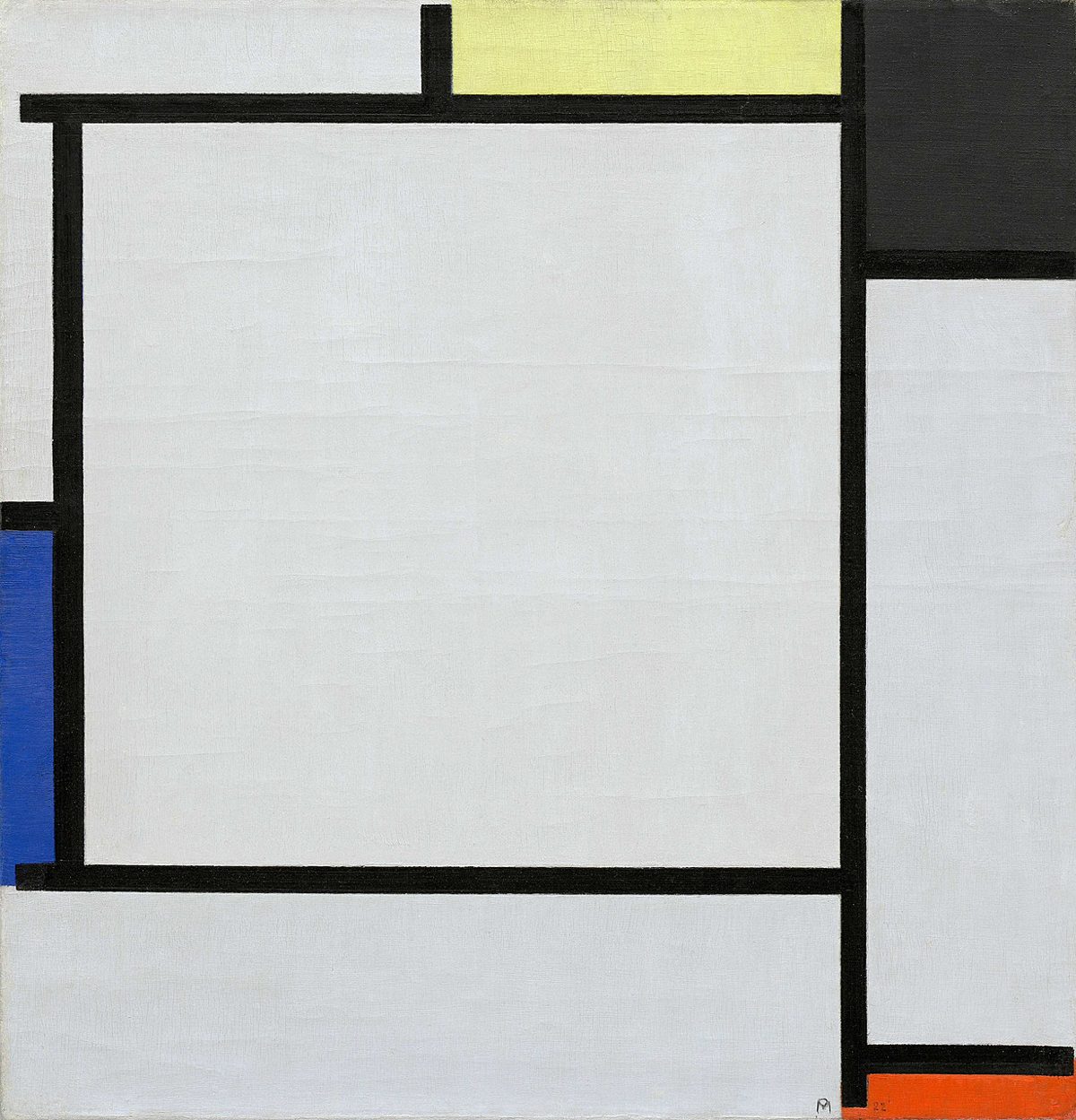
Piet Mondrian. Composition C (No.III) with Red, Yellow and Blue.
Each small element holds the whole picture.
What is on the canvas
Composition C (No.III) with Red, Yellow and Blue is an oil painting on canvas made by Piet Mondrian in 1935. The canvas is nearly square, about fifty six by fifty five centimetres.
It holds only a few kinds of element. Black lines running horizontally and vertically. White planes between them. And the three primary colours, red, yellow and blue, from which, in the familiar understanding of painting, all other colours can be mixed.
No curves. No diagonals. No image of anything in the world. Tate's label calls it a clear example of Mondrian's technique, the simple visual language he used throughout his work.
Even the title tells nothing. A letter, a Roman numeral, the names of three colours. It reads more like a catalogue number than a title. The viewer is not led to a story, only placed before what is there.
From tree to straight line
Mondrian was a Dutch painter, and he did not begin with black and white grids. In his early years he painted the landscapes of home: trees, windmills, fields, water. Over many years the image of things was simplified, then disappeared, leaving only their structure.
In 1917, with Theo van Doesburg and a group of artists and architects, he founded De Stijl, Dutch for the style, both a magazine and a movement. Mondrian called his own path Neo Plasticism. He limited himself to horizontal and vertical lines, right angles, the three primaries, and white, black and grey.
The limit did not make painting easier. It made every decision heavier. With only a few things on the canvas, the thickness of a line, the size of a colour plane, its distance from the edge, all decide whether the picture stands or falls.
In 1935, when he painted this work, Mondrian was living in Paris. A few years later, before the war, he moved to London and then to New York, where he spent his last years.
The individual and the collective
Tate reads the painting as more than geometry. Through the structure and order of its elements, Mondrian suggested an idealised view of society. Each element contributes to the whole composition, symbolising the relationship between the individual and the collective.
Seen this way, a red plane does not stand alone. It means something because of the white beside it, the black line that stops it, the yellow further off that balances it. No element outranks another. Yet remove one and the whole order tilts.
It is an optimistic idea, made in years when Europe was drifting toward conflict. Mondrian did not paint the world as it was. He painted an order he believed was possible.
A painting on loan
The painting does not belong to Tate. It comes from a private collection and has been lent to the museum since 1981. For more than forty years it has remained in Tate's care, where people can stand before it.
Mondrian painted many works called Composition, numbered and lettered, with the same elements. They share a language, but no two share an arrangement. Another of his works, Tableau 2, shows how the same system can open onto different balances.
Before Composition C, what stands out is not simplicity. Anyone can draw geometry. What stands out is the sense that everything has been weighed for a long time. A longer black line, a larger colour plane, and it would be another painting. The stillness is the sum of many small decisions.
Modern Art