
Essays · Modern Art
Max Ernst. Celebes.
A familiar thing, a few additions, and it turns strange.
Tate · Tate
The elephant from Celebes
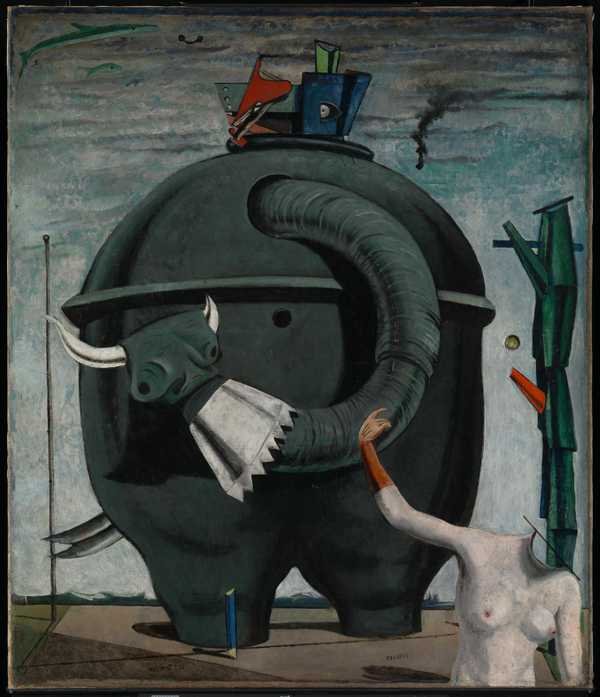
Celebes was painted in Cologne in 1921, oil on canvas, roughly 125 by 108 centimetres. It was Max Ernst's first large painting. The lower left corner carries his signature and the date; the lower right, the title.
At its centre stands a huge rounded form, like a boiler, on two legs. It has a horned head with eyes that seem sightless. Yet a pair of tusks projecting on the left hints at another head on the far side. A long snake-like coil emerges from a hole near the top. Above sits a brightly coloured construction holding an eye.
The creature stands in open space, though there are signs it may also be embedded in a solid ground. Two fish swim in the sky. Three upright objects surround it. In the lower corner, a headless, mannequin-like figure raises one arm as if beckoning the monster closer.
Nothing fits together by ordinary logic. Yet each part is painted clearly and firmly, almost like a photograph.
From an anthropology photograph
The boiler shape has a specific source. According to Tate's records, the painter John Craxton first spotted it, and Ernst later confirmed it: the form comes from an illustration in an English anthropological journal showing a huge communal corn bin belonging to a people recorded as living in the southern Sudan.
The photograph is taken from the same angle and the shape is nearly identical. But Ernst changed its nature. The hollow clay container was given a metallic skin. Then came horns, tusks, a trunk, an eye. A vessel for keeping food became a menacing machine.
This was typical of him. From 1919 he had been cutting up found images from books, illustrations and trade catalogues to build strange combinations. Celebes grew directly from that habit, though this time no collage was made first. Tate observes that his new realities are all the more disturbing because they are made from the known world.
A schoolboy rhyme
The title has an unexpected source too. Ernst told Roland Penrose it came from a crude rhyme German schoolboys recited. Its first line concerns the elephant from Celebes, an island in Indonesia, and some sticky yellow grease on its behind. The later lines are ruder still.
So the painting is sometimes called The Elephant Celebes. The title explains nothing. It opens an association, half childish, half obscene, very much in the Dada spirit Ernst pursued at the time.
The back of the canvas holds some doodles: people, animals, two figures holding what look like golf clubs beside the word GOLF, and a grotesque head with a speech balloon reading HA HA. Most have nothing to do with the front. But they show a painter joking, even while the other side looks grave.
Before Surrealism had a name
In 1921 Surrealism did not yet officially exist; André Breton's manifesto came in 1924. Yet Celebes already holds most of what would define the movement: inexplicable combinations, dreamlike images, echoes of Freud's free association.
The first owner was the poet Paul Éluard, Ernst's friend, who bought it soon after it was finished. In 1938 it passed to Roland Penrose, who kept it until 1975 and then gave it to be sold for the benefit of the Institute of Contemporary Arts in London. Tate bought it that year.
Seen beside Dalí's shifting figures of more than a decade later, Celebes shows how early Ernst opened the way. Unlike many later Surrealist dreams, though, his monster has a very real root. It was once a grain bin, standing in the sun, very far from Cologne.

Modern Art