
Essays · Modern Art
Salvador Dalí. Métamorphose de Narcisse.
Look long enough and one shape becomes another.
Tate · Tate
Two shapes, one story
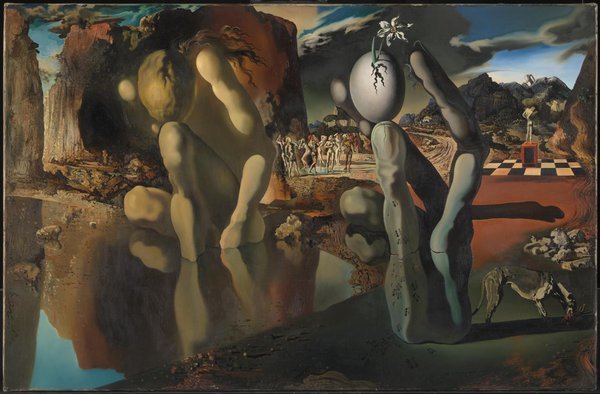
Metamorphosis of Narcissus, Métamorphose de Narcisse in the original French, is an oil painting on canvas made by Salvador Dalí in 1937. It is in the collection of Tate in London.
The composition splits into two near symmetrical halves. On the left a golden brown figure crouches at the water's edge, head bowed to the knee, as if gazing at his reflection. On the right, in the same position, is a huge grey stone hand, fingers raised, holding an egg. The egg has cracked, and from it grows a narcissus flower.
The two shapes share one outline. The knee of the crouching figure is the egg. The arm and body are the fingers. Once you see the match, it is hard to look at one without seeing the other.
Behind them lies a rocky landscape, late light and small figures. Ants crawl over the stone hand, an image Dalí used often. In one corner a dog gnaws at its prey.
The old story of Narcissus
The title comes from Greek myth, through the poetry of Ovid. Narcissus was a young man so beautiful that he fell in love with his own reflection in water. He sat by the pool, unable to leave, and wasted away. Where he had been, a flower bearing his name appeared.
Dalí painted the moment of change itself. The man is not quite gone; the flower is not quite formed. Both states sit side by side on the same canvas, like two frames of a film.
The old story ends in death. Dalí's painting ends in a sprout. The egg cracks not to break but to let something else come through. The self absorbed ego does not vanish; it passes into another form.
The same year Dalí wrote a long poem of the same title, published with a reproduction of the painting. He wanted viewers to read and look in parallel, following the transformation step by step.
The paranoiac critical method
Dalí called his way of working the paranoiac critical method. Put simply, he deliberately cultivated an obsessive way of seeing in which one image could at the same time be another, and then painted it with a meticulous, almost photographic technique.
The double image was the method's main tool. Clouds become heads, rocks become bodies, a crowd becomes a face. Metamorphosis of Narcissus is often seen as one of the clearest examples: the two images set apart so that the viewer can compare them.
In those years the Surrealists in Paris were drawn to dreams and to what lies beneath consciousness. Its painters found different ways to bring that to the surface. Max Ernst scraped, rubbed and printed textures, and in Celebes built a beast that is half machine. Dalí went the other way: not letting chance lead, but building every detail sharply so that the irrational looks real.
The painting brought to Freud
Dalí had long admired Sigmund Freud. In 1938, after Freud had left Vienna for London, Dalí was taken to meet him and brought this painting along.
The choice made sense. In Freud's writing, Narcissus names a fascination with oneself. Dalí brought the man who had given that idea its name a painting of the original myth.
The meeting was brief. But it shows that Dalí considered this his most representative work at the time, the one he wanted to set before the man he regarded as a master.
Standing before it today, viewers still do what Dalí hoped: look left, look right, look left again. Each time, the figure by the pool looks a little more like the stone hand.

Modern Art