
Essays · Modern Art
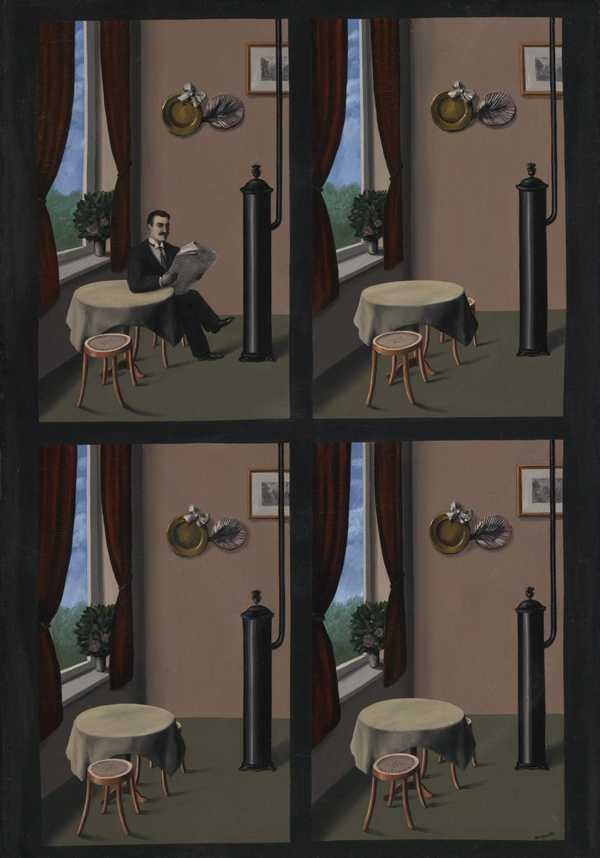
René Magritte. L'Homme au journal.
The man leaves. The room remembers.
Tate · Tate
Four frames, one room
Man with a Newspaper, L'Homme au journal in the original French, is an oil painting on canvas made by René Magritte in 1928. It is in the collection of Tate in London.
The canvas is divided into four panels, like the frames of a comic strip. All four show the same corner of a room: a window, a table, the wall, the floor. Muted colour, flat handling, nothing elaborate.
In the first panel a man sits at the table reading a newspaper. In the other three the room is identical, but empty. He is simply no longer there.
That is all. Nothing happens. No story is told.
The viewer looks for the difference
Because nothing happens, the viewer starts to work. The eye moves from panel to panel, comparing details. Where did the man go? Are the last three any different from one another? Is time passing, or are these four looks at the same moment?
Spot the difference is a familiar children's game. Magritte used its structure and turned it around. Instead of hiding small differences, he offered the biggest one possible, a human being, and left everything else exactly the same.
The result is that the empty panels are no longer empty. They carry the man like an imprint. We cannot look at them without thinking of him.
The four panel structure also recalls a sequence of photographs, or frames of film. We are used to reading them in order, left to right, top to bottom, waiting for something to develop. Here the only development has already happened between the first panel and the second, in the place the painting does not show. Everything that matters lies in the gap between two frames.
Mystery in ordinary things
Magritte is one of the most important Belgian Surrealists. Unlike many in the movement, he rarely painted warped dream scenes. He painted ordinary objects clearly, then placed them in a situation slightly wrong: a pipe with a line of text denying it, a window laid over a landscape, a man in a bowler hat with his face hidden.
Man with a Newspaper dates from the years Magritte lived near Paris at the end of the 1920s, a period of intense work and experiment. The room in the painting contains nothing surreal. That very ordinariness sharpens the question.
For Magritte, mystery was not somewhere far away. It lived in a sitting room, a newspaper, an afternoon. The Surrealists in Paris carried dreams into many fields, from painting to fashion, as in the hats and dresses of Elsa Schiaparelli. Magritte carried them into the most familiar place of all.
A painting as an exercise in looking
The painting can be read as a story of disappearance. It can also be read as an exercise in looking. Magritte asks: do we really look at the room, or only at the person in it?
While the man is sitting there, our eyes stop at him. Window, table, wall are background. When he disappears, the background becomes the main character. For the first time we look closely at the room.
Anyone who has moved out of an old home knows the feeling. Once the furniture and the people are gone, the walls, the floorboards, the window appear most clearly. They were always there; they had simply never been looked at.
The painting does not say where the man went. It only shows that an object, a room, can hold someone's presence longer than the person does.
Modern Art