
Essays · Fashion as Design
Shocking! Les mondes surréalistes d'Elsa Schiaparelli.
A lobster on a dress, a shoe on the head.
Nearly twenty years later
From 6 July 2022 to 22 January 2023, the Musée des Arts Décoratifs in Paris showed Shocking! Les mondes surréalistes d'Elsa Schiaparelli, the Surrealist worlds of Elsa Schiaparelli. It was the museum's first retrospective of her in nearly twenty years.
The curators were Olivier Gabet, the museum's director, and Marie-Sophie Carron de la Carrière, chief curator. Nathalie Crinière designed the space, across two floors of the Christine and Stephen A. Schwarzman fashion galleries.
There were 577 works, including 212 silhouettes and accessories by Schiaparelli. Around them stood paintings, sculpture, jewellery, perfume, ceramics, posters and photographs by friends of her generation: Man Ray, Salvador Dalí, Jean Cocteau, Meret Oppenheim, Elsa Triolet.
Many of the garments, jewels and thousands of drawings on show were given by Schiaparelli herself to the Union Française des Arts du Costume in 1973. The museum now keeps that collection.
An inspired seamstress
Schiaparelli often called herself an inspired seamstress. She grew up in a humanist, learned milieu and came to fashion through her fascination with art and artists. Many of them saw her as an artist in her own right.
The exhibition moved by theme and by time. A large opening room was given to her drawings. Then the role of Paul Poiret, her mentor from 1922. Then her trompe l'oeil knitted sweaters, an idea as brilliant as it was radical. Then Jean Dunand, who made her a dress with lacquer-painted pleats.
From there her collaborations with artists began. Elsa Triolet. Jean Cocteau. Salvador Dalí. She used transparent plastics, crayfish buttons, drawer pockets, lobsters. She sat for Man Ray, and many photographs record that friendship.
Lobster, shoe and the Sun King
One room belonged to Dalí. It held the Lobster Dress of summer 1937 and the Shoe Hat, a small Surrealist headpiece in the shape of a shoe.
The collections Schiaparelli began on her own returned to sources she loved: Italian antiquity, nature, music. The Pagan collection nodded to Ovid's Metamorphoses. The Butterfly collection, summer 1937, was given to insects, a fascination she shared with the Surrealists. The Music collection of 1939 stretched the silhouette of the modern woman.
Then 1938 and 1939. Commedia dell'arte, after the characters of eighteenth century Italian comedy. The Astrological collection, with references to Versailles and the Sun King. And the Circus collection, with boleros embroidered with horses, acrobats and elephants. Much of her embroidery was by Maison Lesage, founded in 1924 and still at work today.
The second floor opened on a reconstruction of her salon at 21 Place Vendôme, Paris, which she inaugurated in 1935. The interior was by Jean-Michel Frank, sleek and spare.
Next came a perfume cage showing her early scents, among them Shocking, which travelled the world. The 1937 Shocking bottle was by Leonor Fini and Fernand Guéry-Colas. On another of her bottles, Penta has a separate essay: Elsa Schiaparelli. Succès Fou.
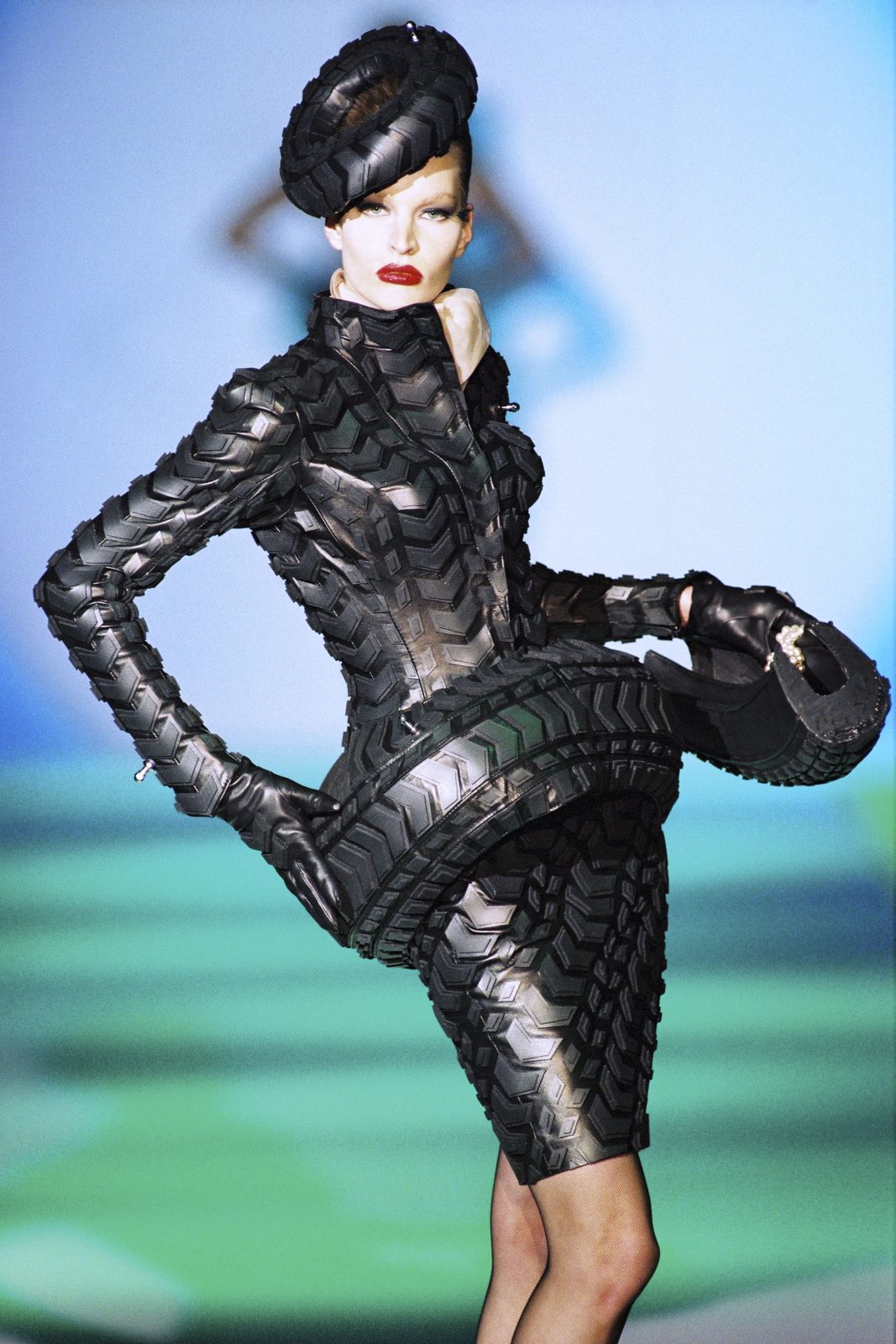
The exhibition ended with designs made in her honour by Yves Saint Laurent, Azzedine Alaïa, John Galliano, Christian Lacroix, and one by Daniel Roseberry, artistic director of the house since 2019. In some twenty-five years of work, Schiaparelli made fashion a natural part of the avant-garde.
Fashion as Design