
Essays · Fashion as Design
Margiela, les années Hermès.
One designer, two houses, two ways of saying the same thing.
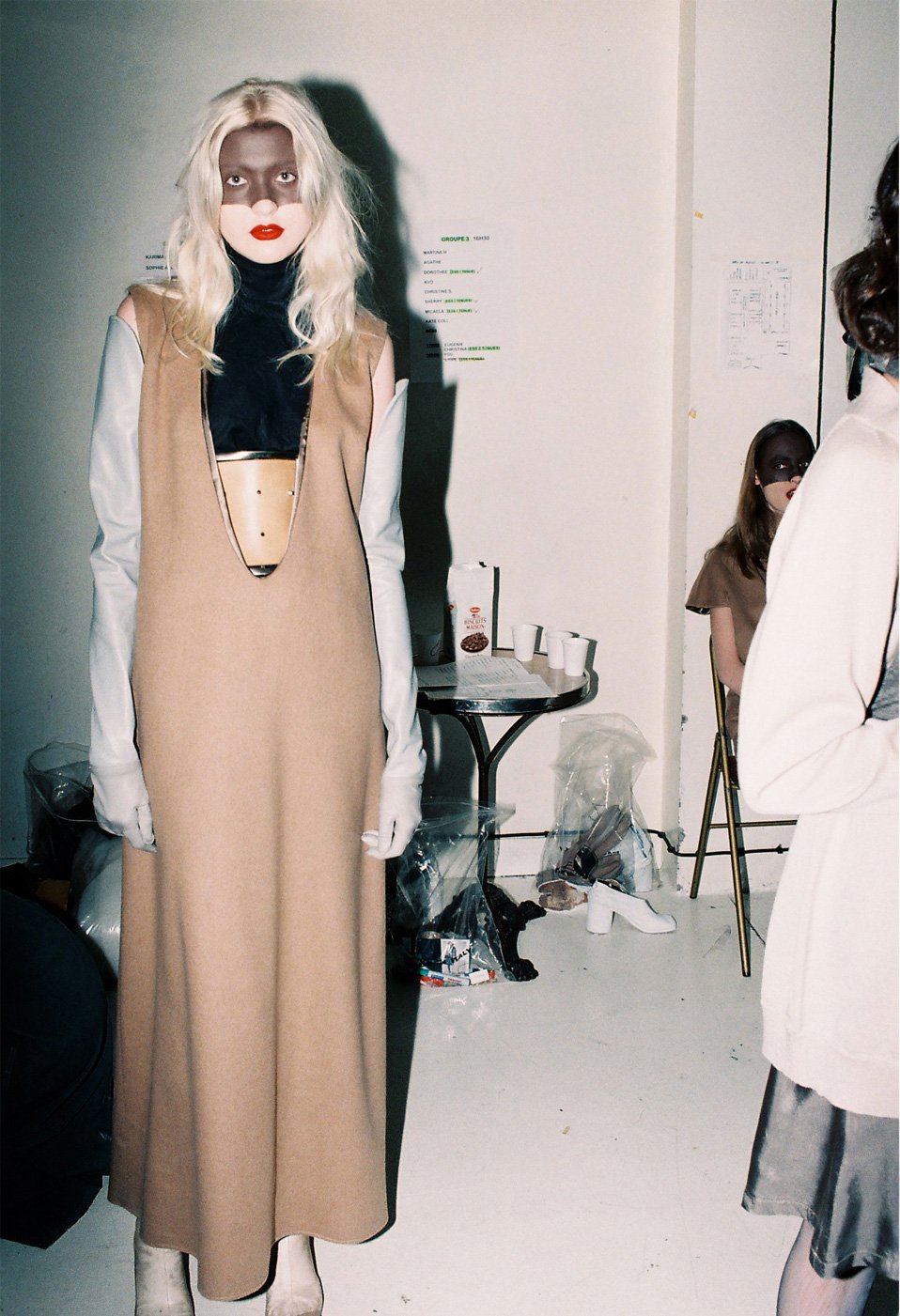
Musée des Arts Décoratifs (MAD Paris) · Musée des Arts Décoratifs (MAD Paris)
From 1997 to 2003, Martin Margiela designed women's ready to wear for Hermès. Twelve consecutive collections. At the same time he kept running his own label, Maison Martin Margiela, founded in 1988.
On paper it was an odd pairing. Hermès is the Paris house of leather, brightly printed silk and long established workshops. Margiela was then known for breaking conventions: exposed seams, oversized shapes, recycled materials, single colours.
According to MAD Paris, Margiela brought a purity of cut and colour to Hermès. He chose a quiet, monochrome palette that broke away from the house's world of colourful prints. What he looked for was comfort, timelessness, a discreet sensuality and the honesty of materials.
He worked with the Hermès studio and workshops, using exceptional materials and many new techniques. At his own label he took garments apart to see how they were built. At Hermès he let good material speak for itself.
Orange and white
The exhibition opened first at the ModeMuseum in Antwerp, MoMu, from 31 March to 27 August 2017, under its director Kaat Debo. The following year it came to Paris. The Musée des Arts Décoratifs showed it from 22 March to 2 September 2018, with Marie-Sophie Carron de la Carrière as chief curator.
Margiela was artistic director. Bob Verhelst designed the space. More than a hundred outfits, with photographs and short films, were arranged in themed sequences. MAD counts 98 accessorised silhouettes.
The layout is a comparison you can see. Hermès orange meets Maison Martin Margiela white along the route. Visitors do not need a label to know which house they are standing in. The colour has already told them.
That white has a name, Meubon white, Margiela's signature. The garment label follows the same spirit: only a piece of white cloth held by four stitches, with no name printed on it. People recognise it precisely because it carries nothing.
Two ways of thinking, one question
The title speaks of the Hermès years, but the real subject is the space between the two houses. One side holds the continuity of craft; the other doubts convention. One keeps, the other dismantles. Margiela stood on both sides at once.
One might expect such a designer to split himself in two. The exhibition shows the opposite. In both places he took away. Less colour. Less pattern. Less name. At his own label the subtraction is visible; at Hermès it becomes a restraint almost impossible to see.
Margiela is known for refusing public appearance. His role as artistic director of an exhibition about himself matters for that reason. He still does not step forward to speak, but he decides how the objects are seen.
What stays after leaving the room is not a particular outfit. It is an idea: luxury and dissent can share a language, as long as both trust material more than introduction.

Fashion as Design