
Essays · Fashion as Design
Balenciaga: Shaping Fashion.
Shape is what we see. Structure is what holds it.
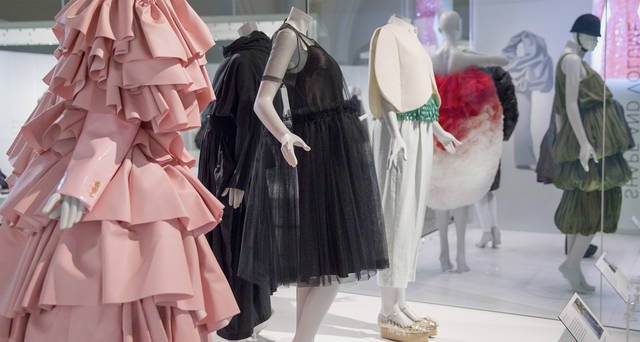
© Victoria and Albert Museum, London · Victoria and Albert Museum (V&A)
A hundred years, eighty years
Balenciaga: Shaping Fashion ran at the V&A in South Kensington, London, from 27 May 2017 to 18 February 2018. The timing was deliberate. 2017 marked a century since Cristóbal Balenciaga opened his first fashion house in San Sebastián, Spain, and eighty years since he opened his famous house in Paris.
The V&A holds the largest Balenciaga collection in the UK. It was begun in the 1970s by the photographer Cecil Beaton, Balenciaga's longstanding friend.
The exhibition showed over a hundred garments and hats by Balenciaga, by his protégés, and by contemporary designers working in his tradition. Its focus was the 1950s and 1960s, arguably the most creative period of his career. Many pieces once belonged to clients such as Ava Gardner, Gloria Guinness and Mona von Bismarck.
New silhouettes
Balenciaga was called the master of couture. He introduced silhouettes that remain staples today: the tunic, the sack, the baby doll, the shift, the envelope dress. These shapes do not cling to the body. They create a space between cloth and wearer.
Among the objects were a cerise silk taffeta evening dress made in Paris in 1955, a black gazar evening dress of 1967, an embroidered evening dress from the early 1960s, and a spiral silk hat made in 1962 for Eisa, his Spanish label.
Beside the clothes were things rarely shown: archive sketches, paper patterns, photographs, fabric samples, catwalk film. A photograph by Henri Cartier Bresson of Balenciaga at work in 1968. One by Richard Avedon of the model Elise Daniels in a Balenciaga suit among street performers in the Marais, 1948. The pictures record not only the dress but how it moved through life.
Seeing through X-rays
What set this exhibition apart was the way it investigated clothing. The V&A described forensic studies of how each garment was built.
In 2016 the artist Nick Veasey X-rayed several Balenciaga pieces, among them the 1955 silk taffeta dress. In the images the silk almost disappears. What appears is what is usually hidden: seams, linings, the reinforcements that let a dress hold its shape with no one inside it.
The museum also worked with London College of Fashion to recreate some patterns digitally. Visitors saw not only the finished dress but the pieces it was cut from and how they came together. The craft of cutting, usually hidden inside, was brought into the light.
A teacher of generations
The final part traced Balenciaga's influence through more than thirty designers. Some had worked near him, such as Hubert de Givenchy, André Courrèges and Emanuel Ungaro. Others came later: Paco Rabanne with his evening mini dress of 1967, Oscar de la Renta, Phoebe Philo at Céline, J.W. Anderson, Erdem, Molly Goddard, Nicolas Ghesquière, Demna Gvasalia.
Side by side, these clothes showed that his legacy lies not in one type of dress but in a way of thinking about clothing as something built in space, just as Christian Dior, his contemporary in Paris, thought about the figure in his own way.
The exhibition was called Shaping Fashion. What visitors took home, perhaps, was a new habit of looking: standing before a garment and asking what is inside it.
Fashion as Design