
Essays · Fashion as Design
Undressed: A Brief History of Underwear.
The layer few people see shapes everything worn over it.
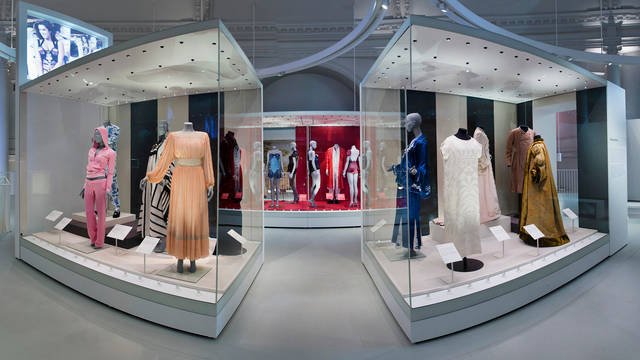
© Victoria and Albert Museum, London · Victoria and Albert Museum (V&A)
The inner layer in the middle of the room
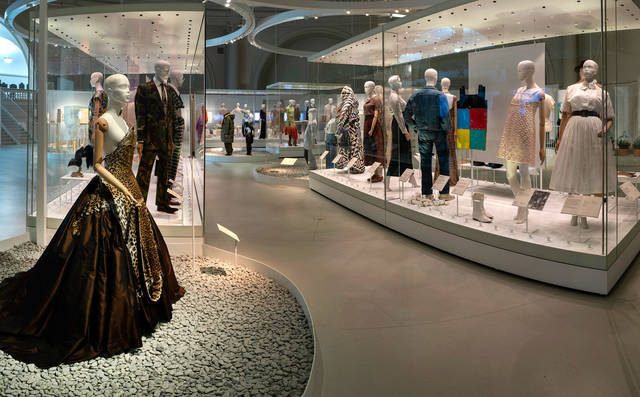
Undressed: A Brief History of Underwear opened at the V&A on 16 April 2016 and ran until 12 March 2017. It followed the design of underwear from the eighteenth century to the present.
Its focus was stated clearly: the intimate relationship between underwear and fashion, and the role of underwear in moulding the body to a fashionable ideal. Through cut, fit, fabric and decoration, the exhibition opened questions of gender, sex and morality.
That approach turns very private things into evidence. A corset stops being a matter for the dressing room. It becomes proof of how an era wanted the human body to look.
Visitors stand before things sewn so that no one would see them. There is some awkwardness in looking. That awkwardness is part of the story.
Frames, bones and goose down
At the centre is the corset of around 1890, cotton and whalebone, from the V&A collection. The whalebone is not decoration. It is structure: thin, flexible strips sewn into the cloth to hold the torso in a set shape. An animal of the sea becomes the frame for a woman's body in a drawing room.
Up close, the corset shows how much labour sits where no one looks. Rows of stitching divide the cloth into narrow channels, each holding a bone. The wearer felt it with every breath, every bend. Others saw only the result: a waist.
In the twentieth century the corset entered advertising. Hans Schleger designed a poster around 1936 for the Charnaux Patent Corset Co. Ltd. Underwear no longer stayed in the drawer. It was sold, drawn, pasted up in the street.
Some objects show underwear was not only about shape. A petticoat padded with Arctic goose down, made for warmth. And the thong, which the V&A describes as created in response to a 1974 ban on public nude swimming in Los Angeles. A piece of underwear born from a by law.
Men were present too. The label Sibling made a man's top and pants for Spring/Summer 2013. A photograph by Jennie Baptiste from 2001, Brixton Boyz, is in the V&A collection. The history of underwear is not only the history of women's corsets.
When the inside comes out
The last part shows underwear becoming outerwear. Antonio Berardi made a trompe l'oeil corset dress for Spring/Summer 2009: the eye thinks it sees a corset, but the image is built into the dress. Gwyneth Paltrow wore it. Alexander McQueen was represented by a dress from Plato's Atlantis, Spring/Summer 2010.
Lingerie houses took part as well. Carine Gilson with the Babydoll slip. Agent Provocateur with the Tamila set from the Soirée line, Spring/Summer 2015. These were made to be seen, even if by only one person.
Walking from start to finish, a clear movement appears. Underwear was once a frame pressing the body into shape. Then it became something for warmth and ease. Then it stepped outside and became a statement.
Undressed makes a simple point. What we see on the outside is always held up by what we do not see. To understand what an era wore, look at the layer it wore closest.
Fashion as Design