
Essays · Fashion as Design
Frida Kahlo. Making Her Self Up.
A person built herself each morning, from cloth, powder and plaster.
© Nickolas Muray Photo Archives · Victoria and Albert Museum (V&A)
Fifty years behind a door
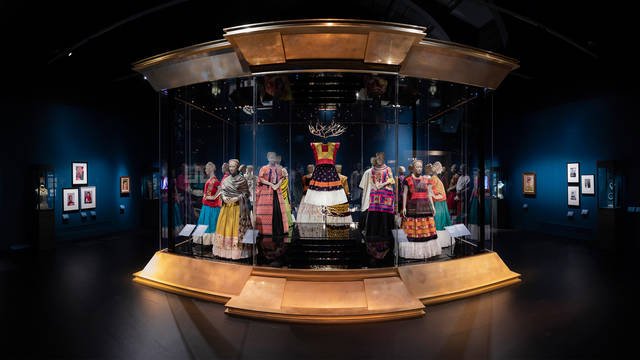
Frida Kahlo: Making Her Self Up opened at V&A South Kensington, London, on 16 June 2018 and closed on 18 November that year. At its centre was a collection of clothing and personal belongings of the Mexican painter.
These things had been locked away for fifty years after her death in 1954. According to the V&A, this was the first time the collection had been shown outside Mexico. Most objects belong to the Museo Frida Kahlo, with the Diego Rivera and Frida Kahlo Archives held by the Banco de México.
The aim was to look at Kahlo's life through her most intimate belongings. Not through biography, not through legend. Through what she wore, applied, and used every day.
That shifts where the visitor stands. We are not before a famous artist. We are before one person's wardrobe.
Cloth, powder and plaster
Most of it was Mexican dress. Cotton huipils, the tunic garment, with machine embroidered chain stitch. Printed cotton skirts with embroidery and a holán, the ruffle at the hem. Satin skirts with chain stitched flowers. A Guatemalan cotton coat worn with a Mazatec huipil and a floor length skirt. This combination of huipil and long skirt is tied to the Tehuana women, and Kahlo wore it as a deliberate choice.
Then cosmetics, all from before 1954. A Revlon compact and powder puff with blusher in Clear Red. Seal-fast top coat. Lastron nail varnishes in Frosted Snow Pink and Frosted Pink Lightening. A lipstick called Everything's Rosy. The names on the packaging read like a small poem of the 1950s.
And harder things. A prosthetic leg with a leather boot, the boot appliquéd with silk embroidered in Chinese motifs. A plaster corset, painted and decorated by Kahlo herself. These speak of a body that needed support. But they were not hidden. They became surfaces to paint, to embroider, to make beautiful in her own way.
Building an image
Photographs and paintings stood beside the objects. Nickolas Muray photographed Kahlo in 1939 in a blue satin blouse, and again that year with an Olmec figurine. A photograph from about 1926 carries an inscription on the back dated April 1929, to Diego, signed Frieda.
Two self portraits were named: Self-portrait on the Border between Mexico and the United States of America, 1932, and Self-portrait with red and gold dress, 1941. In the paintings Kahlo wears clothes like those lying in the nearby cases. Painting and object reflect each other.
As the V&A presented it, Kahlo built her public image with intent, through dress, adornment, and the way she presented herself in photographs and in paint. Each morning's huipil, powder and lipstick was part of one long work.
What Making Her Self Up leaves is not a story of pain, though pain is present. It is a story of choice. A person cannot choose her body, but she can choose how to clothe it. And those choices, locked away for fifty years, still held their colour when the door opened.
Fashion as Design