
Essays · Fashion as Design
Kimono: Kyoto to Catwalk.
One straight garment, passing through many hands, still itself.
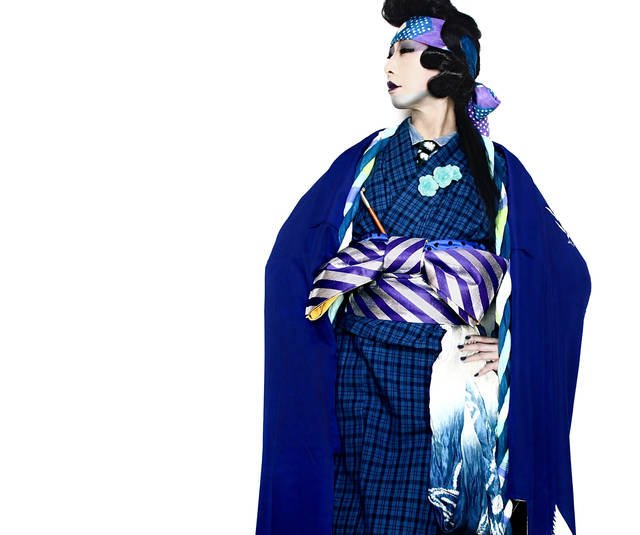
© Image Courtesy of the Joshibi University of Art and Design Art Museum · Victoria and Albert Museum (V&A)
Three centuries in one exhibition
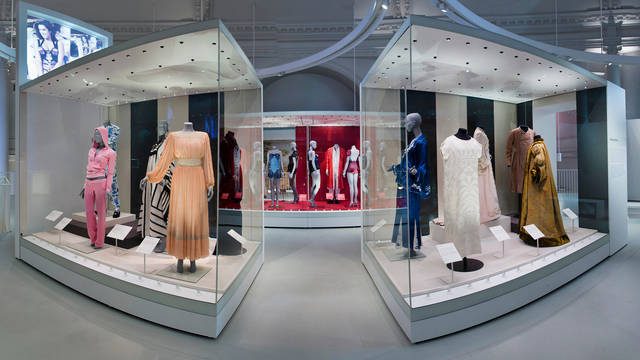
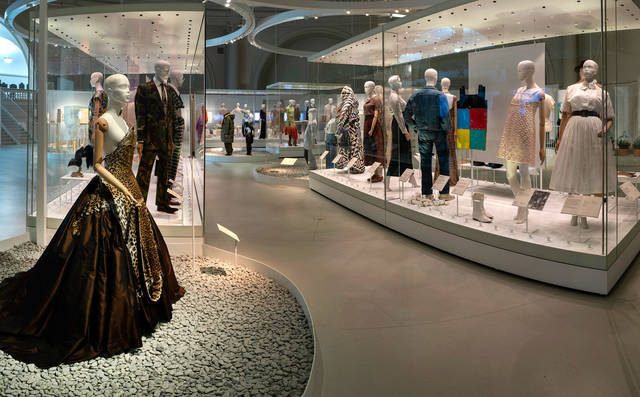
Kimono: Kyoto to Catwalk opened at the V&A on 27 August 2020 and closed on 25 October that year. The museum presented the kimono as a fashion icon in constant motion, not a traditional costume fixed behind glass.
The exhibition's span began in the 1660s and ran to the present, looking at the kimono's importance in Japan and in the rest of the world. Those two directions ran side by side through the rooms.
On the Japanese side were garments from Kyoto. An uchikake, an outer kimono for a young woman, made around 1800 to 1830, probably in Kyoto, with swirling orange and white and orange flowers on white. A furisode, the long sleeved kimono for young women, around 1905 to 1920, also probably from Kyoto, with branches, blue waves, flowers and red leaves.
Beside the garments were pictures. A woodblock print by Utagawa Kunisada I, around 1847 to 1852, showing a woman in black and grey holding lengths of red and purple cloth. A print by Katsukawa Shunsen, around 1804 to 1818, with a black dragon on the back of a robe. A hanging scroll called Kaidan, staircase, by Kobayakawa Kiyoshi, 1935: a woman descending steps with a fluffy cat draped around her neck.
The garment travels
The second part of the story is where the kimono went. A portrait by Gerard Hoet, painted in the Netherlands in 1678, shows Anna Elizabeth van Reede in a black floral kimono style robe, her hand in a bowl of water. The garment had crossed the sea, entered a European interior, and been painted as something precious.
In Paris around 1913 Paul Poiret made a golden silk mantle with a loose bow at the hip. Wide, straight, no waist. Cartier made a vanity case in the shape of an inro, the small tiered box worn at the sash in Japan: two engraved gold boxes with black tassels, opening onto mirrors.
Then cinema. The Obi-Wan Kenobi costume worn by Alec Guinness in Star Wars in 1977, designed by John Mollo, is a long cream and brown robe with a dark brown belt. Many viewers may never have thought of it as a relative of the kimono. The exhibition put it in the same story.
None of these objects copy the kimono. They borrow a part: the straight cut, the crossed collar, the sash, the box. Each borrowing lets the original be seen from one more side.
Back to Japan, and onto the catwalk
The exhibition did not stop at the West looking at Japan. It showed Japanese designers renewing the kimono themselves. The Beyond kimono by Moriguchi Kunihiko, 2005, in black, white and grey, uses squares and diamonds, closer to graphics than to flowers. A kimono ensemble by HIROCOLEDGE, designed by Hiroko Takahashi in 2009, is covered in black and white dots and stripes.
Then a wrap coat by Duro Olowu, made in England in 2015, in yellow, black and purple, polka dots set in stripes, a flower at the waist. The wrap of the kimono enters an entirely different language of colour.
Placed together, these objects do something a strictly chronological display rarely does. They show that the kimono is not a relic. It is a garment still in use, still questioned, still worn in the street.
Perhaps that is why the title names a route, from Kyoto to the catwalk. Not from past to present, but from a city to a runway where people walk. The garment has always been tied to movement, made so the wearer can step, bow, sit, and let the cloth fall.
Fashion as Design