
Essays · Fashion as Design
Fashioned from Nature.
Every garment begins somewhere far from the wardrobe.
© Victoria and Albert Museum, London · Victoria and Albert Museum (V&A)
Garments and specimens
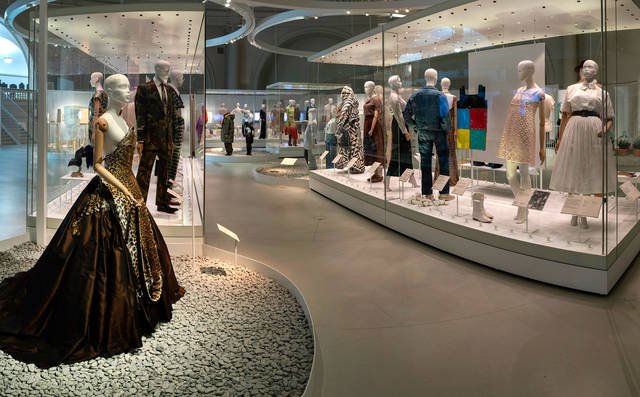
Fashioned from Nature opened at V&A South Kensington on 21 April 2018 and ran until 27 January 2019. The museum presented it as the first UK exhibition to explore the complex relationship between fashion and nature, from 1600 to the present.
The display was unusual. Fashionable dress stood beside natural history specimens, taxidermy, and unprocessed plant and animal fibres. The stated aim was to invite visitors to think about the materials of fashion and the sources of their own clothes.
Placing a coat next to a bird is a simple gesture. But it reveals what is usually hidden. In a shop, clothes arrive as if from nowhere. Here each garment was returned to its source.
Nature on the surface of cloth
The eighteenth century pieces show nature as pattern. A French waistcoat from the 1780s, silk embroidered with monkeys, backed with linen. A mantua and petticoat from the 1760s in red silk brocaded with silver gilt, silver, blue and brown flowers. Nature here is drawn again in thread.
The nineteenth century used the animal body directly. A British cotton muslin day dress from around 1868 to 1869 is decorated with beetle wing cases and metal thread. Green iridescent shells take the place of beads. A skirt with train from around 1890 in black silk satin, trimmed with machine made lace and brocaded with roses.
The twentieth century added materials people invented. In 1936 Alix, later known as Madame Grès, made an evening coat of pale pink cellophane in fan shapes with imitation pearls. In 1946 Lucienne Rabaté made a suede hat for Reboux trimmed with Himalayan monal pheasant feathers, the species Lophophorus impejanus.
The bird's scientific name appears in the caption. A small detail, but it says the hat is not only a hat. It is also the trace of a species living in a particular range of mountains.
From source to responsibility
The final part moved from beauty to questions. In 1989 Katharine Hamnett made the Clean Up or Die menswear ensemble: a black leather jacket with metal studwork forming a skull and text. The title is already a call.
Contemporary designers look for other routes. Bruno Pieters made a trouser suit for Honest By in 2017 in cotton and polyester cloth woven with text. Katie Jones made an outfit from leather off cuts and surplus yarn in 2017. Stella McCartney contributed a Winter 2017 ensemble. A Calvin Klein dress from the Green Carpet Challenge, made from recycled materials, was worn by Emma Watson to the Met Gala in 2016. G-Star RAW showed a 2018 jacket and jeans in denim certified Cradle to Cradle at Gold level.
Some experiments went further. Diana Scherer in the Netherlands made the Rootbound #2 dress in 2017, a work standing between gardening and dressmaking.
The exhibition offered no answer. It placed two things side by side, the beauty of an object and its cost, and let visitors look. A beetle wing dress is beautiful. It is also beetles. Both are true.

Fashion as Design