
Essays · Fashion as Design
Christian Dior. Bar Suit.
The figure is sewn inside the suit.
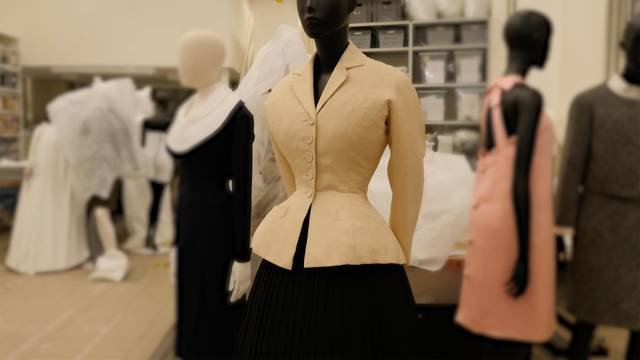
© Victoria and Albert Museum, London · Victoria and Albert Museum (V&A)
A February morning in 1947
On 12 February 1947, Christian Dior launched his house in Paris. His first collection was called La Ligne Corolle. Among its models, the Bar suit was one of the most popular.
Carmel Snow, editor of American Harper's Bazaar, named it on the spot: the New Look. That name outlived the original one. Harper's Bazaar published detailed line drawings of how New Look garments were built. The Bar suit appeared in Vogue and L'Officiel.
The suit has two parts. A hip-length jacket in natural tussore silk, tightly fitted, closed with three self-covered buttons at the centre front, with pockets at the hips, tailored collar and lapels, lined in cream silk. A skirt of fine black wool crêpe, fully pleated, mounted on a stiffened taffeta petticoat, fastened at the back with hooks and snaps.
From a distance you see a round shoulder, a full bust, a hand-span waist, then a skirt that opens wide. Up close you see how those things were made.
The shape is in the seams
What is worth looking at in the Bar suit is that it does not wait for a body. It carries one. The jacket hips are padded to round them. The quilted silk waistband is shaped to throw the waist out from the hips, so it reads smaller than it is. The stiff taffeta underneath keeps the wool pleats standing rather than falling.
The suit is a structure. The wearer steps into a shape already built. In the V&A's Fashion Unpicked series, dressmaking expert Sue Clark examined the Bar suit inside and out, to see the ingenious methods that made it fit exactly as Dior intended.
Dior pushed the soft female silhouette to its extreme: sloping shoulders, narrow waist, spreading skirt. It was the reverse of wartime clothing, which was lean, straight, square-shouldered and sparing with cloth.
Cloth in a time of rationing
That sparing is exactly why the New Look caused outrage. According to the museum, a New Look woollen day dress typically took about 15 metres of fabric, a short taffeta evening dress about 25. In Britain, cloth was still rationed.
There were official complaints. The Board of Trade tried to suppress it. The collection was shown in secret to Princess Margaret at the French Embassy in London. The New Look could not be stopped.
Looking back, the Bar suit is an answer given in material to years of scarcity. Not a statement. Only more cloth, more pleats, a more carefully sewn waist. People understood at once what it meant.
Original, or remake
The Bar suit at the V&A has its own story. The museum asked for a typical New Look costume. The photographer Cecil Beaton contacted Dior on its behalf, and Christian Dior Paris, at 30 Avenue Montaigne, sent a jacket, a skirt and a hat.
On the customs form the house described the skirt as fibranne and wool, the jacket as raw silk shantung. The museum now thinks the suit may be a 1950s remake, perhaps made for Dior's lecture at the Sorbonne in 1955. The famous Willy Maywald photograph of the house model Renée on the cobbled banks of the Seine has also been dated by the Maywald Archive to 1955, not 1947.
So the object that stands for 1947 may have been made eight years later. That does not diminish it. It shows the Bar suit had already become a model, remade to be explained, photographed again to be remembered. The shape mattered more than the date.
In 2019 the suit was shown in Christian Dior: Designer of Dreams at the V&A, from 2 February to 1 September. Another reading of the whole house sits in the Paris exhibition Christian Dior, couturier du rêve.
Fashion as Design