
Essays · Fashion as Design
Christian Dior, couturier du rêve.
One name, and seven people reading it again.
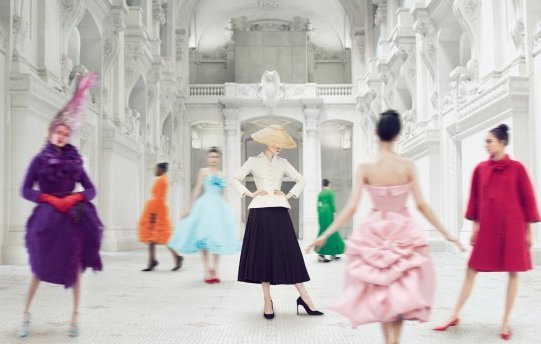
© Emma Summerton · Musée des Arts Décoratifs (MAD Paris)
Seventy years in a museum
From 5 July 2017 to 7 January 2018, the Musée des Arts Décoratifs in Paris staged Christian Dior, couturier du rêve for the house's seventieth anniversary. The curators were Florence Müller, textile and fashion curator at the Denver Art Museum, and Olivier Gabet, the museum's director. The scenography was by Nathalie Crinière.
For the first time, the museum's fashion galleries and its nave were joined into one route, almost 3,000 square metres. It held over 300 haute couture gowns, from 1947 to the year of the show.
Beside the gowns were things rarely seen: white atelier toiles used for fittings, fashion photographs, sketches, letters, notes, advertising, hats, jewellery, bags, shoes, perfume bottles. Most came from Dior Héritage and had never been shown in Paris.
The previous Paris retrospective of Dior was in 1987, at the same museum, and covered only the ten years Dior designed himself, 1947 to 1957.
Before the couturier, a dealer
The exhibition opens with Dior's life: childhood in Granville, the 1920s when he found the Paris avant-garde, his work as a fashion illustrator before he entered couture.
One chapter is often forgotten. From 1928 to 1934 Dior ran an art gallery with friends, first Jacques Bonjean, then Pierre Colle. He hung established older artists beside young ones of his own generation: Giacometti, Dalí, Calder, Leonor Fini, Max Jacob, Jean Cocteau, Christian Bérard.
This part was framed as Christian Dior's imaginary museum. Paintings, sculpture, furniture and decorative objects stood beside the clothes, showing gowns full of references to painting, sculpture, wallpaper, upholstery, porcelain. He collected antiques and Art Nouveau, loved the eighteenth century, and loved gardening.
Crinière staged the themes as a sequence of settings: a gallery, an atelier, a street, a boudoir, journeys, a garden.
Six readers
In the nave, a chronological route crossed seventy years, 1947 to 2017. It opened with the Bar suit, the black and white ensemble that became the image of the New Look. Penta has a separate essay on it: Christian Dior. Bar Suit.
Dior died in 1957. Six galleries followed for six artistic directors. Yves Saint Laurent, a daring choice because he was so young. Marc Bohan, a more measured one. Gianfranco Ferré, flamboyant. John Galliano, dramatic years. Raf Simons, a minimal statement. And Maria Grazia Chiuri, the first woman in the role, with a feminist view of fashion.
Each room asked the same question: how do you keep the spirit of someone gone and still live in your own time? No two answers matched.
Atelier and ballroom
Midway through there was a working atelier, seamstresses among models, sketches and toiles. Couture was shown as a trade: measure, cut, fit, correct, repeat.
At the end, the nave became a ballroom. Evening gowns stood together, some seen side by side in Paris for the first time. Some had been worn by Princess Grace of Monaco, Princess Diana, Charlize Theron, Jennifer Lawrence.
Among them was a dress called Soirée Brillante, found through research for the show. It had been presented at the Musée des Arts Décoratifs itself in November 1955, in Dior's lifetime. On Wednesday 30 November that year, his models walked in evening dress among furniture and objets d'art at the opening of a museum exhibition. Sixty-two years later, the dress came back to the same house.
Fashion as Design