
Essays · Fashion as Design
Thierry Mugler, Couturissime.
Clothes as a stage, the body as a character.
Musée des Arts Décoratifs (MAD Paris) · Musée des Arts Décoratifs (MAD Paris)
An exhibition in acts
Thierry Mugler, Couturissime ran at the Musée des Arts Décoratifs in Paris from 30 September 2021 to 24 April 2022. It was initiated, produced and toured by the Montreal Museum of Fine Arts from 2019, and curated by Thierry-Maxime Loriot.
In Paris it filled two floors of the newly renovated Christine and Stephen A. Schwarzman fashion galleries. The works on show dated from 1973 to 2014, covering Mugler's fashion career from the 1970s to 2002.
The layout did not follow a plain chronology. MAD describes the exhibition as built in several acts, like a classical opera. Garments stood alongside animated projections, photographs and music. Visitors did not walk through an archive. They walked through a performance.
That choice suited Mugler. He designed costumes for the Comédie-Française's Macbeth, staged at the Festival d'Avignon in 1985. The stage was not a side branch of his work. It was how he thought about clothes from the start.
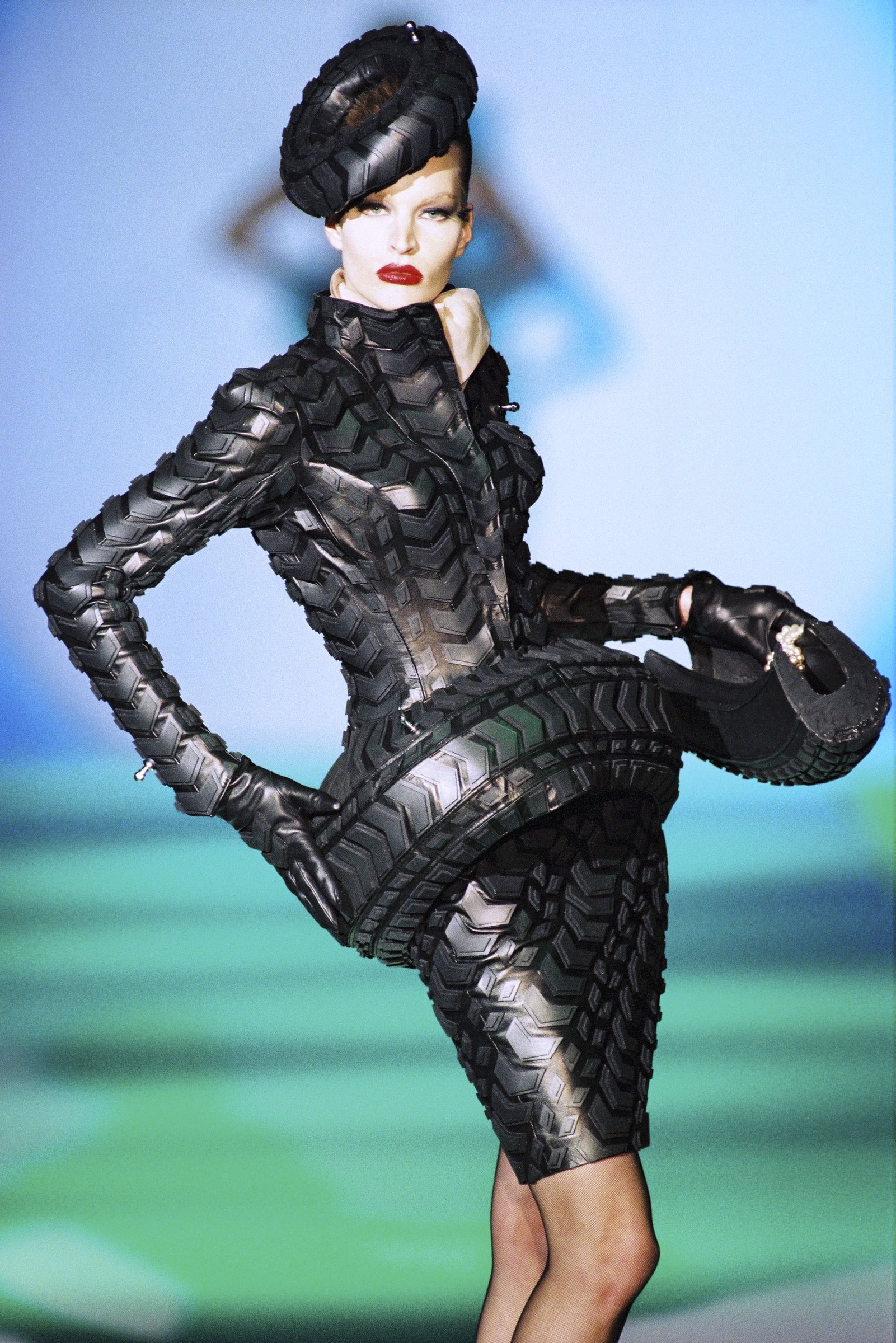
Insects, chimeras, machines
By the late 1970s Mugler had an idea later called the Glamazon: a tall woman, broad shoulders, cinched waist, walking like a character stepping out of a film. Collection by collection, the silhouette was pushed further.
The spring summer 1997 haute couture collection was Les Insectes. Autumn winter 1997 to 1998 was La Chimère, a collection of hybrid creatures. Earlier, the autumn winter 1995 to 1996 haute couture show marked the house's twentieth anniversary, and for that occasion he made Maschinenmensch, a robot figure.
The titles alone show a direction. The human body is not where the garment ends. It is a frame for building something else: a beetle with a glossy shell, a creature no one has seen, a walking machine.
What makes these pieces memorable is not only their strangeness. They were made to haute couture standards, every seam and detail calculated for a particular body. Imagination travelled with precision.
Image and scent
Couturissime showed not only clothes but the images those clothes produced. It included work by Guy Bourdin, Jean-Paul Goude, Karl Lagerfeld, Dominique Issermann, David LaChapelle and Helmut Newton. Models and stars such as Jerry Hall, Iman, Eva Herzigova, Linda Evangelista, Diana Ross and Sharon Stone are part of the story.
Set beside the garments, those photographs suggest that for Mugler an outfit was only complete with a setting, a light, a frame. Clothing was part of a scene, never alone.
Then, in 1992, came the perfume Angel, which MAD calls an olfactory revolution. Beside the armour and insect wings, a bottle is a small object. Yet it carries the logic of the whole house: create a character, and let that character follow the wearer off the stage.
Leaving the exhibition, no one takes an outfit home. They take a scene. Perhaps that is what Mugler wanted: clothes remembered not as clothes, but as a moment on a stage everyone was invited to step onto.
Fashion as Design