
Essays · Modern Art
Giorgio de Chirico. The Uncertainty of the Poet.
One thing about to rot, one thing that never changes.
Tate · Tate
A square without people
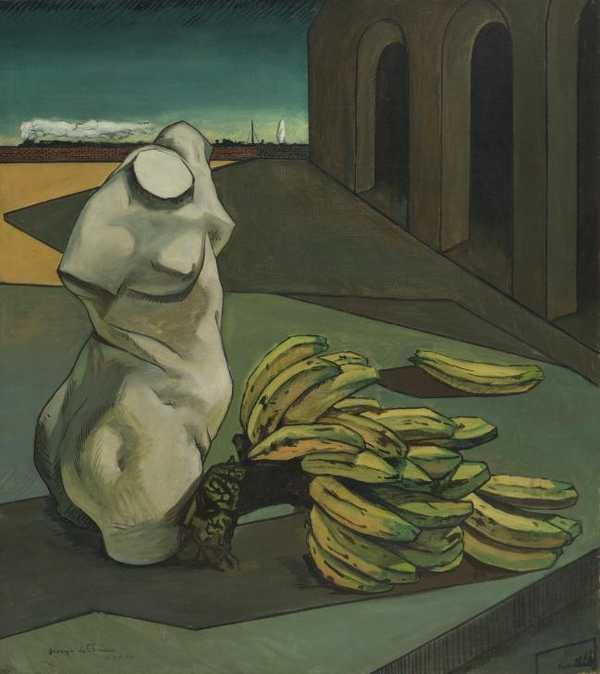
The Uncertainty of the Poet is an oil on canvas, 106 centimetres high and 94 wide. At lower left de Chirico signed it with the year in Roman numerals: M.CM.XIII, 1913. He painted it in Paris, most likely that winter.
In the foreground stands the plaster torso of a woman, headless and armless. Beside it, at its foot, lies a bunch of ripe yellow bananas. To the right an arcade recedes sharply, casting blocks of solid shadow. At the end of the view runs a long brick wall. Behind the wall a train passes, trailing smoke. Further still, a ship's mast.
The sky is emerald green, a colour no one expects of an afternoon. The light is low, the shadows long. There is no living figure.
Tate notes the heavy black outlines, the sharply marked areas of shadow, the crude hatching on the statue as in an engraving. Everything is strangely real and at the same time thin as a stage set.
A statue from a Montparnasse shop
The statue is not an ancient masterpiece. Tate describes it as an Aphrodite type plaster cast, rooted in nineteenth century academic practice rather than any Greek or Roman original.
Roland Penrose, who later owned the painting, recalled that such casts were well known in Paris, sold in many shops around Montparnasse, always the same size. Penrose bought one himself in 1935. Matisse painted it in a still life in 1919.
So de Chirico placed at the centre of his picture a common object, the kind bought to learn drawing. In the empty square it becomes a character. From 1913, Tate explains, plaster casts let him treat the human figure as part of a still life, no more important than the fruit beside it. The human is present, stripped of everything temporary.
The bananas are the opposite. In a manuscript of the time de Chirico wrote of the happiness of the banana tree and the luxury of ripe fruit, golden and sweet. Tate suggests fruit and cast may be set as two poles: on one side body, senses, transience; on the other, a thing that stays still for ever.
Metaphysical painting
De Chirico arrived in Paris from Italy in July 1911. On the way he stopped a few days in Turin, whose arcaded squares and many statues stayed with him. In 1935 he wrote that in Turin everything is apparition, that you enter a square and meet a man of stone gazing as only statues can.
The poet Guillaume Apollinaire met de Chirico in 1912 and became his strongest supporter in Paris, calling these pictures metaphysical landscapes. He is believed to have titled some of them, though the source of this title remains unknown.
De Chirico abandoned single point perspective. Foreground and background do not fit, joined by the arcade's exaggerated diagonal. The space is not meant to look real. It is meant to unsettle.
The train may carry a private memory. His father was a railway engineer who died when de Chirico was eleven. Trains recur in his paintings of these years, often small and almost toylike.
From Guillaume to Eluard to Penrose
De Chirico was under contract to the dealer Paul Guillaume. When he left France for the Italian army in May 1915, most of his recent canvases stayed with Guillaume. In spring 1922 Guillaume showed fifty nine of them in Paris, with a preface by André Breton. This painting was among them.
The poet Paul Eluard bought it, probably in autumn 1922. Eluard wrote that de Chirico's squares look like real squares that we have nevertheless never seen. For the Surrealists, his paintings proved that a dreamlike parallel world could be made from ordinary things.
In 1938 Eluard sold much of his collection to Roland Penrose, this painting included. It hung for years in Penrose's farmhouse in Sussex. In 1985 Tate bought it from Penrose's executors.
In 1968, more than fifty years later, de Chirico painted almost the same arrangement again: statue, bananas, arcade, shadows, wall. With one difference. No train, no mast. No one leaving.
Modern Art