
Essays · Olfactory Art
Exposition Internationale du Surréalisme.
In the dark, the nose leads the way.
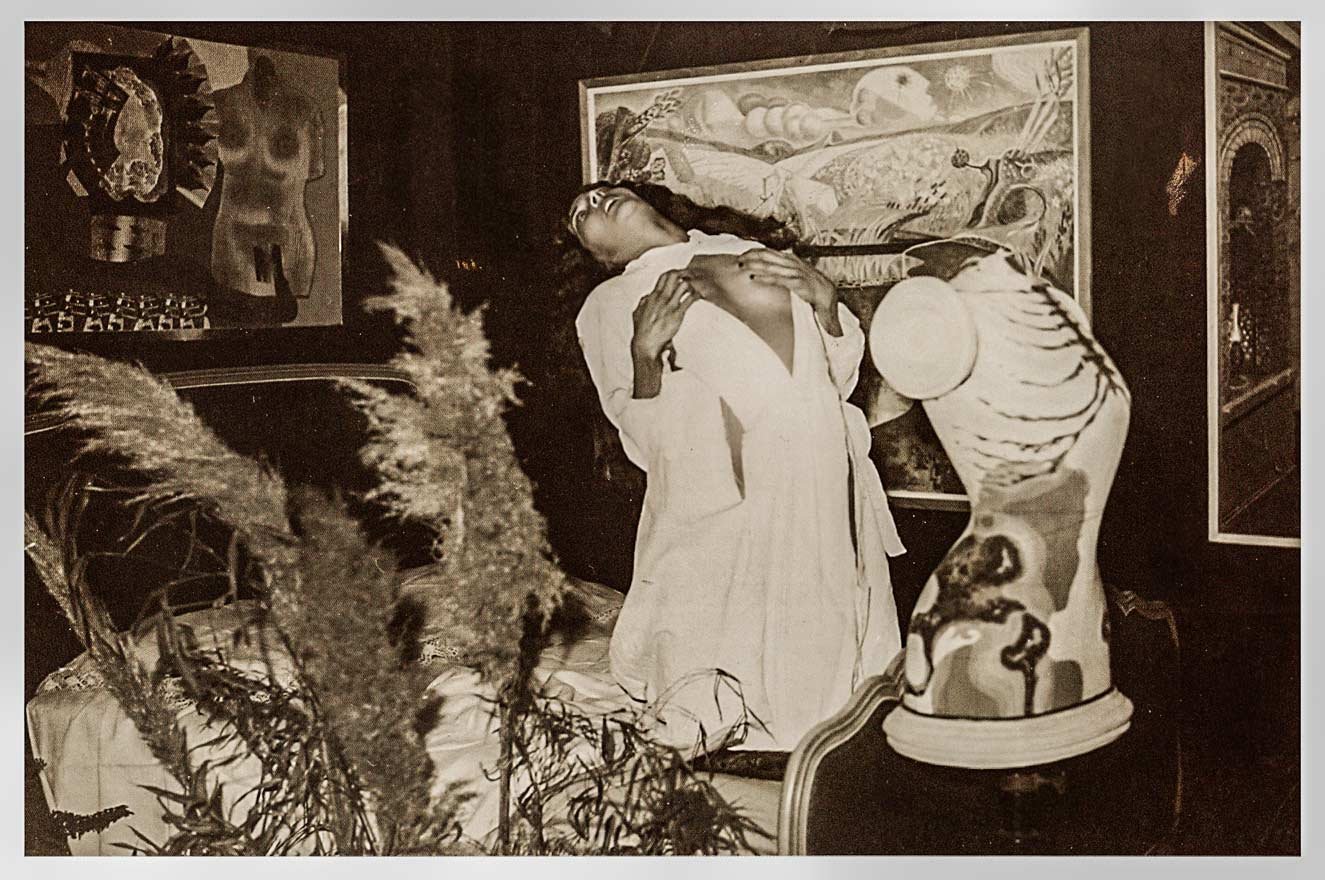
Archival photo 1938, reprinted in Stedelijk Studies (Stedelijk Museum Amsterdam) · Koregos (Revue et encyclopédie multimédia des arts)
Paris, January 1938
The Exposition Internationale du Surréalisme opened on the evening of January 17, 1938, at the Galerie Beaux Arts in Paris and ran until late February. It was organised by André Breton and Paul Éluard, the two central figures of the Surrealist group. The list of participants included many names from the movement, among them the poet Benjamin Péret.
The staging was entrusted to Marcel Duchamp. According to Margaux Van Uytvanck's study on Koregos, he took the title générateur arbitre, generator of ideas and referee. Man Ray was named master of lights.
Duchamp was already known for his readymades, shop bought objects brought into the gallery. This time he brought in not an object but an environment: darkness, coal dust, sand, dead leaves, sound, and smell.
Coal sacks above, dead leaves below
The main hall is where Duchamp intervened most. From the ceiling he hung 1,200 coal sacks. According to Koregos, the first idea was to hang around a hundred umbrellas, which proved impractical. The sacks lowered the ceiling and turned the room into something like a cave. Coal dust sometimes fell on visitors.
At the centre stood a brazier. The floor was covered with sand and dead leaves. In each corner was an unmade bed. There was a small pond edged with ferns. Revolving doors were used to hang works.
The skylight was blocked so the room was almost dark. Visitors were given torches to light whichever works they wished. According to Koregos, the torches disappeared on opening night, and fixed lighting was installed afterwards. Sound was part of the space too: a military parade and recorded laughter.
The smell of roasting coffee
In that dark room, coffee was roasted on an electric heater. Its smell spread through the exhibition. The name attached to it was odeurs du Brésil, the smells of Brazil.
Today this is often cited as one of the first deliberate uses of smell as a material of exhibition design. Before, the gallery belonged to the eye. The air in the room was meant to be neutral, the more neutral the better. Here, the air had content.
Coffee is a telling choice. It is not exotic. It is the smell of cafés, kitchens, Paris mornings. Placed in a dark room with coal sacks overhead and dead leaves underfoot, the familiar smell turns strange. That is the Surrealist method: take the familiar, put it in the wrong place, let it change meaning.
Why it is still remembered
The 1938 show is often seen as a landmark of modern exhibition design. Visitors no longer stood outside looking in. They moved through the work, found their way by torchlight, stepped on leaves, heard noises, and smelled.
There is a small link to Duchamp's earlier work. The exhibition included a mannequin dressed as Rrose Sélavy, his female alter ego. Seventeen years earlier, that face had appeared on a perfume label in Belle Haleine, Eau de Voilette. In 1921, scent was a name on a bottle. In 1938, it was part of the air.
It took museums decades to grow used to the idea that a work might need to be smelled. The scented rooms of contemporary art, from Kienholz's bar to today's olfactory installations, all have a forerunner in that dark Paris room full of coffee.
Olfactory Art