
Essays · Photography
Sophie Calle. The Sleepers.
The bed remembers everyone who has lain in it.
Fraenkel Gallery · Fraenkel Gallery
Eight hours of sleep
In 1979 Sophie Calle asked people to lend her eight hours of their sleep. They would come to her flat in Paris and sleep in her bed. For eight days in a row, the room would never be left empty.
Twenty seven people agreed. Friends, acquaintances, and strangers too. Each came for a shift, slept eight hours, then left for the next person to lie down. Sometimes one shift overlapped the next, and two strangers crossed paths beside the bed.
Calle was there throughout. She took a photograph every hour. She sat and watched her guests sleep, and noted their gestures, their turning, whatever happened during each shift.
The sleepers knew they would be photographed. But once asleep, they no longer controlled how they looked.
Pictures by the hour, words by the person
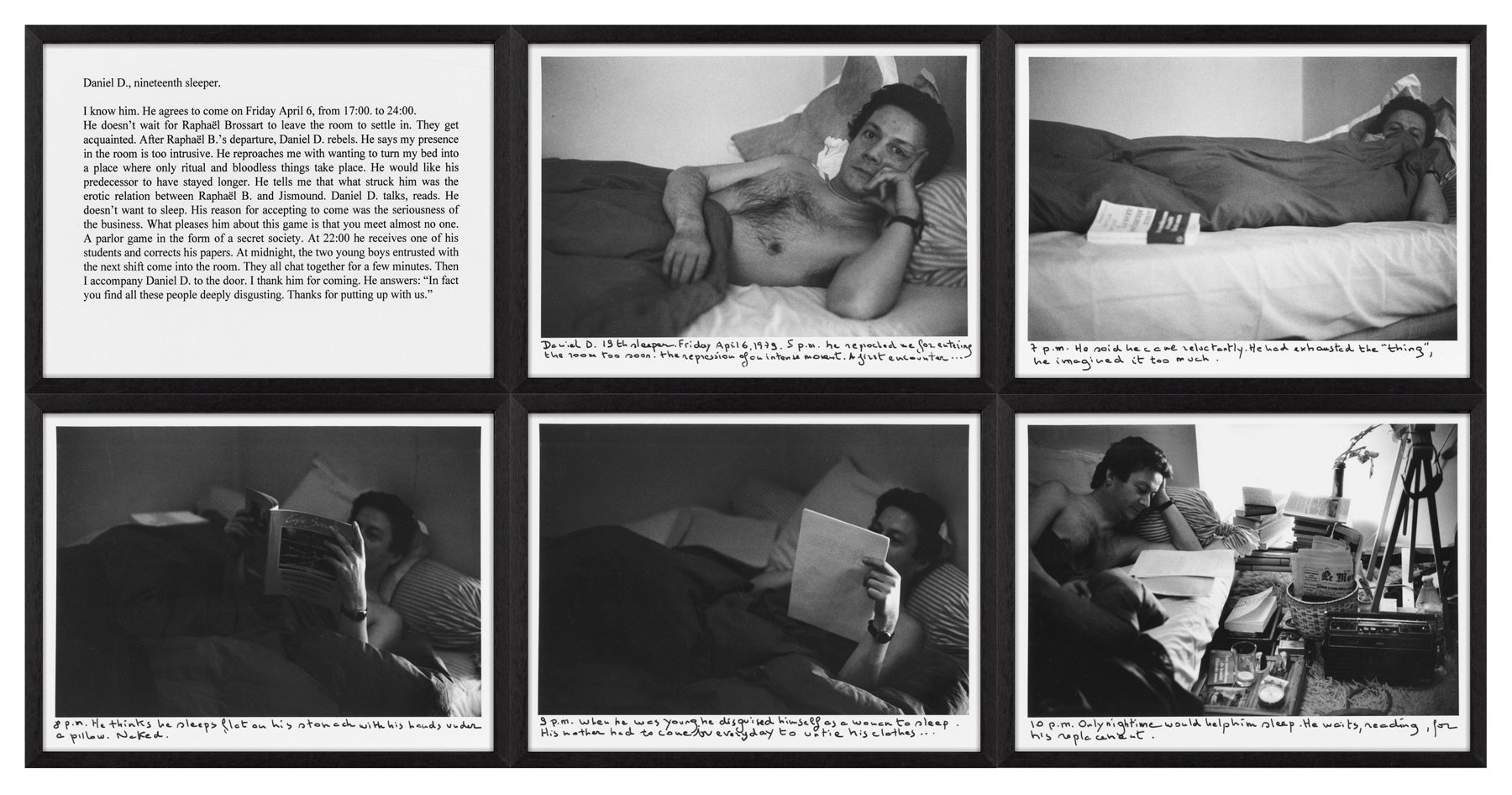
The work is presented sleeper by sleeper. Each person becomes a set of black and white gelatin silver prints beside a text panel. The panel gives a name or initials, their place in the sequence, and what Calle recorded during that shift.
Fraenkel Gallery has shown several of these sets. The fifth sleeper has eight prints. The twelfth has six. The nineteenth has five. Each set has its own length and rhythm, as if every sleep were a short story without words.
The photographs are not beautiful in the usual sense. They are records: the same bed, the same angle, only the sleeper and the posture change. Side by side they look more like a night watch log than a set of portraits.
An early work
The Sleepers is one of Calle's first works. Much of what she pursued later is already here: curiosity about other people, a rule set in advance, recording in images and words side by side, and the blurred line between observing and intruding.
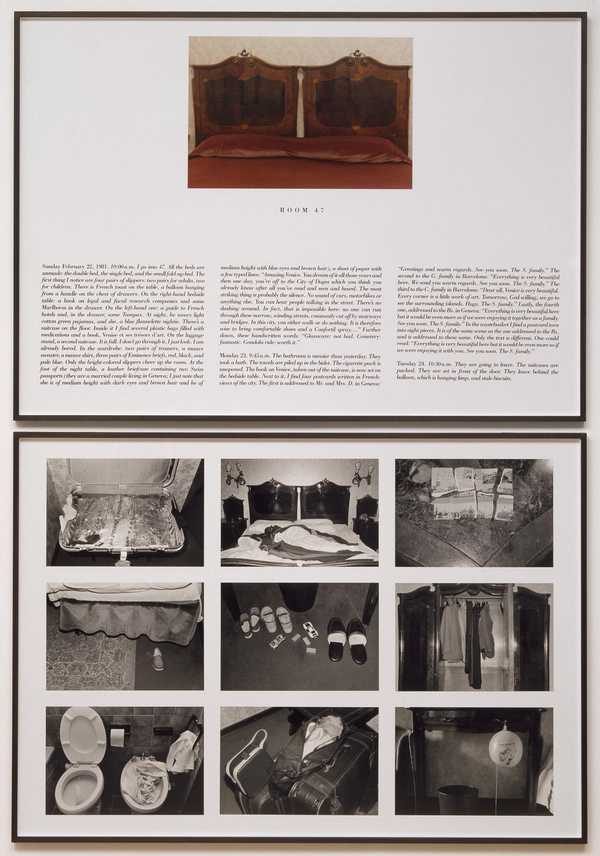
Two years later she went the other way in The Hotel, working as a chambermaid in Venice and going through guests' belongings while they were out. In The Sleepers others enter her space. In The Hotel she enters theirs.
What links them is the bed. The most private place in a home, and the place where people leave the most traces without knowing it.
An occupied space
A bed usually belongs to one person, or two. The Sleepers turns it into a public space for eight days. It is warmed by one body, then taken by the next, hardly ever cooling.
The bed is the one constant character in the work. People come and go, light changes with the hour, day turns into night. Only the bed stays, receiving every body, every posture, every breath.
One small detail carries weight: Calle’s rule was eight hours for each person. When one shift ended, the next began. Sleep, natural and unmeasured, is cut into regular shifts like working hours. The bed runs like a small machine with hours in and hours out, while the people on it simply sleep.
Looking at The Sleepers today, one may think about how private sleep really is. We rarely see ourselves asleep. We rarely see others asleep, except those very close. Calle asked twenty seven people to let her see it, and kept one frame for every hour.
Photography