
Essays · Olfactory Art
Sean Raspet. Residuals (2014).
Không khí phòng trưng bày. đóng vào bình. xịt ngược lên tường.
Tháng 11 năm 2014, Sean Raspet đặt một bình thép kín tại Jessica Silverman Gallery, San Francisco. Bình ban đầu chứa chân không. Trong bảy ngày, không khí xung quanh chảy vào, chiếm dần thể tích. Đến cuối tuần, bình đầy.
Không khí trong bình được gửi đi phân tích phân tử. Một phòng thí nghiệm đếm ra từng hợp chất, theo tỷ lệ và nồng độ. Raspet cô đặc kết quả đó thành một dung dịch lỏng, đậm hàng nghìn lần so với mùi nền ban đầu. Dung dịch được vi nang hoá thành lớp 'scratch and sniff' rồi xịt lên tường gallery.
Người xem đến, cào vào sơn tường, ngửi lại chính không khí của không gian đang đứng. Mùi nền của phòng, vốn không ai chú ý, hiện ra như một vật cụ thể. Đó là mùi sơn, mùi chất tẩy rửa, mùi vật liệu xây dựng. Trước đây không khí. Sau khi cô đặc, là mùi.
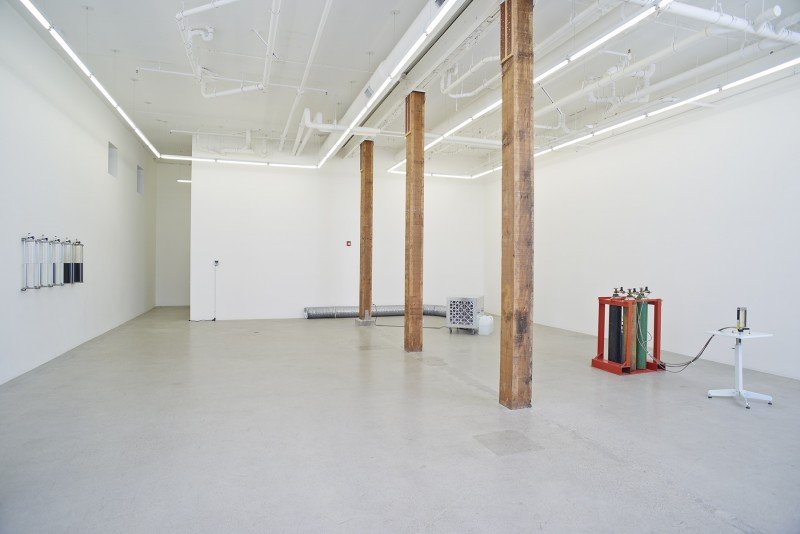
Trên tường còn có năm bình thuỷ tinh, mỗi bình chứa một phiên bản dầu thô được tái dựng từng phân tử. Bốn bình khí nén thả lại nitơ, oxy, argon, carbon dioxide theo tỷ lệ khí quyển. Một máy hút khí ở góc phòng lọc rồi tái nén mùi nền vào dung dịch lau rửa, dùng để vệ sinh tường khi triển lãm kết thúc.
Residuals không nói về biểu tượng. Nó nói về vật chất: cái còn lại sau khi đã trừ đi. Không khí là một vật. Mùi nền là một vật. Dầu thô là một vật. Raspet để chúng tự xuất hiện, ở đúng nồng độ phân tử của mình.
Gallery air. sealed in a canister. sprayed back on the wall.
In November 2014 Sean Raspet placed a sealed stainless steel canister inside Jessica Silverman Gallery, San Francisco. The canister initially held a vacuum. Over seven days, surrounding air flowed in, slowly filling the volume. By week's end, the canister was full.
The air inside was sent for molecular analysis. A laboratory counted every compound, by ratio and concentration. Raspet condensed those findings into a liquid mixture many thousand times more concentrated than the original ambient scent. The liquid was micro-encapsulated into a scratch and sniff emulsion and spray coated on the gallery walls.
Visitors arrived, scratched the wall, and smelled the air of the very space they were standing in. The background scent of the room, which no one had noticed, became a specific object. Paint, cleaning solvent, construction material. Before, it was air. After condensation, it was scent.
On the walls, five glass containers held reconstituted versions of crude oil, rebuilt molecule by molecule. Four gas cylinders released nitrogen, oxygen, argon, and carbon dioxide in atmospheric ratio. A negative air machine in one corner filtered stray odors and re-concentrated the background scent into a cleaning solvent, used at the end of the show to return the walls to their original surface.
Residuals is not about symbol. It is about matter: what remains after subtraction. Air is a thing. Background scent is a thing. Crude oil is a thing. Raspet lets them appear, at the molecular concentration of their own being.
Hình ảnh: Sean Raspet, Residuals, installation view, Jessica Silverman Gallery, San Francisco (2014). Trích dẫn cho mục đích phê bình nghệ thuật phi thương mại theo nguyên tắc fair use học thuật. Nguồn gallery: jessicasilvermangallery.com.
Image: Sean Raspet, Residuals, installation view, Jessica Silverman Gallery, San Francisco (2014). Reproduced for non-commercial art criticism under principles of academic fair use. Gallery source: jessicasilvermangallery.com.
Olfactory Art