
Essays · Olfactory Art
Alexis Karl. The Exquisite Inevitable.
The forest needs no permission to return.
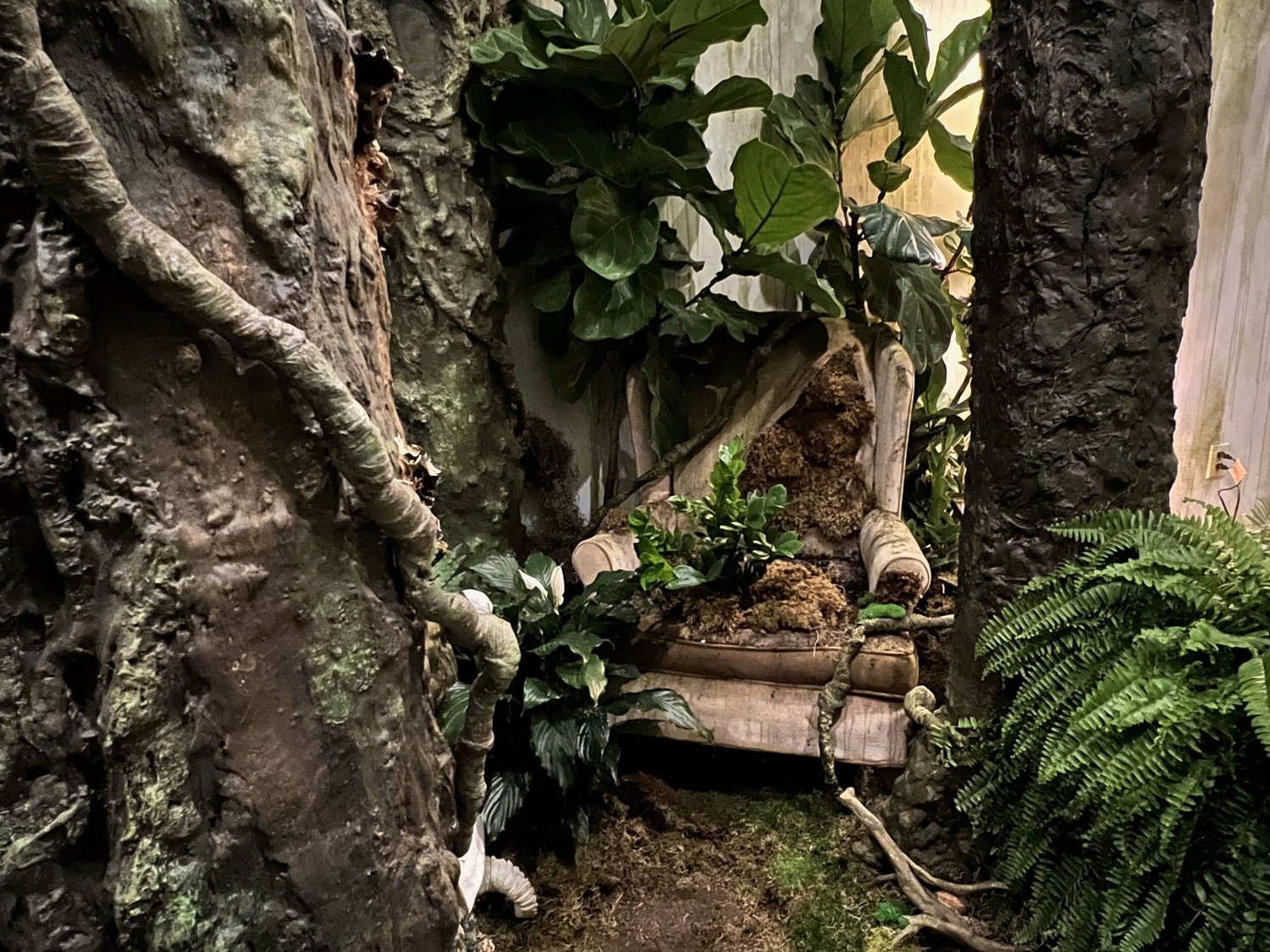
Photo: Alexis Karl · Olfactory Art Keller
From a film set
Alexis Karl is a filmmaker and visual artist. The Exquisite Inevitable, shown at Olfactory Art Keller in New York from November 9 to December 16, 2023, did not begin as an installation. It began as a film set.
Karl was preparing ANTON, a feature in the urban folk horror genre. The film tells of an apartment slowly consumed by the vegetation of a forest. To build the set, she fabricated that forest by hand inside her own apartment. She then reimagined it as an installation for the gallery.
Moving from film to gallery changes where the viewer stands. In a film, the audience watches the forest through a lens, at a safe distance. In the gallery, they step inside, walk on disintegrating rugs, smell, listen and touch.
The detail that she built the forest in her own apartment deserves attention. Before it was a work, it was something she lived with. Moss had to be watered, soil kept damp, and their smell must have filled her home for days. The film's story, an apartment swallowed by forest, partly came true before it was ever shot.
What remains in the room
The forest has fabricated trees rooted in moss and forest floor. Vines hang low, draped with Spanish moss. A lounge chair is overtaken by live moss and plants. A record player plays forever, its needle skipping like a heartbeat.
Among the plants are traces of whoever lived here: a decomposing coffee mug, reading glasses, books carrying messages no one can read. Then stranger things. A petrified wooden altar. Hybrid ritual skulls. Ritual vessels encrusted with semiprecious stones, bones and teeth. And impossible creatures in various states of decay.
Everything is arranged as if after an event no one describes. Visitors do not know where the tenant went. They only see the forest doing its work: growing back, without pause.
Nothing in the room is explained. Visitors link things up themselves. The glasses suggest a reader. The chair suggests someone sitting. The record player suggests someone who once chose a record. Each object is a trace, and the forest is slowly erasing them.
The smell of forest and of decay
Scent is central to the work. Karl extracted essences from the forest materials themselves: mushrooms, bark, moss, dried and fresh leaves, seed pods, acorns, dirt. She isolated individual smells, among them animal musk and decay, and set them beside the green of leaves and flower stems, of moss and deep earth.
That opposition is the content of the work. The green smell is life growing. The musk and decay are life coming apart. In a real forest the two always travel together: new leaves rise out of old ones rotting.
Sound is the final layer. Forest sounds merge with opera and a low mechanical hum. According to the exhibition page, the work sketches a sinister post human world where overgrown plants are in a relentless process of regrowth, and asks what is real and what is not.
That question is built into the materials. The trees are fake, the moss is real. The dirt is real, the creatures are fake. The smell is always real, even when extracted to build a false forest. Within the Olfactory Art Keller programme, few works blur that line as thoroughly.
Olfactory Art