
Essays · Olfactory Art
Polymorf. Famous Deaths.
No images. Only the sound and smell of a final moment.
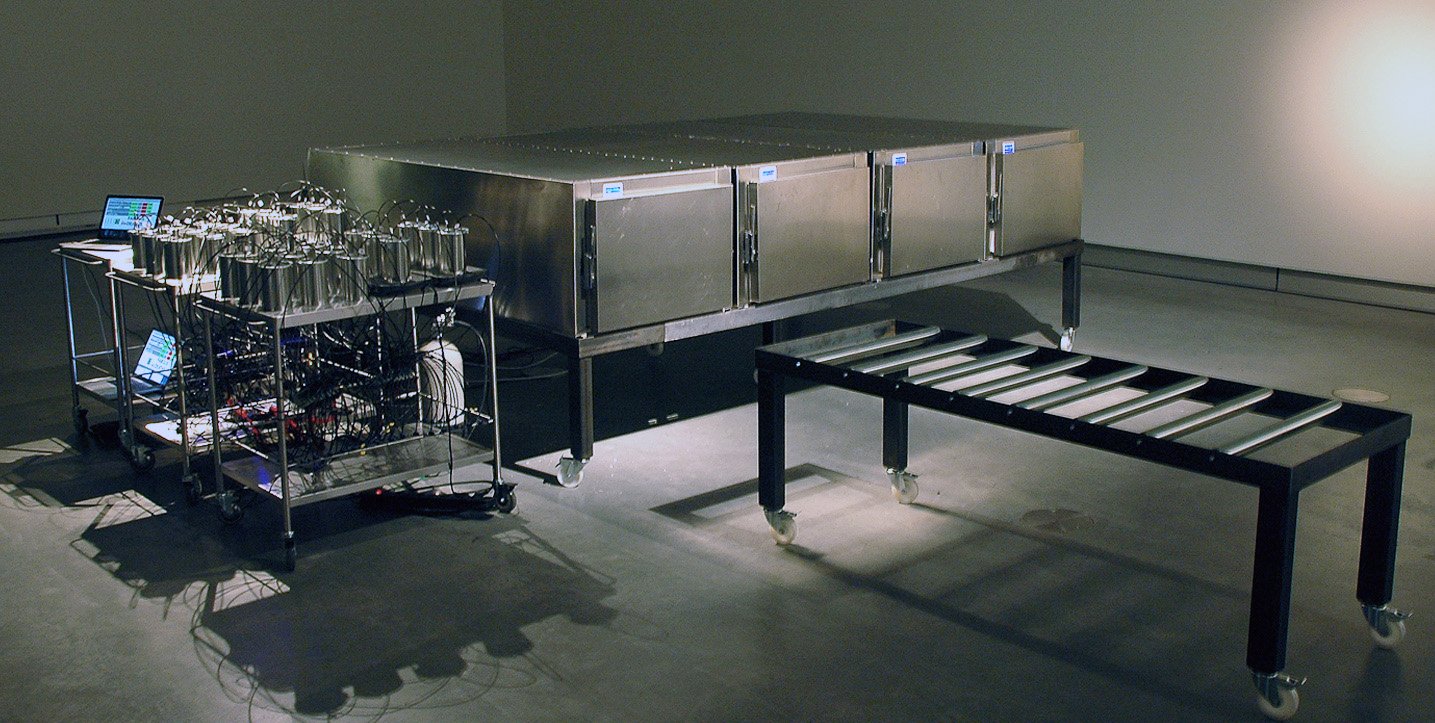
© Polymorf · Polymorf (official studio site)
Lying down in the freezer
Famous Deaths is an installation by Polymorf, the Dutch collective of Marcel van Brakel, Frederik Duerinck and Mark Meeuwenoord. It was developed with CMD Breda and AVANS University.
At its centre are four mortuary freezers, the metal drawers used to hold bodies. Each drawer holds one story. The visitor lies down, the drawer slides in, and they are alone in complete darkness.
For about four minutes they hear a documentary soundscape and smell a sequence of scents timed to it. There is no screen. There are no images. The story unfolds in the first person: the one in the drawer takes the place of the one about to die.
The rules are precise. At most four people at a time, one per drawer. Visitors must be at least 11 years old. Each drawer has a panic button. Once a story is chosen, it cannot be switched midway. Those administrative details say something about the weight of the work: this is not a game.
Five deaths retold
The stories cover five people: John F. Kennedy, Whitney Houston, Diana, Princess of Wales, Moammar al Qadhafi and Vincent van Gogh. All are deaths retold many times by the press, in books and on film. Nearly every visitor arrives with an image of them already in mind.
Polymorf chose deaths everyone has already "seen". The work relies on that stored picture and then replaces it with something else. When the eyes are not working, what we thought we knew turns strange.
The Van Gogh episode was commissioned by the Van Gogh Museum in Amsterdam, where the work was shown in 2016. That same year Famous Deaths travelled to the Tribeca Film Festival and SXSW. In 2017 it appeared at the STRP Biënnale in Eindhoven, and it kept touring until 2019.
Its presence at film festivals matters. Famous Deaths sat beside documentaries, as a kind of document without pictures. It was selected for the IDFA DocLab interactive documentary canon and for MIT's Moments of Innovation canon.
Smell as narration
The scent sequences were made by Caro Verbeek, a researcher of the history of smell, and Peter de Cupere, an artist who has long worked with olfaction. In 2015 the work received the Sadakichi Award for experimental work with scent from the Art and Olfaction Awards.
In a film, images lead the story and sound supports it. In Famous Deaths, smell has to do the work of images. It tells us where we are, what space, what moment. One smell arrives, leaves, and the next takes its place. Each smell is a scene.
That demands a different kind of writing. Smell does not cut as quickly as a picture. It lingers in the nose and bleeds into the next. The makers had to decide when a smell should appear and when it should clear, so the story would not blur. The work shows that smell can be composed in time, like music.
Readers who know Peter de Cupere's plants carrying foreign smells will recognise a shared interest: smell can be assembled to tell of something absent. In Famous Deaths, what is absent is a person, at their last second. When the drawer slides out, the light returns. But the one who climbs out carries a memory that is not their own.
Olfactory Art