
Essays · Olfactory Art
Anicka Yi. Biography.
A life can be written in smell.
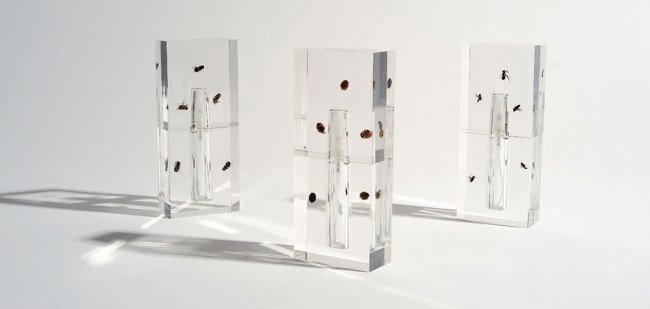
Anicka Yi, Biography fragrances, 2019 · Artforum
Three women, three bottles
In November 2019, Anicka Yi launched Biography at Dover Street Market in New York and Los Angeles. It consisted of three perfumes, each in a limited edition of one thousand bottles. Yi worked with the French perfumer Barnabé Fillion.
Each scent carries the name of a female figure. Volume one, Shigenobu Twilight, is about Fusako Shigenobu, founder and leader of the Japanese Red Army, who spent many years in exile in Lebanon. Volume two, Radical Hopelessness, is about Hatshepsut, one of the very few women to rule ancient Egypt as pharaoh. Volume three, Beyond Skin, is about an unnamed female artificial intelligence belonging to the future.
The three share no era and no country. What they share is that each refused the limits set for her. And each is easily written wrongly by history, or not written at all.
Materials that tell a life
Yi did not try to recreate the body odour of these women. She used materials the way a biographer uses details.
For Shigenobu there is cedar, thyme and frankincense, materials that recall Lebanon, where she lived in exile. Beside them sit yuzu, shiso and black pepper, a lasting homesickness for Japan.
For Hatshepsut there is sandalwood and patchouli, with pink pepper, juniper and cardamom. Materials that recall tombs, temples, the incense shipments of ancient Egypt.
For the artificial intelligence there is rose, seaweed and suede. A flower, something from the sea, something from tanned hide. Like a body assembled from three different worlds.
Yi has described Biography as a way of writing one's life beyond one's biology. In other words: a woman need not be defined by the body she was born with.
Bottles like fossils
The Biography bottles are made of clear acrylic. Set inside each is the form of an insect, ladybirds, ants or flies depending on the scent, like fossils from the future. The project's official site describes the bottles as combining molecular, animal and industrial elements, in keeping with Yi's sculptural vocabulary.
The insects are not ornament. Yi has worked for years with bacteria, fungi, insects and small living systems. For her the human body has never been a sealed unit. Other lives always travel with it. The perfume bottle, long a symbol of cleanliness and perfection, now holds a fly.
A scent twelve years in the making
Shigenobu Twilight is not new. Yi made the first version in 2007 with the architect Maggie Peng, after months of trying out smells in her own kitchen. Yi was not yet a well known name. The scent was kept, and twelve years later became a bottle one could buy in a shop.
In the meantime Yi made much larger works with smell, such as You Can Call Me F in 2015, where bacteria from a hundred women were cultured together in a gallery. Biography is far smaller. It fits in the palm of a hand.
That small size lets it ask a different question. The perfume business is used to selling myths: a mysterious woman, a city, a summer. Yi reuses that form, the shop, the bottle, the name, but replaces the myth with real lives and one life not yet born. The buyer does not purchase a model to become. They take home a story to carry.
Olfactory Art