
Essays · Olfactory Art
Anicka Yi. In Love With The World.
The air of a place keeps its history.
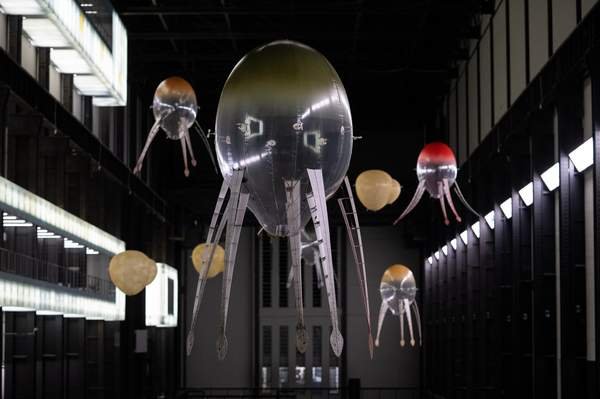
Installation view, Hyundai Commission: Anicka Yi, Tate Modern · Tate
Two species in a great hall
From 12 October 2021 to 16 January 2022, the Turbine Hall at Tate Modern in London belonged to Anicka Yi. It was the Hyundai Commission, the programme that invites one artist each year to make work for the museum's largest space.
Yi did not fill the hall with a single large object. She released flying machines she calls aerobes. There were two species. The xenojelly has a semitransparent body, tops in different colours and patterned tentacles below, recalling a jellyfish. The planula is bulbous and covered in short yellow hair.
Both are filled with helium, moved by small rotors and powered by compact battery packs. They follow no fixed route. They show individual and group behaviour, responding to elements in their surroundings.
Visitors stand on the floor and look up. One drifts close, another floats away. No story is told. There is only a space that is alive.
A layer of time each week
The invisible part of the work is smell. Yi calls them scentscapes. They changed every week, each evoking a period in the history of Bankside, the ground on the south bank of the Thames where Tate Modern stands.
One week smelled marine, recalling the Precambrian, when this land lay under water. Another carried the vegetation of the Cretaceous. Another, the coal and ozone of the twentieth century machine age. Another, the spices people in the fourteenth century used against the Black Death.
The sequence is not a history lesson. Visitors are not led along a timeline. They walk in during some week and meet some layer. Someone who came in October and someone who came in January may have smelled two very different pasts of the same ground.
When the scent changed, the aerobes changed too. According to Tate, their behaviour and interactions developed with each scentscape. The air is no longer a backdrop. It is part of the system.
An old power station that breathes
The Turbine Hall was once the turbine room of a power station, built to hold machines, heat and coal. Yi brought the smell of coal back into a room that once burned it, but this time it arrived with new machine creatures: light, drifting, producing nothing.
Yi was born in Seoul in 1971 and works in New York. Before this project she had spent years working with bacteria, fungi, food and smell, and she won the Hugo Boss Prize in 2016; the prize exhibition, Life Is Cheap, already used smell as a central material. In Love With The World took those concerns to another scale: not a vitrine or a small tent, but an indoor atmosphere.
The question of the work is not technology. It is relation. If machines can live with us in one environment, reacting to the same air, where does the line between organism and made thing fall? Yi does not answer. She leaves the question hanging, like the aerobes.
The work stays with us because it reverses the usual order of a museum. Normally the visitor moves and the work stands still. Here the work moves, the smell moves, and the visitor stands still to breathe. A room that once made electricity for the city now makes something else: attention to the air we breathe every day without thinking.
Olfactory Art