
Essays · Olfactory Art
Anicka Yi. 7,070,430K of Digital Spit.
Forgetting leaves a trace too.
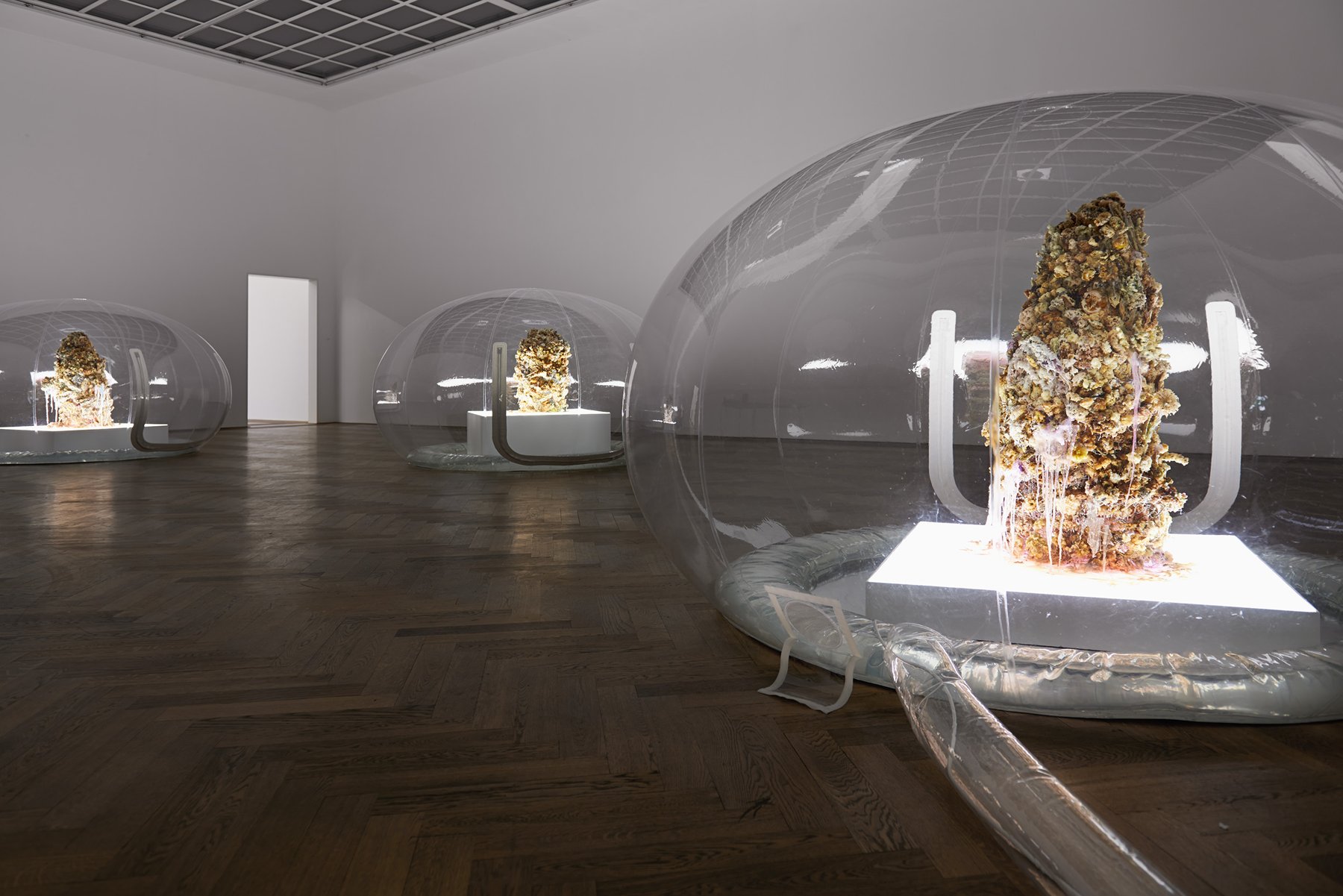
Installation view, Kunsthalle Basel · Anicka Yi Studio (official artist site)
A coda to five years
On 12 June 2015, Kunsthalle Basel in Switzerland opened Anicka Yi's 7,070,430K of Digital Spit. The exhibition took the entire ground floor and ran into mid August.
Kunsthalle Basel described it as a coda to five years of Yi's production and exhibition making. Those years circled very personal subjects: denial, divorce, death. In Basel she added one more theme to close them: forgetting.
Just weeks earlier in Cambridge, Yi had opened a show with an almost identical title, 6,070,430K of Digital Spit, about flavour and sense memory. In Basel the first digit went up by one and the direction reversed. If Cambridge asked how we remember, Basel asked how we forget.
The title itself reads like the size of a data file: over seven million kilobytes of digital spit. Yi does not explain the number. But placed beside the theme of forgetting, it raises a question: if a person's memory could be measured in storage, how much would need deleting to make room for something new?
Materials that will not keep still
Thirteen works were shown. Their titles alone read like a strange inventory: Laptop Lap Burn, Shameplex, Lung Condom, Lapidary Tea Slave, ALZ/AZN, 2666. Some sound like a diagnosis, some like a book, some like wordplay that resists translation.
The materials too. According to the studio, Yi used perishable substances: deep fried flowers, recalled powdered milk, potato chips, snail excretions. Things from the kitchen, the market, the damp garden. None of them were made to last in a museum.
In the gallery they kept changing. Fried flowers dry. Powdered milk clumps. Snail slime leaves trails. Part of Yi's work is always out of the artist's hands, held instead by time, humidity and microbes.
For a show about forgetting, that choice fits. What we forget does not vanish at once. It fades, changes colour, changes smell, until it can no longer be recognised.
The scent of forgetting
Through the galleries drifted a smell made for the exhibition. Yi called it the scent of forgetting, developed with the perfumer Barnabé Fillion, with whom she would keep working in the years that followed.
No one can say exactly what forgetting smells like. That is the point. A smell named after an abstract state asks the person breathing it to fill the gap. Some found it soft, some found it strange, some forgot it the moment they left, and in that case the work did its job.
At the centre of the show was a book. Yi reprinted the contents of her first monograph on incense paper soaked in the scent, titled 7,070,430K of Digital Spit, A Memoir. Buyers were invited to burn it after reading. As the paper burns, the smell escapes.
A monograph is usually kept: shelved, cited, archived. Yi made it something to be used up. The memory of five years is not framed. It is handed to others, who decide when to let it dissolve into the air. The show ends not with a summary but with a gesture of release: a wisp of smoke, and a smell that lingers a while, then goes.
Olfactory Art