
Essays · Olfactory Art
Anya Gallaccio. Falling from grace.
The smell changes every week. That is how the work keeps time.
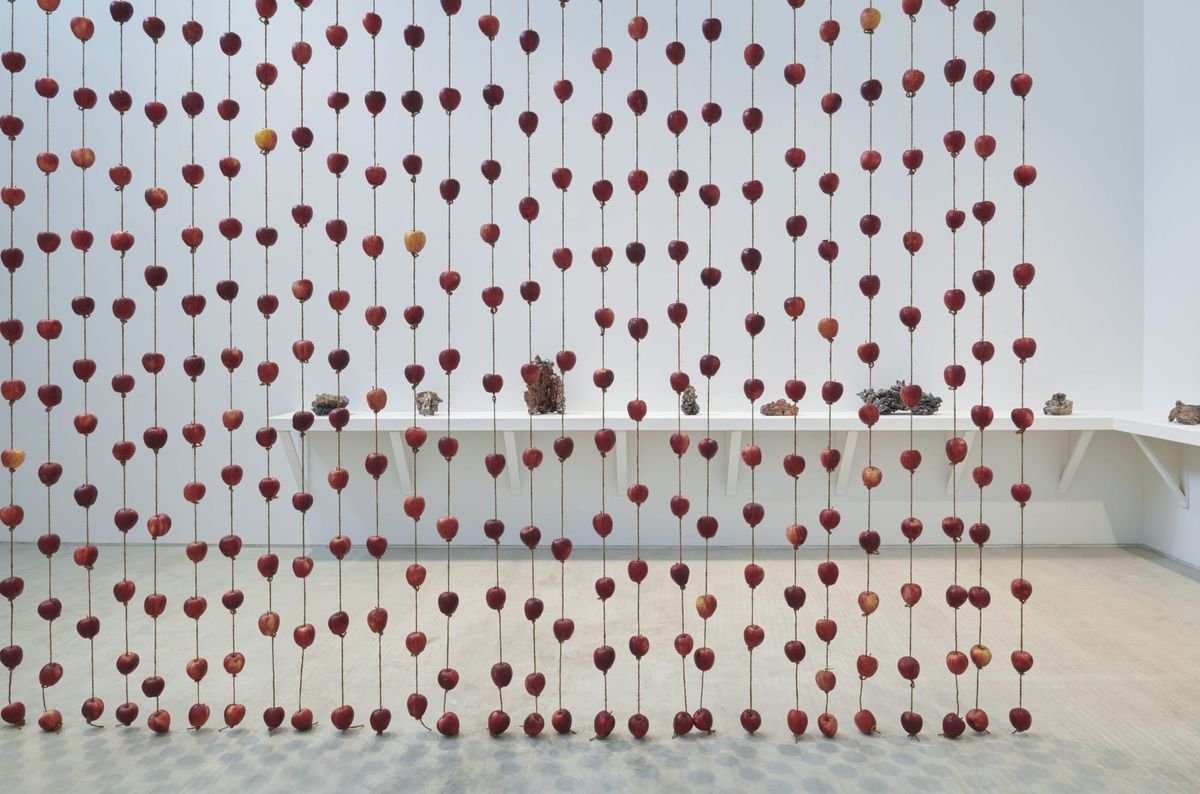
© Anya Gallaccio; photo by Jo Underhill, courtesy the artist · Hyperallergic
Two thousand seven hundred apples
Falling from grace has a very short list of materials: 2,700 Gala apples and hop twine. Each apple is threaded onto twine, and the strands hang densely from the ceiling, forming a mass suspended in the middle of the room.
Anya Gallaccio first made the work in 2000. In 2024 she remade it at Turner Contemporary in Margate, England, in a solo exhibition called preserve, curated by Melissa Blanchflower and running until late January 2025.
According to Hyperallergic, the room at first smelled comfortably autumnal, sweet like cider. But apples are fresh fruit, and the work does nothing to keep them fresh. Over the weeks the smell would turn to fermentation, then rot. The skins would darken and wrinkle.
When the exhibition ends, the apples are not thrown away. They are to be planted nearby. That small detail changes how the work reads. The rot in the room is not an end point. It is the middle stretch of a road that begins in an orchard and returns to the soil. Visitors stand on one stretch of it for a few weeks, and smell that stretch.
An exhibition about impermanence
Falling from grace was not alone in preserve. Around it were other works by Gallaccio built on the same logic: living material brought into the gallery and allowed to change.
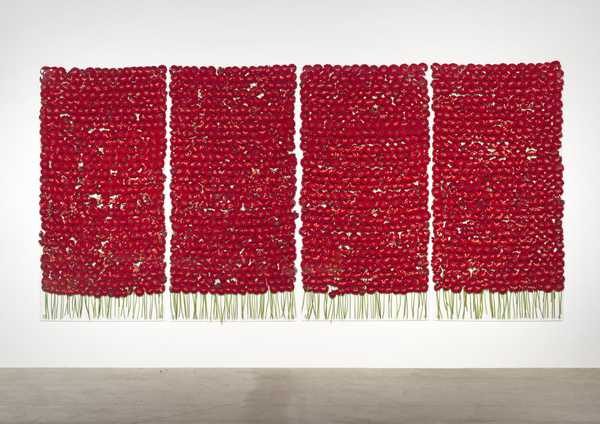
preserve 'beauty', first made in 1991, consists of 1,700 gerberas held between seven panes of glass. Soon after the opening the flowers had withered and grown mould. The inner space within, first made in 2008, is an ash tree over a hundred years old, dying of ash dieback, cut up, brought indoors and reassembled with wire and bolts. La Dolce Vita, from 1994, is a set of candles on aluminium foil, replaced and relit every day, their wax spreading into an uneven ground.
The show carried an idea Hyperallergic summed up: decay is full of energy, not simply an end but part of an endless cycle of life.
The title has two layers. Falling from grace is an idiom for a moral fall, calling up the apple in the Garden of Eden. But taken literally, it is also what will happen to each apple on the twine: it leaves its best state, one day at a time.
Smell as a clock
Most works in a museum are conserved to look the same every day. Gallaccio's work does the opposite. A visitor in the first week and a visitor in the last do not see the same piece. They smell two different ones.
Here smell does the work of time. The eye may not notice that an apple has gone overripe over a few days. The nose knows at once. The cider smell means the yeasts have started. The sharp sourness means they have gone further. Visitors need no dated label; they can smell the date.
This brings the work closer to daily life than to exhibition display. Anyone who has forgotten a bag of fruit in the kitchen knows the order: sweet, too sweet, sour, spoiled. Gallaccio simply multiplies it by two thousand seven hundred and hangs it in a bright room.
Falling from grace stays with you because it does not treat decay as failure. Museums usually fight time. This work lets time win, then returns what is left to the soil, where another round begins.

Olfactory Art