
Essays · Contemporary Art
Anya Gallaccio. preserve 'beauty'.
The flower is not kept. It is allowed to go all the way.
Tate · Tate
A wall of red flowers
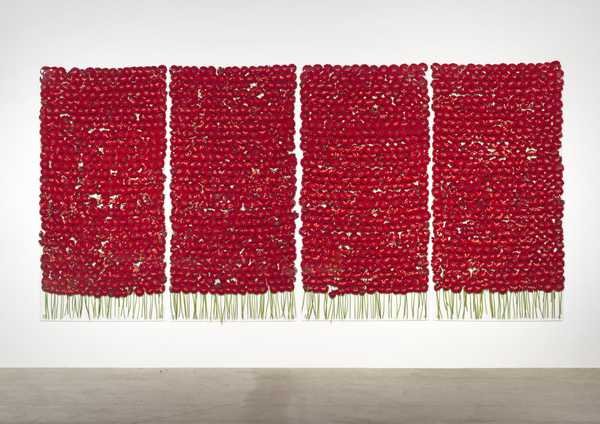
preserve 'beauty' consists of four large sheets of clear glass set side by side on a wall. Behind the glass are rows of red gerberas with dark centres, pressed into a single layer. The flower heads face the viewer. The stems point down, so the lower edge of each panel carries a band of green: the stems of the bottom row.
Displayed at Tate, the wall is more than five metres wide and more than three metres high. The number of flowers varies with the size of the heads, usually between sixteen hundred and two thousand.
The flower is a hybrid gerbera sold under the name 'Beauty'. The word in quotation marks is both the name of a variety and a pun. The work says it will preserve beauty. Then it lets that beauty wither in front of everyone.
Built in order to decay
Anya Gallaccio, born in 1963, first made the work in 1991 for the window of Karsten Schubert, a gallery in London. That time she used eight hundred flowers, pressed between the gallery window and a sheet of glass, facing outward for people passing in the street.
Because the flowers die, the work cannot last in one form. Since 1991 Gallaccio has rebuilt it many times, in many places. Each time with new flowers.
Tate records the installation in detail. A glass panel is laid flat on the floor. The flowers are arranged in rows and tied to the back with dental floss. The panel is raised quickly and fixed to the wall, pressing just enough to hold the flowers. The floss is cut and drawn out. The flowers stay, held only by the glass.
During the display the flowers shrink as they dry and rot, so the panels must be adjusted. Some fall to the floor and are left there to keep decomposing. When the display closes, all the flowers are thrown away.
The flower as a commodity
Gallaccio often works with organic, perishable materials: ice, flowers, fruit, sugar. In another work, Stroke, she covered walls with chocolate. Tate's label says preserve 'beauty' challenges romantic ideas about flowers and our relationship with nature. She has called cut flowers a mass produced, disposable commodity.
Placing two thousand flowers behind glass is a way of looking straight at that. Each gerbera was grown, cut, boxed and shipped. In a florist it lives a few days in a vase and then goes in the bin. Here it lives the same short life, but no one removes it when it turns ugly. The viewer has to face the part of its life we usually do not look at.
The red darkens, then browns. Petals curl, flatten, stick to the glass. The smell changes too. Tate notes that visitors meet the work through smell: fresh flowers or rotting ones, depending on how long it has been up.
A performance with material
Gallaccio calls her work a performance between herself and the material. She also describes it as a collaboration with the people who come to see it during its limited life. No one sees all of preserve 'beauty'. Each visitor meets only one stretch of it.
Tate received the work in 2004 as a gift from an anonymous donor. What the museum owns is not quite an object. It is a method: the variety of flower, the number, the tying, the raising, and the instruction to let them die. Each display, the work is born again and runs its course.
That is why it stays in the mind. It does not give the viewer a still image to take home. It gives a span of time, and a smell that changes within it.
Contemporary Art