
Essays · Contemporary Art
Carsten Höller. Test Site.
The body knows before the mind does.
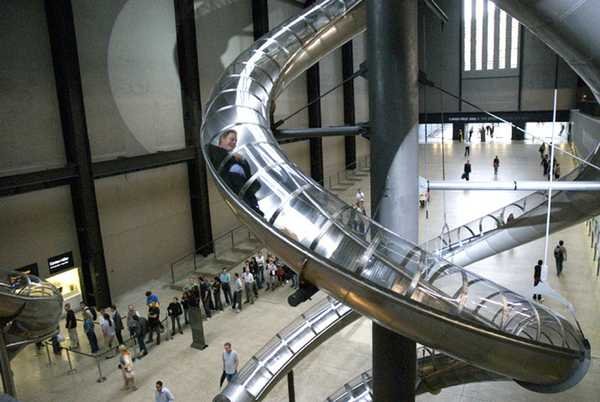
Tate Modern · Tate Modern
Five tubes in a former power station
From 10 October 2006 to 15 April 2007, the Turbine Hall at Tate Modern held five slides. They were spiralling tubes that began on the upper floors of the building and ran down to the floor of the hall. Anyone could ride them, free of charge.
The work was called Test Site. Carsten Höller, an artist born in 1961, made it for The Unilever Series, Tate's annual commission for the great hall.
From the balconies the tubes looked like giant cords wound through the space. At the bottom was a familiar scene: adults and children shooting out, staggering up, laughing. Shrieks echoed down the concrete hall.
Before the Turbine Hall, Höller had installed six smaller slides elsewhere. He treated Test Site as a prototype: if slides work inside a museum, could they become a way of moving through a city?
A scientist who changed trades
Höller earned a doctorate in biology before becoming an artist. Traces of that first discipline remain clear. He often builds things that resemble experiments, but the experimenters are the visitors, and the subject being tested is their own body.
Tate mentions several earlier works. Flying Machine, from 1996, a flying machine for visitors. Upside-Down Goggles turned the world upside down for the wearer. Frisbee House, from 2000. Each shifts an ordinary perception slightly, as the goggles turn up into down.
Test Site was the largest step in that series. It needs no instructions, no explanation. A tube, an entrance, an exit. The body does the rest.
Years later the same artist moved from the slide to sleep: Insensatus Vol. 1 Fig. 1, a set of scented toothpastes made to alter dreams. Still a test, this time through the nose and mouth.
Voluptuous panic
To describe the feeling of sliding, Höller borrowed from the French writer Roger Caillois, who wrote about games of vertigo and called that state a voluptuous panic upon an otherwise lucid mind.
The two words pull against each other. Delight and fear. Clarity and loss of control. In the seconds of the descent, you cannot pick one. You are in between. Höller is interested in exactly that middle: an inner state no one outside can see.
A study published in Tate Papers reads Test Site through Caillois's theory of games and stresses one feature: the player is free to accept or refuse. No one is pushed into a tube. People queue, look down, measure their nerve, then decide. The decision is part of the work.
Caillois also wrote of a vertigo of a moral kind, tied to a desire for disorder that we usually hold down. In a museum, where people walk slowly, speak softly and touch nothing, a slide is a permission. A little disorder, in the right place, for the right few seconds.
Watching and being watched
Test Site works on two levels. The outer one is spectacle: five great curves in an industrial hall, people going up and coming down, laughter. Anyone on the bridge can watch. The inner one is the rider's sensation, which cannot be passed on.
The Tate Papers study draws on theories of interactive art and of the social relations a work produces. People in the queue talk. Someone who has just slid tells someone about to go. The work is not only the tube. It is what happens between people around it.
What remains once the tubes are gone is a simple question. Do we trust the body as a way of knowing, or only what the eyes see and the mind can explain? Höller does not answer. He opens an entrance and waits.
Contemporary Art