
Essays · Olfactory Art
Carsten Höller, Ben Gorham. Insensatus Vol. 1 Fig. 1.
The last smell before sleep follows us into the night.
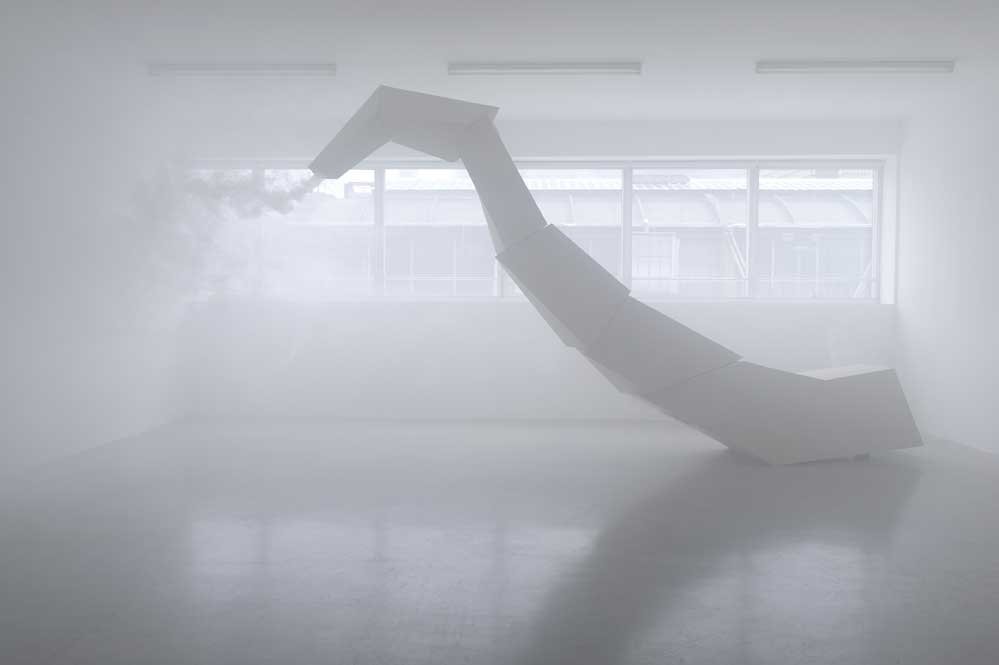
Carsten Höller & François Roche, Hypothèse de Grue, 2013 (exhibition view, "With") · ArtReview
A wooden box, four tubes
In 2013 Carsten Höller opened With at Air de Paris, his first show at the Paris gallery in nearly six years. Among the works was a small object that looked like a luxury item: a walnut box holding four tubes of toothpaste.
The work is titled Insensatus Vol. 1 Fig. 1. Three tubes are scented and labelled Male, Female and Infantile. The fourth is a base, called Activator. The user mixes the base with one or more scents and brushes before bed.
The promise is strange: depending on the dosage, the toothpaste will influence your dreams. More Male, more Female, more Infantile, and the dream leans that way.
The work was made with Ben Gorham, founder of the Stockholm perfume house Byredo. Gorham has said he wanted to make a scent that could guide dreams through the night, and that it was Höller who thought of bringing taste in. So the scent went into the mouth, as toothpaste.
The scientist behind it
Höller did not come to smell by accident. Before making art he trained as a scientist and studied how insects communicate through smell. He knew that a smell can carry information, can change a creature's behaviour without a word.
Many of his works turn visitors into participants in an experiment. People slide, sleep, wear inverting goggles, then watch what changes inside them. Insensatus belongs to that line. Only here the laboratory is the user's own bathroom, and the results appear in dreams.
Insensatus is Latin and suggests the senseless, the irrational. The full title reads like an entry in a scientific volume: volume one, figure one. The work sits between the two: as serious as an experiment, as absurd as a joke.
An exhibition of pairs
With is an exhibition about collaboration. Höller worked with a taxidermist, a model maker, a perfumer, a photographer, an artist and an architect. The thread running through it is the double.
There was So Alone, a photograph by Davide Monteleone of Höller among more than thirty pairs of twins. There was Memory, thirty reversible frames of amusement park rides; each week gallery staff tossed a coin to decide which side faced out. There was The Memory Game, with thirty two double sided cards. And there was Hypothèse de Grue, made with the architect François Roche, a white metal structure shaped like a dragon, with a smoke machine.
Among these, Insensatus is another pair: the one awake and the one dreaming. The person who brushes at night and the person who wakes in the morning are the same, yet between them lies a night neither can control.
Smell and sleep
The work can be read as a jab at the beauty industry, where every product promises to change something in the user's life. The 2013 review also noted that the set was due to be sold. The promise of dreams came in a fine box, like every other promise.
But the work also touches something real. Smell runs close to memory and emotion. A familiar smell can bring back a room, a person, a season. Whether smell enters our dreams is a question each of us can only ask alone. Dreaming in Smell takes up that question from another side.
Insensatus gives no answer. It puts a tool and a promise in the user's hands and lets them go to sleep. In the morning only the dreamer knows what happened. Or perhaps not even they remember.

Olfactory Art