
Essays · Olfactory Art
Clara Ursitti. Eau Claire.
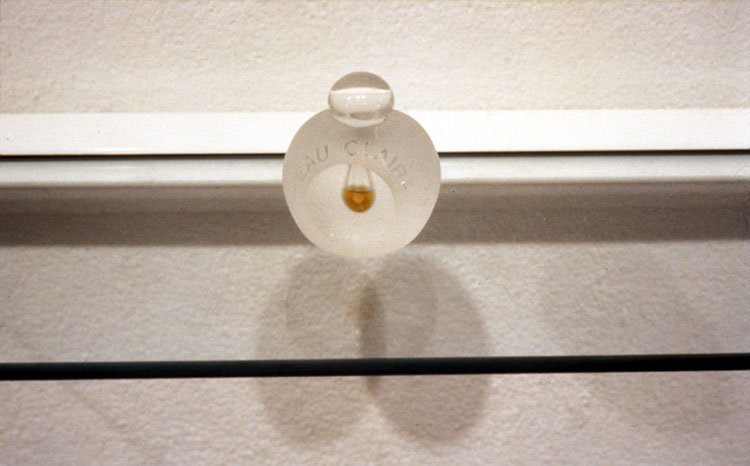
The bottle keeps what perfume usually hides.
© Clara Ursitti · Clara Ursitti (official artist site)
A bottle and a person
Around 1992 and 1993, Clara Ursitti made a very small object. A hand blown glass bottle. Inside, her own body scent.
The work is called Eau Claire. In 1993 it was shown at Mercer Union, an artist run space in Toronto, Canada. Almost ten years later, in 2002, it went to Auckland Art Gallery in New Zealand. In 2015 it appeared at Museum Tinguely in Basel, Switzerland.
To the eye, Eau Claire offers almost nothing. A bottle shaped like a perfume bottle, set in a gallery. Its most important part is the part you cannot see.
Ursitti began working with scent in the early 1990s, when very few artists used smell as a main material. Eau Claire is one of her early works and one of the most compact: no machines, no room, no sensors. Only glass and a body.
Perfume in reverse
To understand Eau Claire, remember what commercial perfume usually does. For much of its history, perfume has been used to cover. To cover sweat, skin, the smell of a body after a long day. People spray on flowers, woods, citrus, so that others smell that instead of them.
The perfume industry also sells an image. Each bottle comes with a name, a story, a face in an advertisement. The buyer does not only buy a smell. They buy another version of themselves.
Ursitti borrows the whole form. The glass bottle, the name that sounds French, the look of a luxury good. But she swaps what is inside. What sits in the bottle is not there to hide the smell of a person. It is the smell of a person.
The result is familiar and strange at once. It looks like perfume, yet does what perfume was invented to prevent.
A portrait you can carry
Eau Claire is often read as a portrait in scent. But unlike a room or an installation, it is an object you can pick up. It is the size of something kept on a dressing table.
That changes the relation between viewer and sitter. A painted portrait hangs on a wall and the viewer stands back. A bottle of body scent asks for closeness. To know what it holds, you must bring it to your nose. That is the distance of two people standing close, of an embrace.
There is an uneasy intimacy in it. Body odour is something we hide, wash away, apologise for if someone notices. Putting it in a bottle and showing it in public is a bold act. It asks: would you smell a stranger, with no perfume in between?
The hand blown glass matters too. Each hand blown bottle carries a small difference, an air bubble, an uneven curve. Like the body inside it, the bottle is not mass produced.
Why a small bottle is still remembered
Seen from today, Eau Claire looks simple. Many later artists have worked with body odour, sweat, unpleasant smells. But in the early 1990s, putting a body's scent into the form of perfume and calling it art was still an open question.
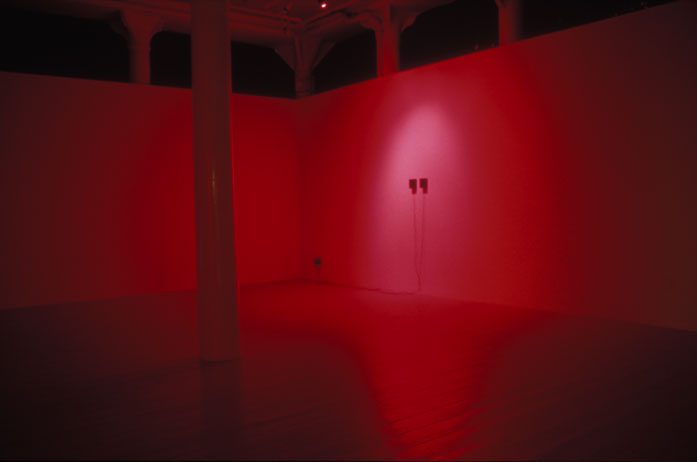
The work also begins a long thread in Ursitti's practice. She kept asking what smell says about identity, gender, attraction. Soon after came Self-Portrait in Scent, Sketch no. 1, where her portrait became a whole room. Eau Claire is the smallest version of that question, small enough to fit in a palm.
And the bottle keeps its paradox. Perfume sells the dream of becoming someone else. Eau Claire offers only a real person, without makeup, without a story. The visitor opens it, or just looks and imagines, and meets someone through the one thing she cannot hide.
Olfactory Art