
Essays · Olfactory Art
Leather. The smell of a process.
The smell of leather is a trace of fire, not of the animal.
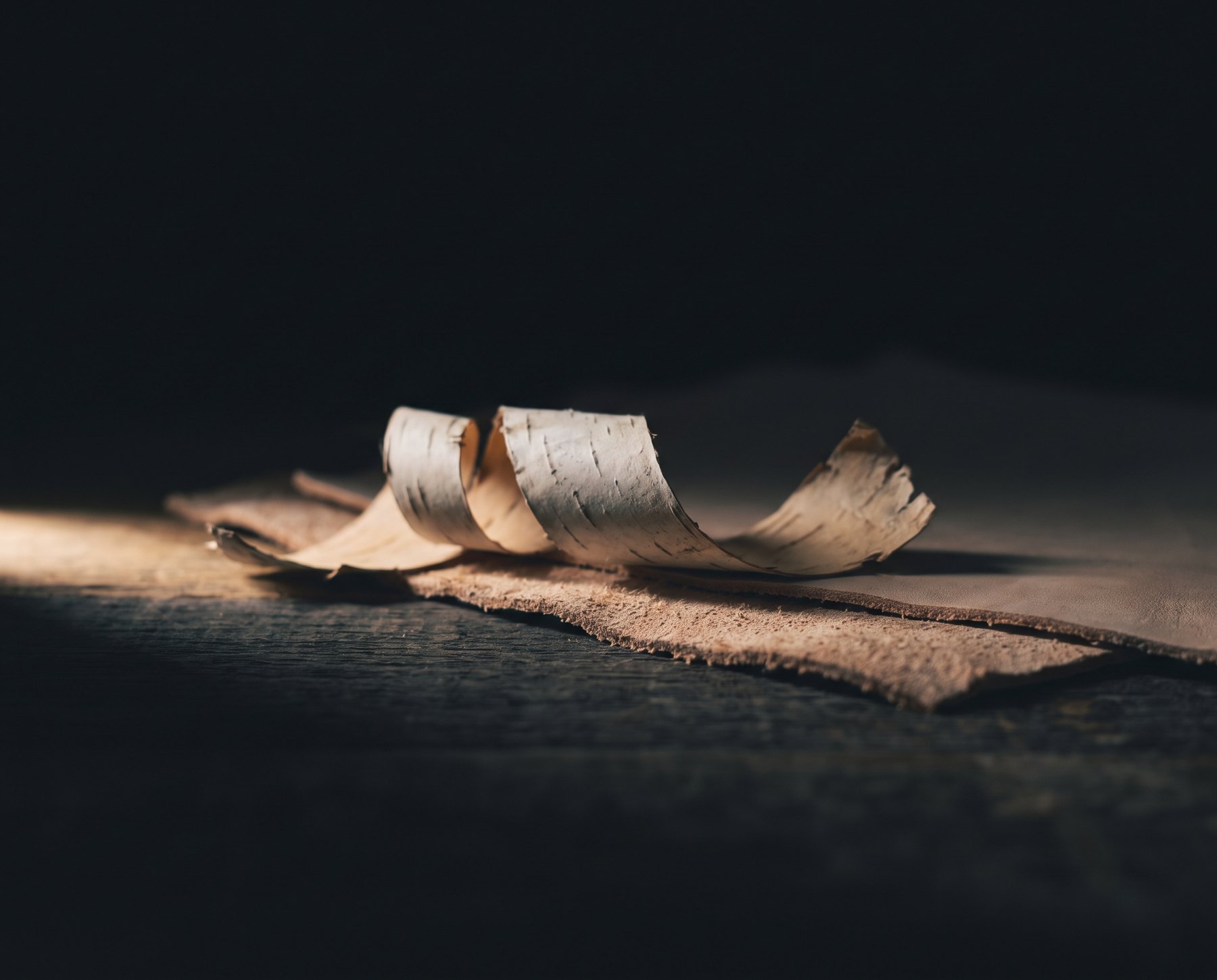
Russian leather and birch tar
Russian leather, cuir de Russie in French, was leather treated with an oil taken from birch bark. The oil made the leather resistant to water and mould, and left a distinctive smoky smell on the hide. For centuries this leather was traded across Europe. People recognised it by nose before they recognised it by eye.
Birch oil is not distilled in the usual way. Bark and wood are heated with little air, so the material does not burn to ash but gives off a dark, viscous liquid. This is dry distillation. Together with cade oil, from a species of juniper, it is one of very few aromatic oils made by fire in this way.
Its smoke comes from phenols such as guaiacol and cresol, the same molecules found in wood smoke, smoked meat and road tar. The nose links them not by learning but because they really are related: all are what happens when wood meets heat.
In France, tanning and perfumery long travelled together. Leather gloves were scented to mask the smell of the hide. Over time the masking scent became part of what a glove smelled like. What was hidden and what did the hiding merged.
Cuir de Russie and the early leathers of the twentieth century
When perfume began to name leather, it borrowed the name of Russian hide. According to Nez magazine, Aimé Guerlain had a Cuir de Russie as early as 1872. In 1919 Ernest Daltroff made Tabac Blond for Caron, setting leather beside tobacco and flowers; Nez regards it as the perfume that truly opened the leather family.
Chanel's Cuir de Russie, by Ernest Beaux, is usually dated 1924, though some sources give 1927. Around the same time the Vienna tailor Knize released Knize Ten. These perfumes appeared in a Europe just out of war, when leather coats, driving gloves and car interiors were part of daily life. Leather no longer smelled of the tannery. It smelled of a new way of living.
The Société Française des Parfumeurs later made leather a family of its own, the smallest in its table, with three subfamilies. Its description stays close to the origin: dry, sometimes very dry compositions that rebuild leather through smoke, burnt wood, birch and tobacco. Not a word about the animal.
Isobutyl quinoline: leather without leather
Chemistry opened another route. Isobutyl quinoline is a synthetic molecule with a leathery, earthy, slightly bitter smell. In 1944 Germaine Cellier used it at a very high dose in Bandit for Robert Piguet. Leather no longer needed fire or bark. It could be built from a molecule in a laboratory.
What is striking is that the molecule speaks the same language as birch tar: dry, bitter, a little smoky. Perfumers were not copying hide. They were copying the impression tanned hide leaves in memory. A copy of a record.
Birch tar is still used today, but only in rectified form. The crude oil carries compounds produced by the heating, and the IFRA Standards, the rules the scent industry sets for itself, allow only grades from which they have been removed. Fire gives the smell, and fire also leaves something that has to be taken out.
Fire and time on a hide
Put side by side, these facts say something simple. The smell of leather is the smell of work. Heat the bark. Soak the hide. Rub in oil. Dry it. Each step leaves a layer, and the final smell is the sum of the steps.
An old wallet, a bicycle saddle, a leather book cover: each carries both the process that made it and the life that used it. Hands, dust, sun, oil worked in after each season. The hide keeps recording. That is why old leather smells different from new, even when cut from the same skin.
Penta does not make a leather scent. But the way leather smell is made says clearly what Penta cares about: a scent is often the trace of a transformation. Not the thing as it was, but the thing after it has passed through fire, water, hands and time.

Olfactory Art