
Essays · Olfactory Art
Vanillin. Vanilla without the pod.
One smell, many birthplaces.
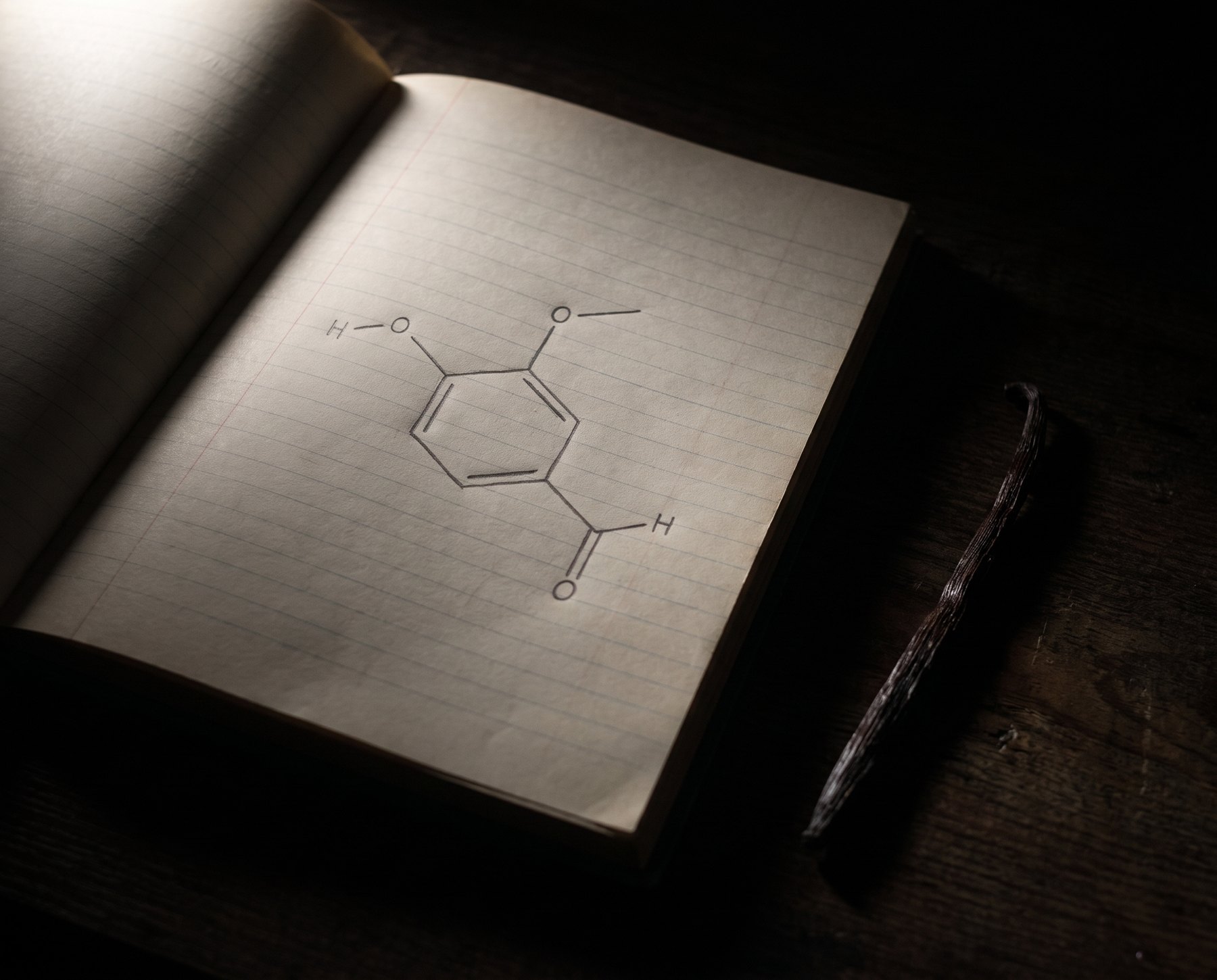
An orchid, a year of waiting, a molecule
The vanilla pod is the fruit of a climbing orchid native to Mexico and Central America. The flower opens for one day. Where no native bee does the work, as in Madagascar or Réunion, growers pollinate each flower by hand with a small stick.
The pod is picked green and almost odourless. The smell comes only after months: dipped in hot water, left to sweat, laid in the sun by day, wrapped at night, then dried slowly. In the process, compounds bound to sugars in the pod are released, and vanillin with them. Sometimes it forms small white crystals on the skin.
Natural vanilla contains hundreds of compounds. But vanillin is the main one, the first thing we recognise. In 1858 the French chemist Nicolas Gobley isolated pure vanillin from the pod.
Until then, the smell of vanilla required a vanilla pod. And pods were scarce, slow, and dependent on a flower open for a single day.
Tiemann and Haarmann, vanilla from the pines
In 1874 two German chemists, Ferdinand Tiemann and Wilhelm Haarmann, determined the structure of vanillin and found a way to make it. Their starting material was coniferin, a compound found in the sap and young bark of conifers.
Picture the shift. The smell of a tropical orchid fruit, once shipped from the Indian Ocean to Europe, could now come from pine trees in central Germany. No flower. No dry season. No hand pollination.
Tiemann and Haarmann built the first vanillin factory in Holzminden, a town on the Weser. The firm later took the name Haarmann & Reimer, after Haarmann and the chemist Karl Reimer. The same site is now the headquarters of Symrise, which counts 1874 as its founding year.
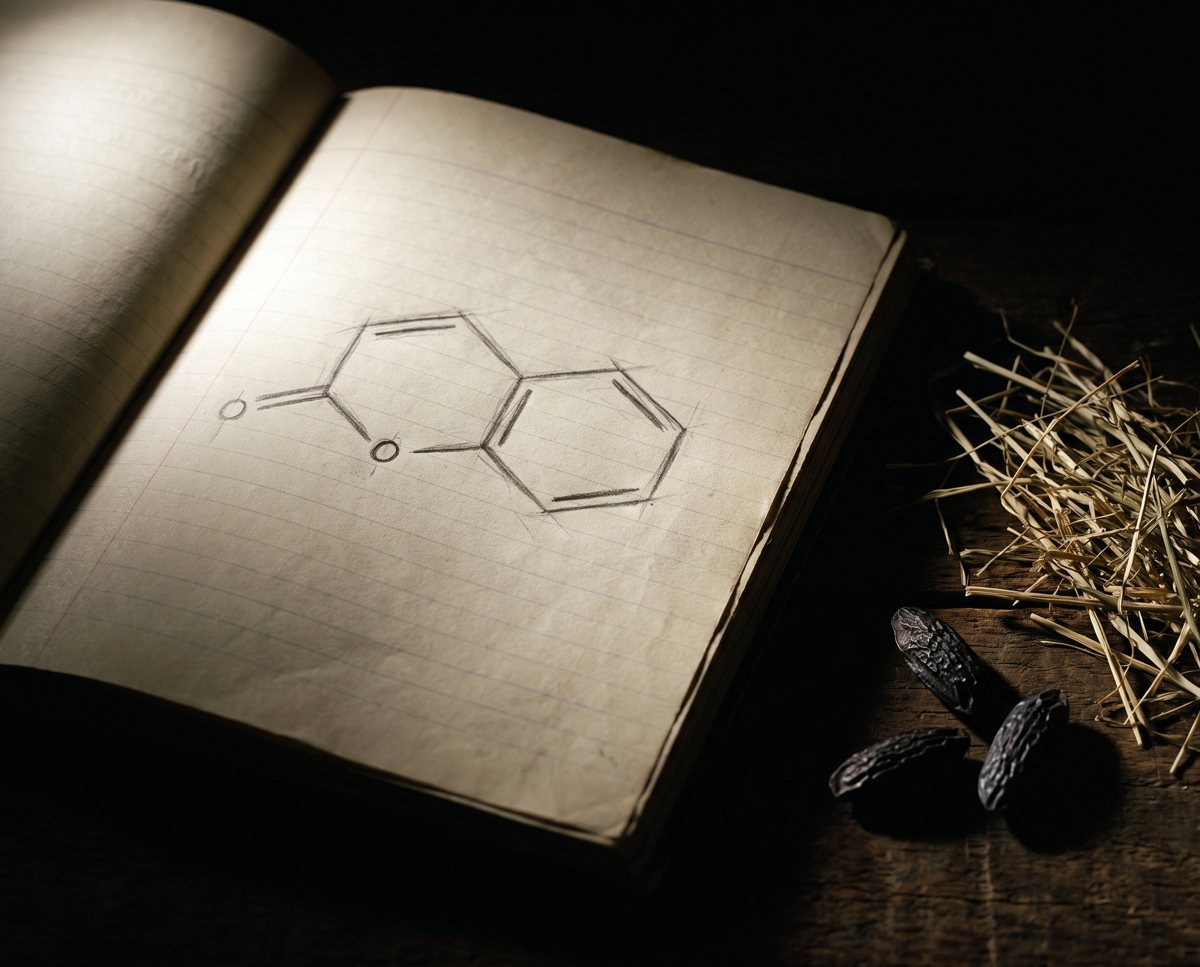
Within a few years perfumers were using vanillin at doses no pod could supply. Guerlain's Jicky of 1889 used both synthetic vanillin and synthetic coumarin. Later, other routes to vanillin were found, from clove oil, from paper industry byproducts, from petroleum. Each route a different source, one molecule.
Vanillin in wood, in spirits, in paper
Vanillin does not live only in the pod. It appears wherever lignin, the material that stiffens wood cell walls, slowly breaks down.
When the inside of an oak barrel is toasted over fire, lignin is broken and vanillin forms. Spirit resting in the barrel for years draws it in. Part of the sweetness found in whisky or oak aged wine comes from here, not from any vanilla pod.
Old paper too. Paper made from wood pulp contains lignin, and over time lignin breaks into smaller compounds, vanillin among them. Part of the warm, faintly sweet smell of an old library is the smell of paper ageing.
Dried tobacco, roasted coffee, toasted bread crust all carry traces of vanillin. In each case it is the result of a process: fire, time, slow drying.
A trace of what?
If one smell can come from an orchid, a barrel, a page, a pine forest, whose smell is it?
Synthetic vanillin is often called fake vanilla. But the molecule is not fake. It is identical, atom for atom, to the vanillin in the pod. What differs is everything around it: hundreds of other small compounds, months of resting, the grower's hands, the soil. Synthetic vanillin is the smell of vanilla without its company.
There is another way to see it. Perhaps vanillin was never the pod's own smell. It is the smell of a kind of change: when matter ages, dries, passes through fire, it leaves this sweetness behind. The pod is simply where we meet it most clearly.
Today vanillin is on Europe's expanded list of substances to be named on cosmetic labels. Like any trace, it is named, measured, tracked. But when we smell it, no one sees its source. The person smelling chooses the story.
Olfactory Art