
Essays · Olfactory Art
Maki Ueda. Viral Parfum.
What cannot be seen still leaves a mark.
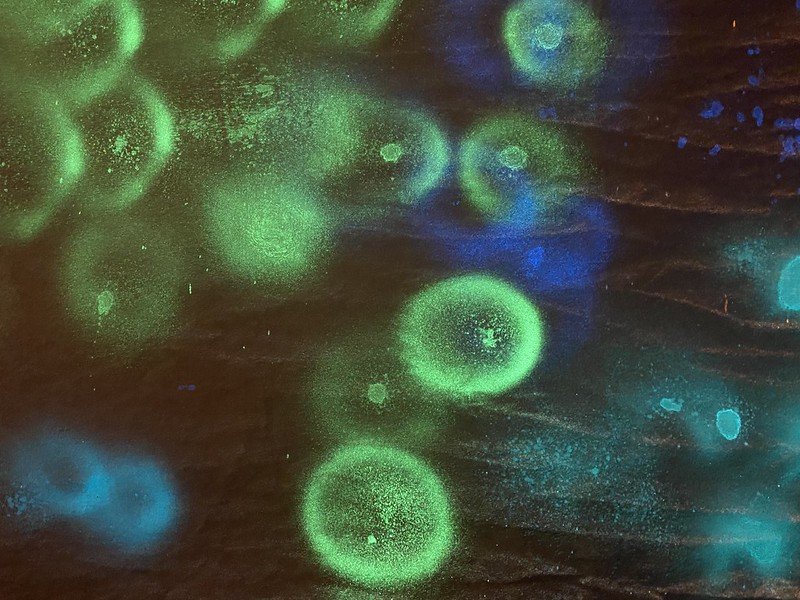
© Maki Ueda · Maki Ueda (official site)
A gallery in the middle of a pandemic
From 7 May to 29 August 2021, the Städtische Galerie Bremen in Germany showed Smell It!, curated by Ingmar Lähnemann. It was the second summer of the pandemic. The air of a closed room, the very material of the exhibition, was then what people feared most.
There Maki Ueda, a Japanese artist who has worked with smell for many years, premiered Viral Parfum. The title joins two words that should never stand side by side: virus and perfume.
The work is a spatial installation of smell and black light, the ultraviolet lamps that make certain substances glow in the dark. Under ordinary light the room looks unremarkable. Under ultraviolet, streaks of colour appear everywhere.
In 2022 Viral Parfum received the Sadakichi Award from the Art and Olfaction Awards, for experimental work with scent. Ueda had worked before with the distance between nose and object: in Olfactory Labyrinth Ver. 4 she used smell to raise invisible cherry trees. In Viral Parfum, the invisible thing is one everyone wanted to avoid.
Six smells, six colours, six variants
Ueda made six accords. Each stands for a variant of the coronavirus and carries its own colour: sky blue, green, yellow, blue, white, orange. The colours cannot be seen in ordinary light. They appear only under ultraviolet.
The artist published the ingredients of each. Number one contains ylang ylang oil. Number three is ylang ylang alone. Number five contains linalool and vanillin. Number six is a neroli composition of her own. These are ordinary perfumery materials, nothing frightening. That is why they suit the work: what stands for the virus is made of flower smells.
Visitors are invited to take a spray and apply the "viral parfum" anywhere in the room. Walls, floor, objects. Those who come later use their noses to find where the virus has attached. Under the ultraviolet lamps they see the traces of the people before them.
The room slowly becomes a map of spread. No statistics, no charts. Only streaks of colour and crossing smells, each one the gesture of someone who stood there.
White lily
When the six smells meet in the air, they form the smell of white lily. Ueda chose the flower as a tribute to those who died in the pandemic. In many places the white lily is a funeral flower.
This is where the work turns. Each smell alone stands for something harmful. But as they spread, overlap and settle across the room, what emerges is a flower. Spread, in this work, does not end in a number. It ends in a farewell.
Ueda names the likeness between smell and virus plainly: both are invisible, travel through the air, attach to surfaces, and fade over time. In 2021 these were daily sources of anxiety. She took them out of fear and placed them in a room where they could be observed slowly.
What stays with Viral Parfum is that it does not try to make visitors forget. It makes the invisible appear, under a lamp, through a smell. Then the smell fades, like every smell. But anyone who smelled lily in that room will find it hard to smell the flower the old way again.
Olfactory Art