
Essays · Olfactory Art
Maki Ueda. That Microplastics Smell Delicious!
A smell can turn waste into bait.
Maki Ueda (official artist site) · Maki Ueda (official artist site)
Blue balls, white balls, one smell
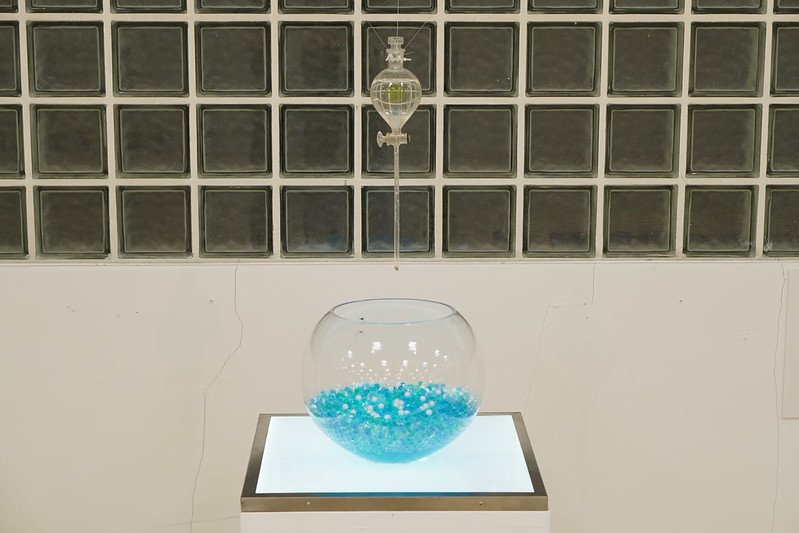
That Microplastics Smell Delicious! is an installation Maki Ueda made in 2023 and presented at Tokyo Biennale 2023 on 22 September that year, within a programme produced by Masaki Fujihata with the Super Sorted Trash Cans Project 2023.
Its form is simple. Inside a container are blue balls and white balls. Blue is the ocean. White is plastic. To the eye, the two are distinct and impossible to confuse.
But the work is not for the eye. A small mechanism releases a smell in controlled doses, around twenty drops a day. The smell is dimethyl sulfide, DMS, a compound produced by plankton. Many people will recognise it as part of what we call the smell of the sea.
DMS boils at around 38°C, so it evaporates very easily. According to the artist, she adjusted the solvents so the smell would stay stable in exhibition conditions. A smell that escapes so readily has to be held in place by calculation, drop by drop.
Why sea creatures eat plastic
The work rests on a scientific finding. Marine creatures mistake microplastics for food not because of how they look but because of how they smell. Plastic absorbs odours easily, DMS among them. Many sea creatures see poorly but smell keenly. To them, plastic soaked in DMS becomes a false bait.
A study published in Science Advances in 2016 described this mechanism in seabirds. After a few weeks at sea, plastic fragments are coated by microbes, which give the plastic a DMS signature. In nature, DMS is released when phytoplankton are eaten by zooplankton such as krill, and some seabirds use that smell to find feeding grounds.
The study reported that bird species responsive to DMS ate plastic about five times as often as species that were not. Its methods were later debated by other scientists. But the core idea is worth pausing on: a signal that once helped birds find food now leads them to waste.
Smell as a message
Maki Ueda is a Japanese artist who has worked for many years in the Netherlands. Much of her work uses smell to explore space and perception, like Olfactoscape or her smell mazes. This work turns elsewhere: using smell to speak about ocean pollution.
Many environmental works rely on strong images: landfills, dead birds, statistics. Ueda takes a detour. She does not show the consequence. She lets people smell the cause. The DMS in the room is not horrifying. It is a little salty, a little sulfurous, like a shoreline. Because it is familiar, visitors understand how easily a bird is fooled.
The title does the same work. Microplastics smell delicious! It sounds like a cheerful advertisement. But the speaker is a seabird, and the sentence is a trap.
What stays is the shift in position. We usually look at environmental problems from above. Here, for a few seconds, we smell the world through another creature's nose, and realise that what we throw into the sea has not only a shape, but a smell, and that smell tells other creatures something false.
Olfactory Art