
Essays · Olfactory Art
Maki Ueda. Tangible Scents: Composition of Rose in the Air.
Even a familiar smell can be taken apart, piece by piece.
© Maki Ueda · Maki Ueda (official site)
A November day at Reed College
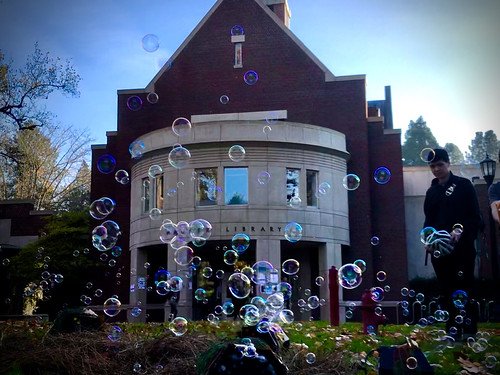
On 15 November 2018, during Reed Arts Week at Reed College in Portland, Oregon, five bubble machines were set up outdoors. Each held its own soap solution. Each solution carried its own scent molecule.
The five molecules are major components of the smell of rose. Phenyl ethyl alcohol, fresh and sweet, with a hint of sake. Geraniol, fresh and faintly citrus. Phenyl acetic acid, sour and floral. Rose oxide, fresh and slightly metallic. Aldehyde C9, fatty and green, close to cucumber.
Alone, none of them quite smells like a rose. Together they suggest one. The work places the audience in the space between those two states.
The timing of each machine was controlled remotely. The curator was Aersen Lease, artistic director of Reed Arts Week that year. In 2019 the work was a finalist for the Sadakichi Award of the Art and Olfaction Awards.
Taken apart, put together in mid air
Ueda calls her method deconstruction and reconstruction in the air. Instead of presenting a finished smell in a bottle, she splits it into parts and lets the space do the assembling.
There are two ways to stand before the work. One: chase a single bubble, pop it right under your nose, and smell one molecule on its own. Two: stand among the bubbles from all five machines, where the scents burst close together and overlap in the air. There, the rose appears.
She describes this as a composition in space. There is no fixed formula. The wind shifts, bubbles drift, one machine blows more densely than another, and the ratio of scents in the air changes by the second. Each visitor, in each spot, smells a slightly different rose.
The question Ueda set for the project was practical: how can smell become more tangible and easier for an audience to grasp? Bubbles were her answer. They give smell a shape, a flight path, and a moment of disappearance you can watch.
Why a rose
Ueda chose the rose because almost everyone recognises it. But also for the opposite reason: there is no typical rose smell. Damask rose differs from tea rose; a wild rose differs from one grown under glass. Everyone carries their own idea of what rose smells like.
That mix of familiarity and disagreement makes the rose good material for an experiment. When a visitor says this bubble smells of rose and that one does not, they reveal which molecule holds their private idea of a rose.
Before Portland, Ueda had tested the idea in several forms: a short performance at WOMB in Tokyo in November 2017, a candle installation at Art Hotel Ishigaki the same month, and a workshop on Ishigaki Island in August 2018. Tangible Scents took the experiment outdoors.
Smell in the air, not in a bottle
Many of Ueda's works treat air as material rather than merely the medium smell passes through. In Aerosculpture: Sea of Fragrant Cloud she used smoke to show smell in motion. In Tangible Scents she used bubbles to show smell divided into parts.
Both share one idea: smell does not stand still. It drifts, thins, meets other smells, and dissolves. A capped bottle holds a scent in stillness. A bubble bursting outdoors returns it to the movement that is its nature.
What remains after the work is another way of smelling. Next time they stand before a real rose, visitors might try what Ueda did: not smelling the whole flower, but looking for its pieces. Where it is sweet. Where it is green. Where there is a touch of metal.

Olfactory Art