
Essays · Olfactory Art
Maki Ueda. Aerosculpture: Sea of Fragrant Cloud.
Scent is always moving. Here, for once, we see it go.
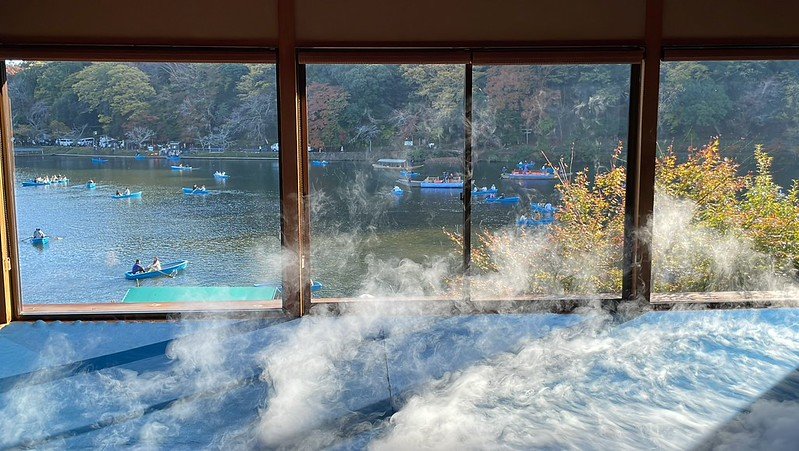
© Maki Ueda · Maki Ueda (official site)
Ten days in Arashiyama
From 3 to 12 November 2022, a riverside inn in Arashiyama, Kyoto, became an exhibition space. The inn was the Riverside Ryokan Arashiyama Benkei. Arashiyama lies on the western edge of the old capital, a district of temples that has long been a place of pilgrimage and rest.
The work was Aerosculpture: Sea of Fragrant Cloud by Maki Ueda, a Japanese artist who has worked with smell for many years. It was produced for the Kyoto Arashiyama Art Festival, a festival of performing arts.
That detail matters. The work was not invited as a static object. It was placed in a festival of things that unfold in time: theatre, music, dance. Ueda wanted to show that scent can also be a performing art.
Visitors did not walk through a labyrinth, as in her earlier works. They stood in a room and watched clouds.
Dry ice, smoke and incense
The main materials were dry ice and smoke. Dry ice is frozen carbon dioxide, very cold. Meeting warm air, it turns into a thick white mist, heavier than air, that creeps along the floor. Ueda experimented with making that mist carry a smell, and the smell she aimed for was temple incense.
When the smell travels with the mist, its path can be seen. The cloud spills, flows down, breaks into thin ribbons as someone walks through. A smell normally only breathed now has a shape, a direction, a speed.
The title calls it sculpture. But it is a sculpture with no fixed form. Its shape changes minute by minute, with the room's temperature, with how many people stand in it. No two visitors see the same work. When the dry ice is spent, the sculpture vanishes, and only the smell remains.
The sound was by Friedrich Glorian, on Tibetan gongs. The gongs ring long and low, spreading through the room the way cloud spreads across the floor. Sound and smell were arranged to move together in time, like two parts of one score.
Ueda said she wanted to make a place to play with scent like a child. The idea came from her own childhood memories. Dry ice cloud is something every child wants to touch and none can hold. Scent is the same.
A question from the pandemic years
Aerosculpture continues a question Ueda asked during the pandemic: what if we could see scent? In those years the whole world worried about something invisible in the air. A virus moving through breath, closed rooms, the space between two people. No one could see it.
Ueda thought scent might reveal that invisible movement. If a smell can travel from one person to another, other things in the air follow the same path. Scent becomes a tool for seeing, not only for smelling.
Yet in Arashiyama the question carries no anxiety. It is turned into something lighter: a sea of scented cloud in an old inn, the sound of gongs, and visitors standing still to watch the air move. The fear of earlier years becomes curiosity.
In 2023 the work was a finalist for the Sadakichi Award for experimental work with scent. Set beside Olfactory Labyrinth Ver. 4, where Ueda used the nose to measure distance, Aerosculpture goes the other way. There the eyes handed their task to the nose. Here the nose asks the eyes to look for it.
Olfactory Art