
Essays · Olfactory Art
Maki Ueda. Olfactory Labyrinth ver. 5: Invisible Footprints.
Every footstep is a message for whoever comes next.
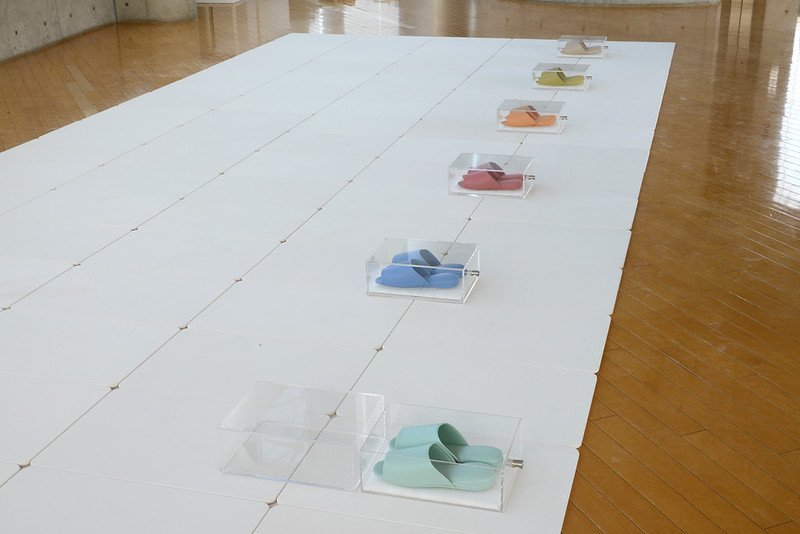
© Maki Ueda · Maki Ueda (official site)
Seven pairs of slippers, seven scents
At the entrance, visitors are invited to choose a pair of slippers. There are seven colours, each tied to one scent. Green is cis 3 hexenol, the molecule behind the smell of cut grass. Light blue is eucalyptus oil. Blue is rosemary. Red is lavandin, a hybrid of lavender. Orange is orange oil. Yellow is limonene. Brown is pine needle oil.
The soles are pressed onto a stamp pad Maki Ueda designed herself. The ink is colourless. She also mixed the solvent, so that the oils would cling to the floor without leaving a visible mark. Visitors walk into the room. They cannot see what they are leaving behind.
But they are leaving a route. Each step is a dot of scent. Steps join into a trail. As more people pass, the floor gathers a web of overlapping paths, each with its own smell.
Those who come later can do the opposite. They bend down close to the floor and follow someone else's trail. The posture is that of a dog sniffing. The work leads visitors into exactly that posture on purpose.
A labyrinth without walls
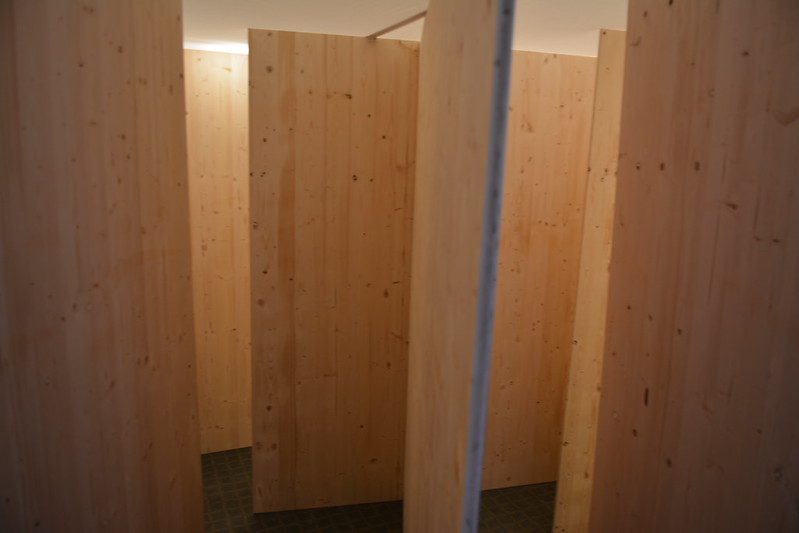
Olfactory Labyrinth is a series Ueda has developed through several versions. Earlier ones built the maze from partitions or from points of scent hung in space, like the fourth version with its grid of cherry blossom scents. Visitors found their way by nose rather than by eye.
The fifth version removes the walls. The maze is not built in advance. The visitors draw it themselves, step by step. No one knows which paths will form. An empty room in the morning can become a dense map by the afternoon.
The work premiered in Ueda's solo exhibition at the Kiyosu Haruhi Museum of Art in Japan, from 12 October to 8 December 2019, curated by Nana Fujimoto, with scent materials supported by Yamamoto Perfumery.
In 2020 Invisible Footprints was a finalist for the Sadakichi Award of the Art and Olfaction Awards, the category for experimental work with scent.
Animals talk with their noses
Ueda's starting point was watching dogs. Dogs use smell to mark territory, to recognise one another, to find a mate. A lamppost, to a dog, is a crowded notice board. Each passing dog leaves a line. The next reads it and adds another.
People have noses but hardly use them to speak to one another. We talk in words, letters, pictures. Our own body odour, if noticed at all, is usually covered up. The work's question is blunt: if people tried to communicate by smell as animals do, what would happen?
The answer is not in a wall text. It is in how people behave in the room. Some walk quickly, indifferent to what they leave. Some deliberately draw a loop. Some kneel, crawl after an orange trail, then look up laughing at how strange they feel.
That moment of feeling strange matters. It shows that human smell has not disappeared. It has only been ranked low, below sight and hearing. The work lifts it back up, if only inside one room.
Traces without owners
One thing is worth noticing: in Invisible Footprints no one signs their footprints. The scent belongs to the slippers, not to the walker. Two people in the same colour leave the same smell. A trail says that someone passed, but not who.
This sets the work apart from Ueda's projects with real dogs, such as Dog's Nose, where one particular nose crosses one particular city. Here smell becomes a shared script. Seven scents, like seven characters, and each visitor writes a sentence with their feet.
When the exhibition closes, the floor is mopped. The labyrinth vanishes. There is no map left to display. The work exists only on the days it is walked on, and in the memory of those who once knelt to smell a floor.

Olfactory Art