
Essays · Olfactory Art
Maki Ueda. Dog's Nose (Ars Electronica Version).
The city has another map, at the height of a dog's nose.
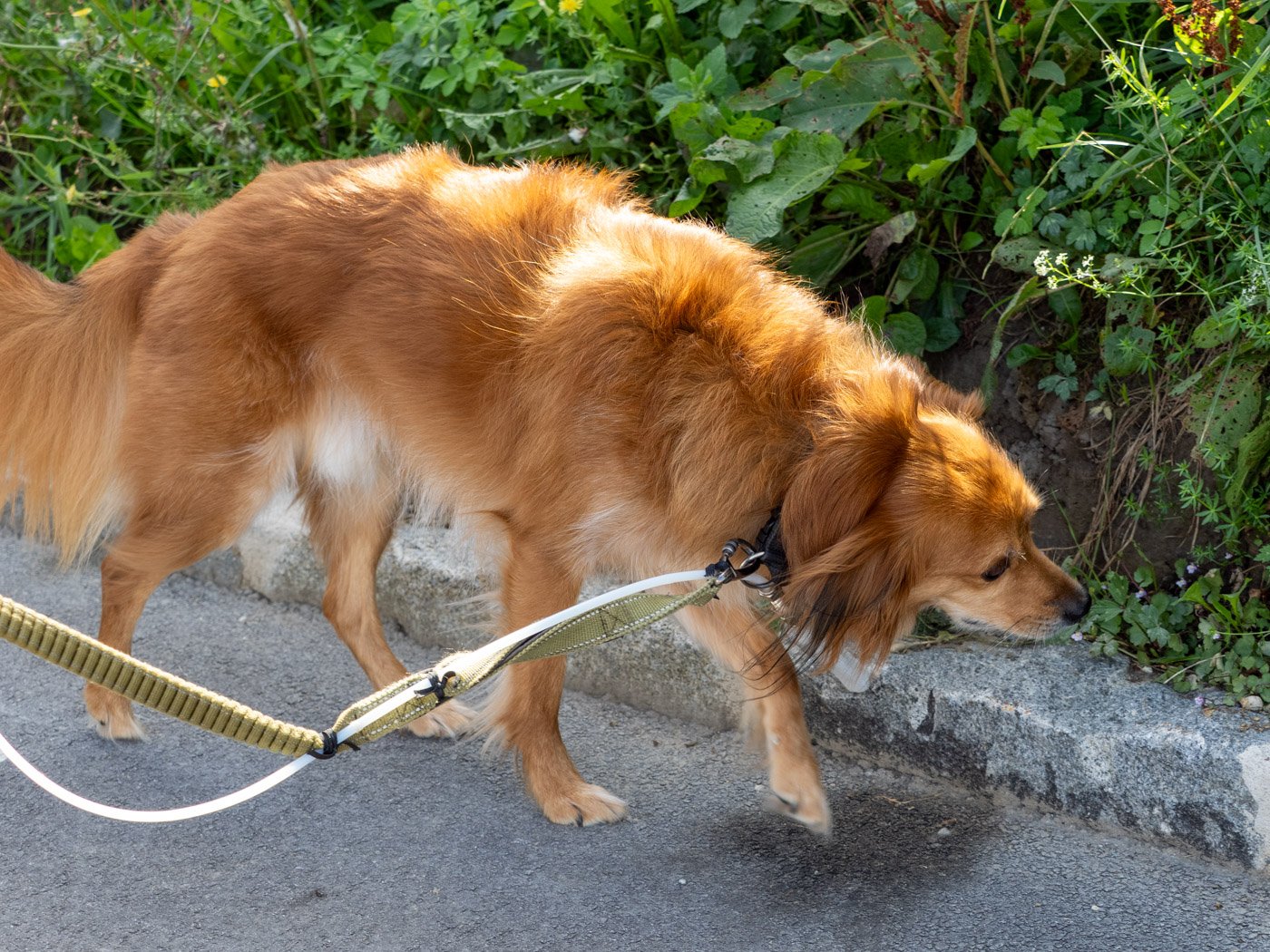
Photo: Konflozius · Maki Ueda (official artist site)
An hour's walk in Linz
On the morning of 3 September 2026, between 10:30 and 11:30, a seven year old male dog named Wim left the Ars Electronica Center in Linz, Austria, for a walk through the city. He carried a handheld gas measurement device called FAIMS Mobile. In the work's credits, Wim is listed as the olfactory researcher.
For an hour the device logged volatile molecules in the air at the height of Wim's nose. The data was sorted into four groups: ammonia, small molecules, middle sized molecules and large ones. Each group produced its own distribution map laid over the streets of Linz.
The result is four maps of the same morning and the same route, none alike. Here, heavy ammonia. There, a thick band of large molecules. An ordinary pedestrian could walk through both without noticing a thing.
The technical analysis was carried out by Katsuya Ujimoto of Ricoh. Photographs are by Konflozius. Maki Ueda is the author and researcher. This version was made for Ars Electronica, the annual festival of art, technology and society held in Linz.
Record, then play back
Ueda describes Dog's Nose as a bio-logging system for capturing and playing back smellscapes. Bio-logging is the practice, familiar to biologists, of fitting instruments to animals to gather data from their own lives. Here the data is not heart rate or position but the air the dog is breathing.
Before Linz the project passed through Tokyo. According to the artist's site, Chiyoko, Ueda's own dog and, in her words, her olfactory mentor, wore the sensor through Shibuya, Harajuku, Yoyogi Park and Meiji-dori for about six hours in total.
The second half of the system is playback. The data is turned into a small scale map that can be smelled, using digitally controlled scent spray and microencapsulation. Looking at the map is not enough. Visitors have to bend down and bring their nose close.
The difficulty in recording smell is that it has no common unit, no pixel, no musical note. Ueda does not try to reproduce each odour of Linz. She records its structure: which molecules, what size, how dense and where. The smellscape that comes back is a translation, not a copy.
That gap between translation and original is what makes the work worth thinking about. We will never smell as Wim does. But we can know that his world exists, and that it has a shape.
The politics of a nose
Dog's Nose belongs to a group of projects Ueda calls Olfacto-Politics. The keywords she attaches to it include multispecies engagement and digital olfaction, and they point in two directions.
The first is the dog. For most of history dogs have worked for human noses: tracking game, finding the lost, sniffing out explosives. Dog's Nose reverses the arrangement. Wim is not searching for what people want found. He simply walks as a dog walks, and people follow to learn how the city appears to him.
The second is the machine. The device does not smell like a dog or like a person. It counts molecules. Between the three noses, biological, mechanical and human, the work shows that none of them is the standard. Each reads a part.
Ueda is a Japanese artist who has long worked in the Netherlands and whose main material is smell. Her earlier projects, such as Olfactoscape, built in Osaka in 2010, often placed visitors inside a constructed space of smell. Dog's Nose steps out of the gallery, down onto the pavement, and invites another species to share the authorship.
What stays with you is the work's modesty before the dog. One hour's walk, four maps, and an admission that a city we think we know still has layers we have never smelled.
Olfactory Art