
Essays · Olfactory Art
Coumarin. Hay in a test tube.
The grass is dry. The smell remains.
The smell of cut grass
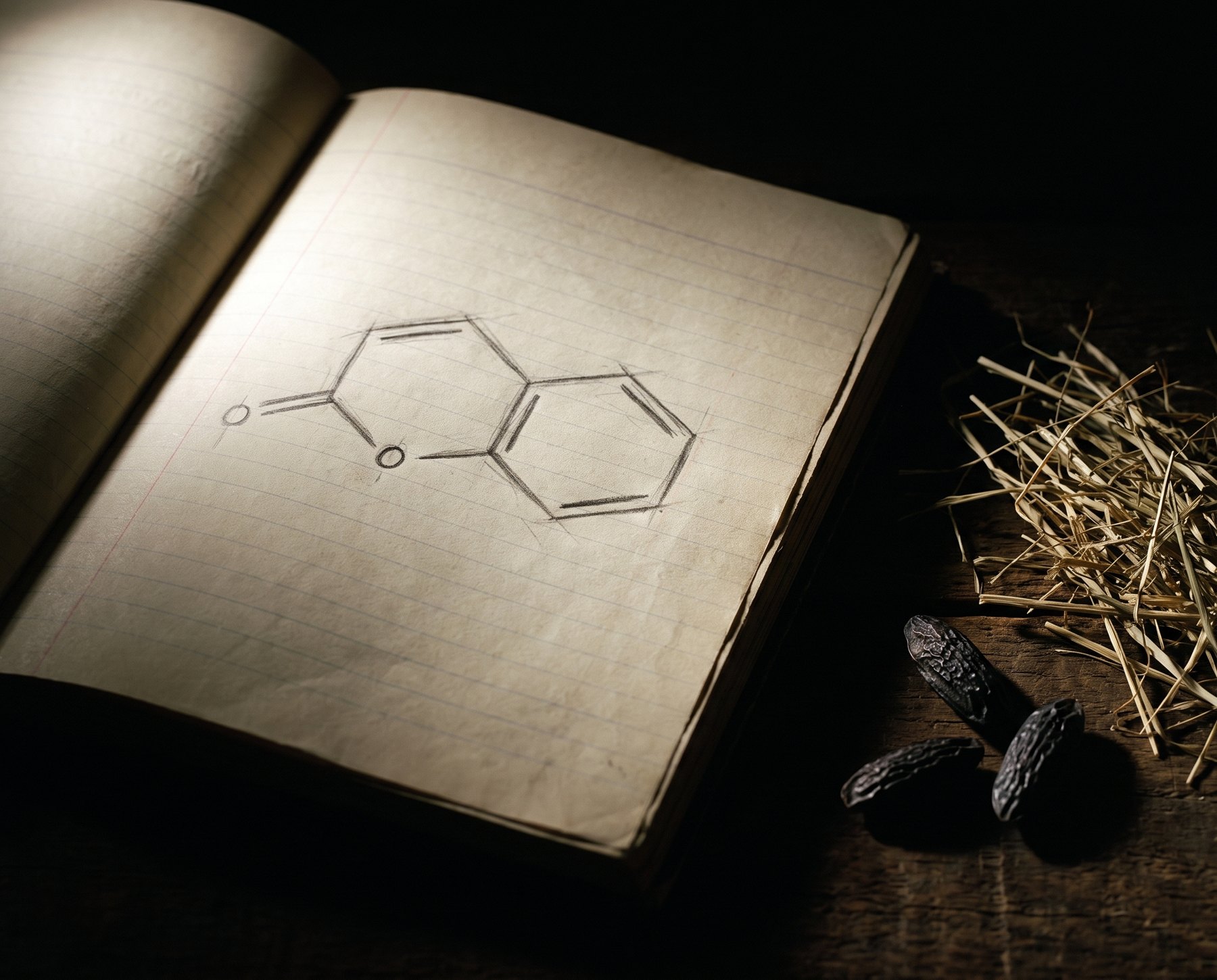
Coumarin is a small molecule, a benzene ring joined to a lactone ring. Pure, it forms white crystals. Up close it smells of hay and almond, a little like dried tobacco, a little like pastry left to cool.
In nature it turns up in many places. The tonka bean, the black, wrinkled seed of a large South American tree, holds so much coumarin that white crystals sometimes form on its skin. Sweet vernal grass has it. So do deertongue leaves in North America, cassia bark and sweet clover.
What these materials share is that their smell grows stronger as they dry. Fresh sweet grass smells faintly. Dried for a few days, it fills a barn. European farmers knew the smell long before they knew its name: a haystack at the end of summer, a barn shut all winter.
Coumarin was isolated from tonka beans early in the nineteenth century. The name comes from coumarou, a local name for the tonka tree in the Guianas. For decades, anyone who wanted coumarin still needed tonka beans.
Perkin, from purple dye to hay
William Henry Perkin is known first for a colour. In 1856, an eighteen year old student in London trying to make quinine, he obtained a purple dye by accident. He called it mauveine. It was one of the first synthetic dyes, and it opened an entire coal tar chemical industry.
Twelve years later, in 1868, Perkin reported a way to make coumarin from salicylaldehyde. The reaction later took his name. For the first time the smell of hay was made without grass, without tonka, without summer.
This is worth a pause. Until then every smell in a perfume bottle came from an object: a flower, a peel, a piece of wood, a musk pod. To have the smell you needed the thing. With synthetic coumarin that thread broke for the first time. A smell could be written as a formula and made again, as often as needed, wherever there was a laboratory.
Perkin did not make perfume. But his work in London gave perfumers in Paris something they had never had: a stable, affordable material that did not depend on seasons or on ships from South America.
Paul Parquet, who ran the house of Houbigant, used synthetic coumarin with lavender, bergamot, geranium and oakmoss to make Fougère Royale. It is usually dated 1882, though some sources say 1884. It was among the first perfumes built around a synthetic molecule.
The name is odd. Fougère is French for fern, and ferns hardly smell at all. Parquet named an imagined smell: if a fern had a scent, it might be this. A damp wood, moss on oak bark, dry leaves underfoot, and in the middle the dry sweetness of hay.
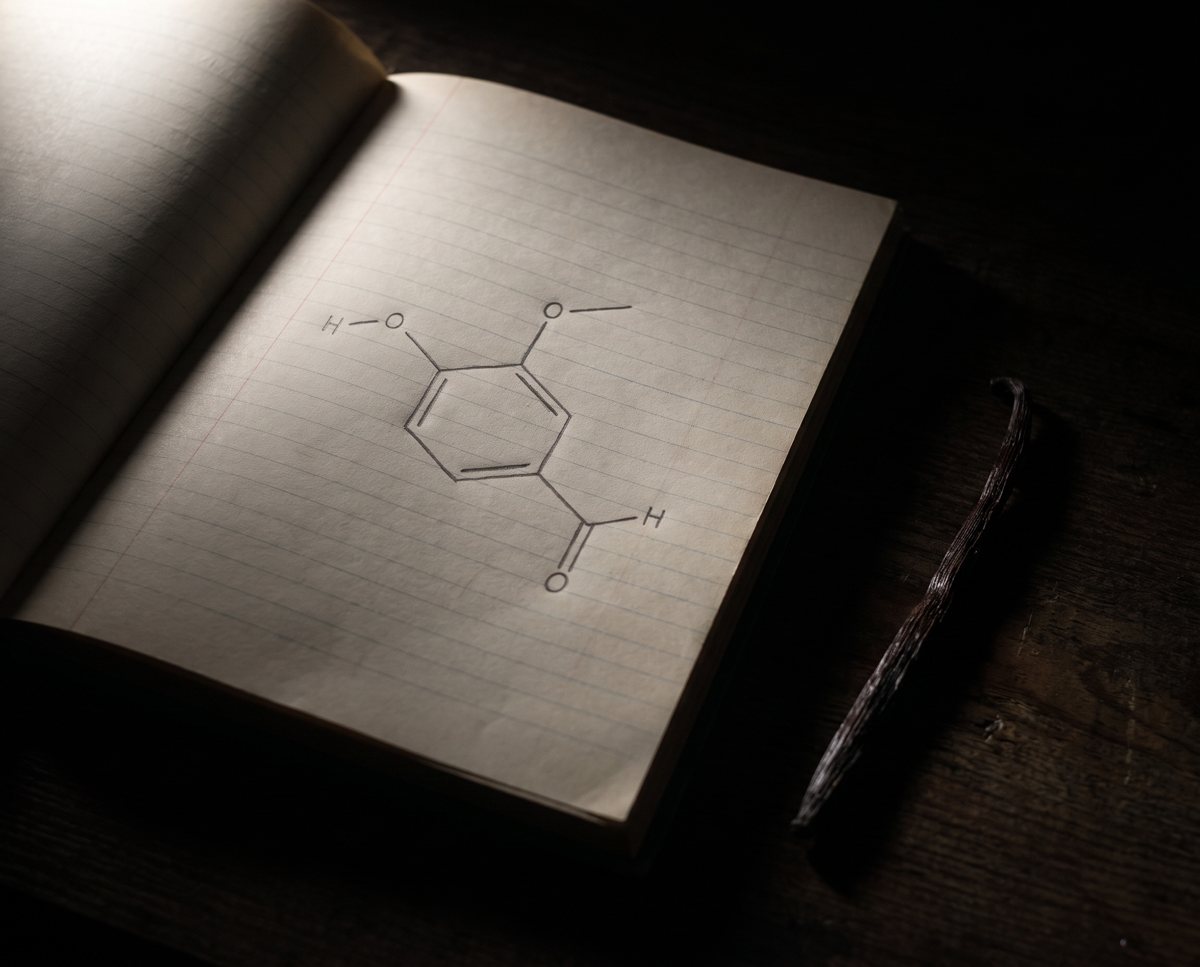
A whole family grew from that bottle. The French perfumers' society defines Fougère as a frame of lavender, woods, oakmoss and coumarin. In 1889 Aimé Guerlain made Jicky with lavender, coumarin and synthetic vanillin. Through the twentieth century the Fougère frame became the familiar structure of aftershave and men's perfume.
Houbigant released Fougère Royale again in 2010 with a new formula. The original is known only through descriptions and research reconstructions.
A field without a field
Coumarin raises a question every later synthetic has repeated. Is a smell an object, or only a sign of one?
When we smell coumarin in a lab, no grass has been cut. No sun, no haystack. Yet the person smelling still finds hay, still finds a summer that has passed. The smell carries a whole scene it does not need.
One could put it the other way round. Because hay was always the smell of something past, it separated from its object so easily. Hay is already a trace of fresh grass. Synthetic coumarin is a trace of a trace.
Today coumarin appears in a great many things, from perfume to soap. In Europe it must be named on cosmetic labels above a set threshold, and IFRA has a standard for it. The fields are still there, still cut every summer, unaware how far their smell has travelled.
Olfactory Art