
Essays · Olfactory Art
Fougère Royale. A fern with no smell.
A name for something with no smell.
Houbigant, Paris
Houbigant is a Paris perfume house dating from the late eighteenth century. Paul Parquet was its perfumer and owner in the late nineteenth century. Fougère Royale is his most cited work.
The year is usually given as 1882. Some accounts, including a review of the version kept at the Osmothèque, the perfume conservatory in Versailles, put a question mark between 1882 and 1884, and suggest the scent may have appeared in soap before it reached a bottle. Penta keeps 1882 as the usual reference and records the uncertainty.
According to the same accounts, Fougère Royale was not an instant success. Its structure spread only in the early twentieth century. A new idea often needs time before others see it.
Houbigant reissued Fougère Royale in 2010 with a new formula, markedly different from the original. The smell of 1882 now survives mainly through preserved reconstructions and through what people have written about it.
Coumarin and lavender: a new structure
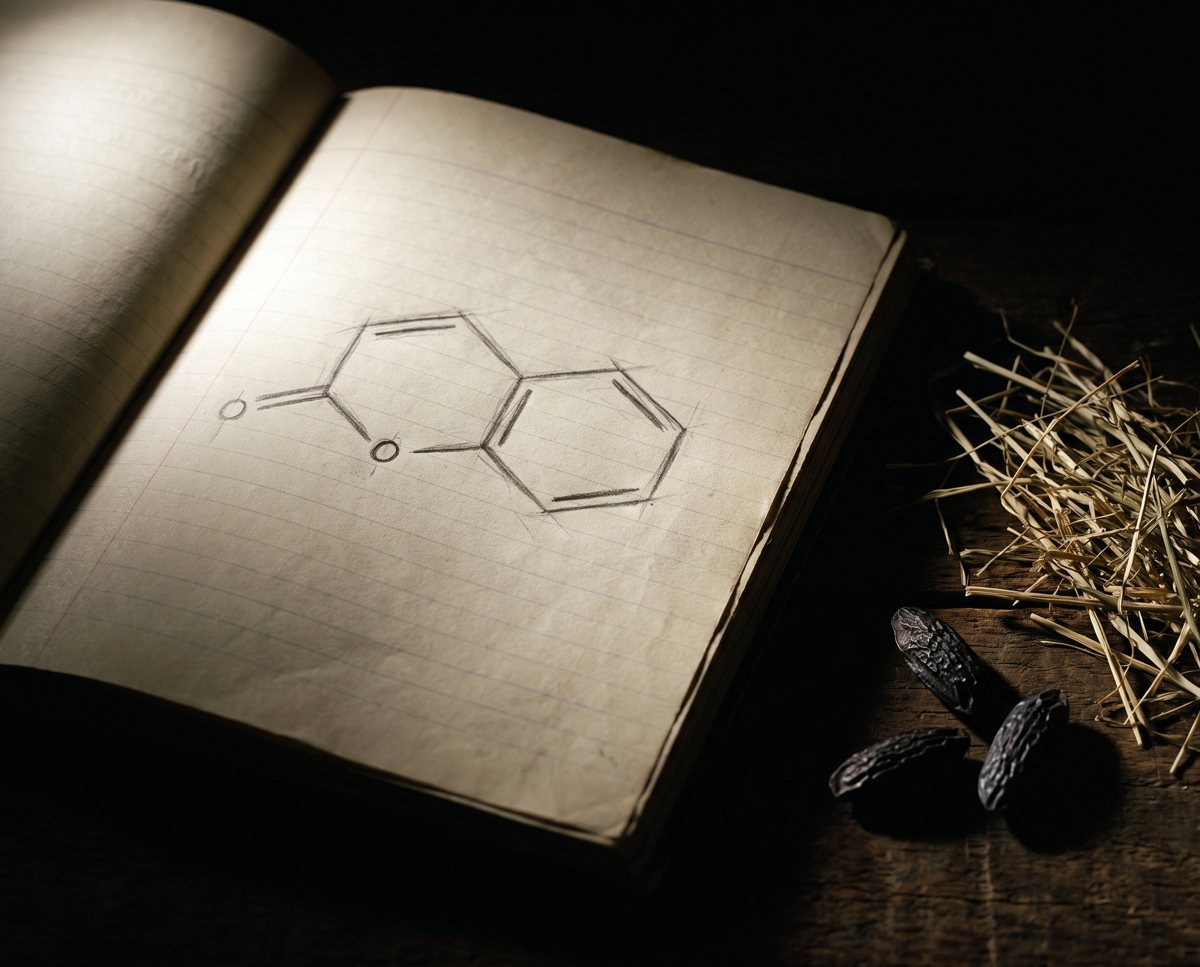
What makes Fougère Royale a landmark is coumarin. The molecule occurs naturally in tonka beans, sweet grasses and cassia bark, and smells of hay, almond and sweet tobacco. In 1868 William Henry Perkin published a way to synthesise it. From then on coumarin could be made in quantity, without tonka beans.
Fougère Royale was one of the first perfumes to use such a synthetic molecule as its axis. Coumarin was set beside lavender, bergamot, geranium and oakmoss. Bergamot brings brightness. Lavender brings a dry, open quality. Coumarin brings smoothness, a little powder. Oakmoss holds everything to the ground.
The structure later got a name of its own: lavender, coumarin, oakmoss. It was stable enough to be lifted from the first bottle and used again in others, like a frame.
One thing is worth noticing. A molecule made in a laboratory was used to build a forest. The artificial served a very natural image.
A fern with no smell: naming something imagined
Fougère is French for fern. Ferns have almost no smell. The Société Française des Parfumeurs, in classifying the Fougère family, notes that the name is imaginative: it describes not the plant's smell but an impression.
So Fougère Royale is not a record. It is a landscape. The person smelling is invited into a damp wood under divided fronds, where earth, moss and hay have a smell and the fern itself is silent.
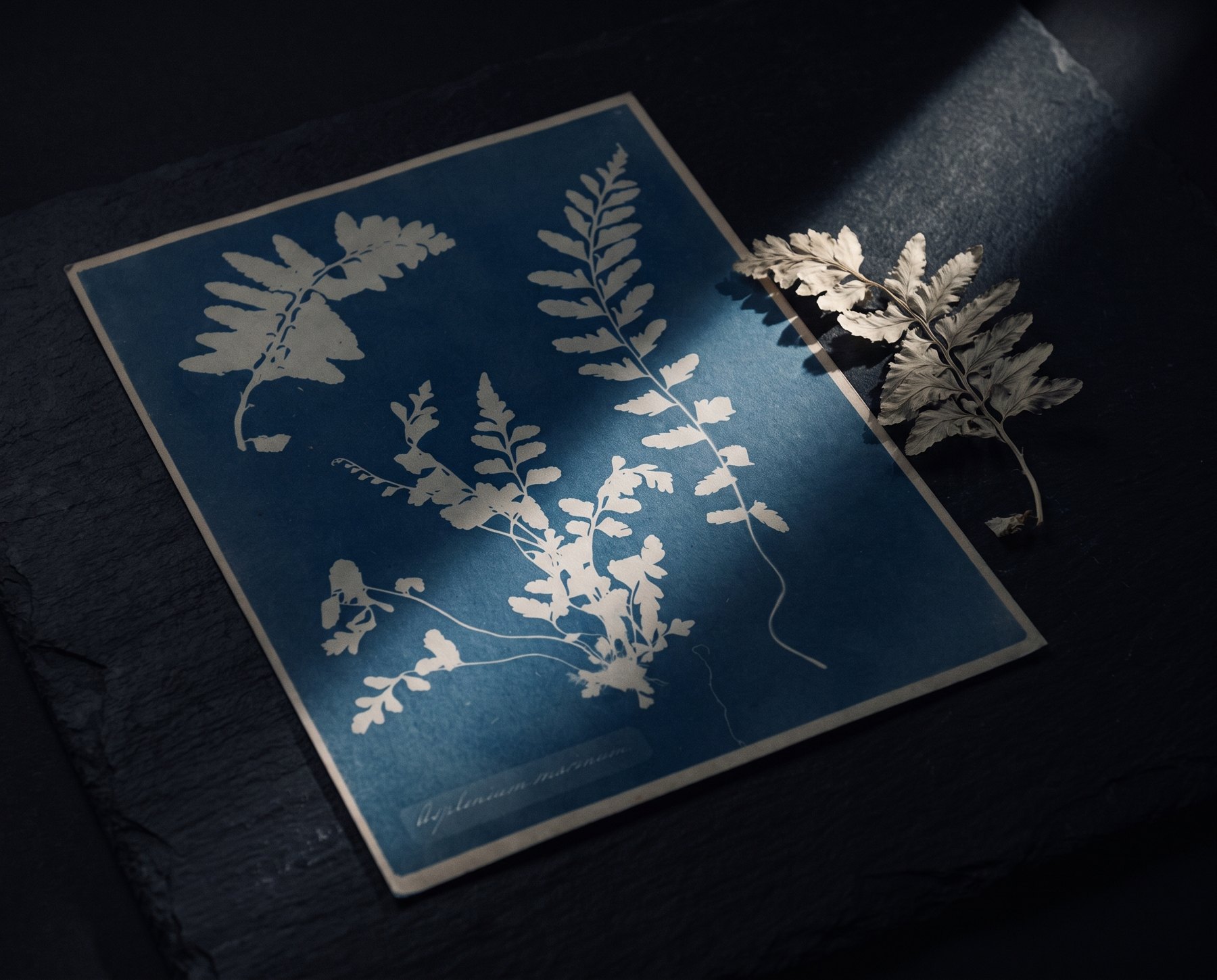
Ferns were also being looked at very closely at the time. In 1853 Anna Atkins printed her cyanotypes of British and foreign ferns, white fronds on a blue ground. There the fern is an image. In Fougère Royale it is a name. Both record the plant without its smell.
A name, once strong enough, creates what it calls. More than a century later, many people who hear the word fougère think at once of lavender and hay, not of a green, odourless leaf.
Words sometimes carry a smell in place of the thing. A black and white photograph by Jan Saudek is silent, but its title smells of hot railway track. Fougère Royale works the same way: the plant is silent, the name has a smell.
From one bottle to a family
In the SFP classification, Fougère is family C, with six branches, defined by lavender, woods, oakmoss and coumarin. Its founding bottle is Fougère Royale.
Through the twentieth century the Fougère structure became the backbone of many men's perfumes, from aftershaves to the herbal bottles of the 1970s and 1980s. The smell of an imagined forest became a familiar smell in millions of bathrooms.
Today both coumarin and oakmoss are regulated. Oakmoss must be a grade reduced in atranol under European Union rules. Many new Fougères replace the moss with other woody and mossy molecules. The forest is still there, but the ground underfoot has changed.
One bottle, one name, one molecule. From them, a family. And at its centre, a plant with no smell.

Olfactory Art