
Essays · Olfactory Art
White musk. There is no deer.
The name stayed. The animal did not.
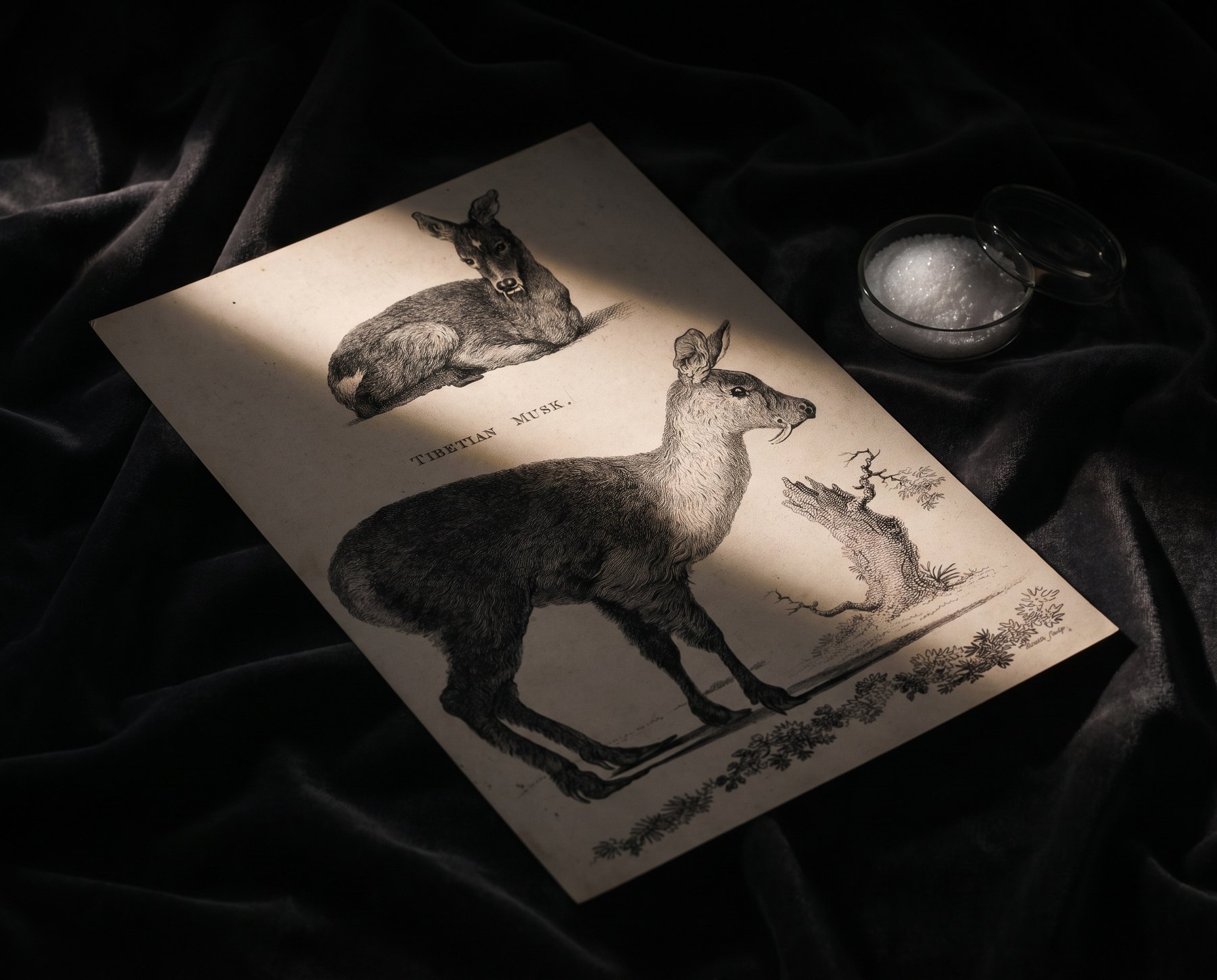
The musk deer and a gland
The musk deer is a small, antlerless deer of the mountain forests of Asia, from Siberia across the Himalaya to southern China. The male carries a gland under its belly. The secretion inside dries into dark brown grains. That is musk in its original sense.
For centuries, getting musk meant killing the deer to cut out the gland. The material was costly, harsh when concentrated, and a tiny amount could fill a room. Perfumers steeped it in alcohol, let it age, and used it by the drop.
One detail touches Vietnam. In nineteenth century European trade, a highly graded musk went by the name Tonkin, the colonial name for northern Vietnam. The name did not mark a separate species. It marked a trade route, where goods from Yunnan and the northern mountains reached the sea.
Today the musk deer species are controlled under CITES, some populations at the highest level of protection. Natural musk has been almost absent from international perfumery since the late twentieth century. The deer has left the story.
From nitro musks to large rings
The substitutes began by accident. In 1888 the chemist Albert Baur, working on compounds related to explosives, obtained a substance that smelled of musk. These were the nitro musks: cheap, stable, and widely used in the first half of the twentieth century. Most were later banned or restricted over toxicity and persistence in the environment.
In 1906 Heinrich Walbaum isolated muscone, the main odorant of deer musk. In 1926 Leopold Ružička showed that muscone is a large ring of fifteen carbon atoms, work that fed into his Nobel Prize in Chemistry in 1939. The macrocyclic musks grew from there.
In 1965 chemists at IFF found Galaxolide, a polycyclic musk. It was cheap, stable in soap and detergent, and it smelled clean. It soon became the most used musk in the world. Later it was found in wastewater and sludge, and the industry moved slowly toward molecules that break down more easily.
Each generation of musk answers the problem of the one before. None of them needs the deer.
Why white
The word white does not come from the colour of any molecule. It comes from where people meet the smell most: a freshly washed shirt, sheets dried in the sun, soap in the bathroom. Galaxolide and the musks after it entered detergent and fabric softener before they entered perfume. A whole generation learned the smell from its clothes.
So white musk does not recall an animal. It recalls cleanliness, closeness, skin after a shower. Some macrocyclic musks are described as freshly washed linen, faintly metallic, faintly waxy. Nothing of the mountains.
There is one more oddity. Not everyone can smell every musk molecule. Many people miss one musk that the person beside them finds obvious. Perfumers therefore often use several musks at once, so that each nose catches at least one. White musk, in that sense, is built for a crowd of different noses.
The name that remains
The history of musk is a history of complete substitution. The original thing has gone. The substitutes have changed many times. Only the word stayed, like a label on a box whose contents were replaced.
That does not make today's smell less real. It is simply different. Clean laundry is a fact of modern life, as the gland was a fact of another time. Few people, hearing white musk, picture a small deer standing in mountain mist.
Perhaps that is how many words survive. They carry something that has gone, and we use them every day without needing to know.



Olfactory Art