
Essays · Olfactory Art
Lilac. A smell that must be rebuilt.
Like the flower. Never the flower.
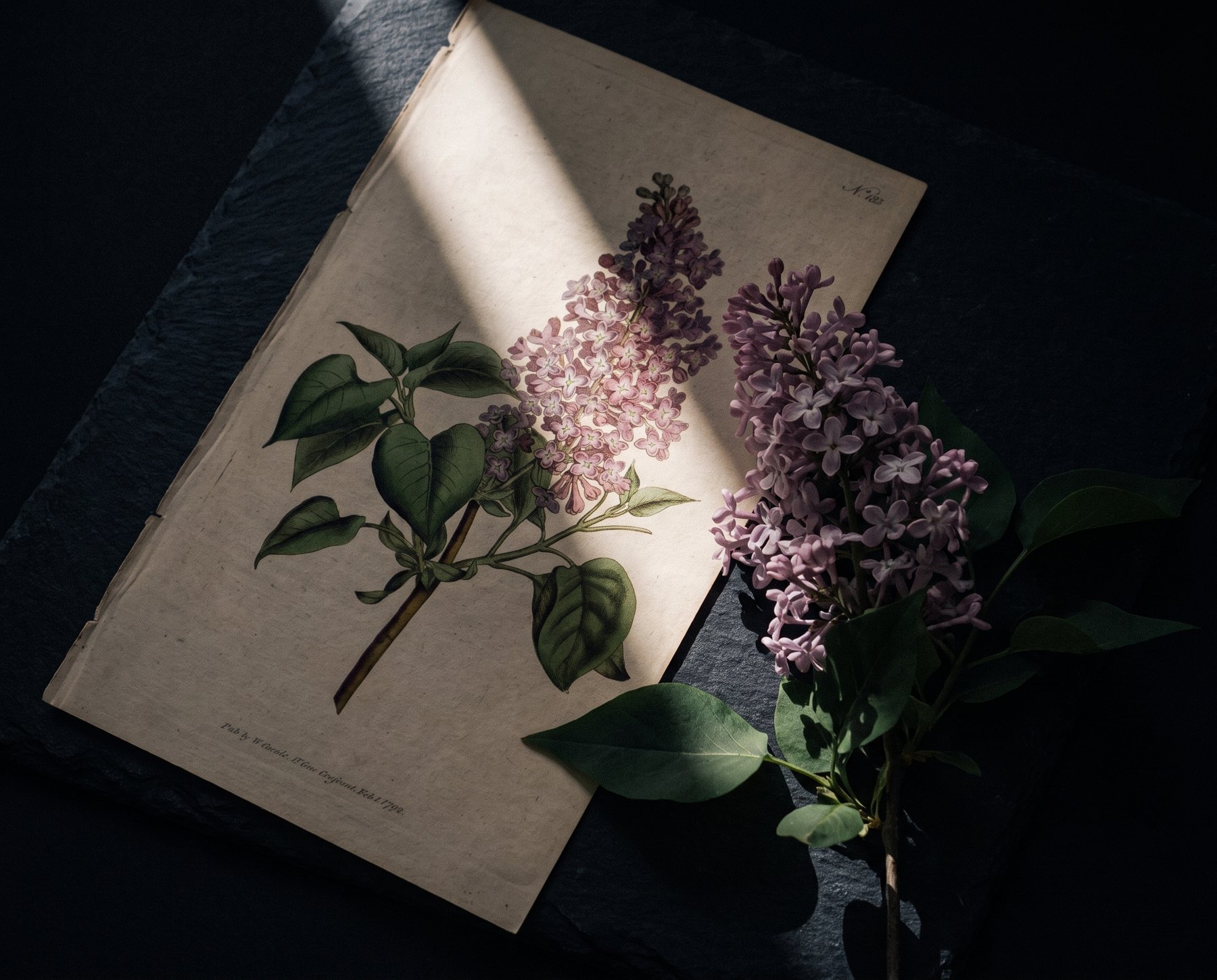
A spring flower that yields no oil
Lilac, Syringa vulgaris, is a shrub native to the Balkan peninsula, later planted across Europe and North America. In late spring it carries dense clusters of small flowers, pale purple, deep purple or white. Its colour is so strong that in English and French the flower's name became the name of a shade.
The smell of lilac is easy to remember. Sweet, cool, a little powdery, with a green edge from the leaves and a very light spice. It travels on the wind, comes in through windows, stays on clothes. But like lily of the valley, the flower refuses the bottle. The blossoms are small and thin, the scent material is scarce, and what can be taken does not hold the smell people remember. Today there is almost no lilac extract in trade.
So from early on, perfumers understood that if they wanted lilac, they had to build it.
A nineteenth century formula
G. W. Septimus Piesse, a chemist and perfumer in London, published The Art of Perfumery in the mid nineteenth century. In the 1857 edition he writes that lilac can be taken by steeping the flowers in fat. Then, straight away, he gives an imitation formula, as if he knew few would take the first road.
The formula calls for tuberose extract, a smaller part of orange flower extract, a few drops of almond oil and a little tincture of civet. No lilac at all. Only other white flowers, a bitter touch of almond, and a trace of animal to hold everything together.
That was the method of the time: build one flower out of others. The wearer did not need to know. They only needed to recognise the smell they had met in a garden.
Terpineol and heliotropin
As organic chemistry grew in the second half of the nineteenth century, the perfumer's paintbox widened. Two materials became central to lilac.
Terpineol, found naturally in many oils such as pine and cajeput, has a dry, clean floral smell that recalls lilac. It was cheap and stable, and it became the backbone of many rebuilt lilacs, especially in soap.
Heliotropin, also called piperonal, smells sweet and powdery, of almond and heliotrope. It softens the cleanness of terpineol and adds the powder of petals. Later, muguet molecules such as hydroxycitronellal were added for coolness and green.
None of these is lilac. Each is a stroke: one for cleanness, one for softness, one for coolness. Lay down enough strokes and the flower appears.
A portrait from memory
There is a fine difference between copying and remembering. The copyist looks at the thing and reproduces each detail. The one who remembers keeps an impression and drops whatever has faded. Lilac in perfume always belongs to the second kind. It is not copied from the flower, because the flower cannot be copied. It is built from what people remember of the flower.
So each lilac carries the trace of its maker. One remembers the powder, another the green, another the cool of a morning when the blossoms were still wet. None is wrong. None is enough.
And the real flower still blooms each spring, for a few weeks, for anyone who passes the garden at the right time. Its smell is there, whole, and no one can take it home.

Olfactory Art