
Essays · Olfactory Art
Alexandra Daisy Ginsberg. Resurrecting the Sublime.
The smell of a flower that no longer exists.
Courtesy Alexandra Daisy Ginsberg · Alexandra Daisy Ginsberg (official site)
Three flowers, three disappearances
The first is Hibiscadelphus wilderianus, known in Hawaiian as hau kuahiwi. It grew on the southern slopes of Haleakalā on Maui. The last tree was found dying in 1912. Its lava field home had been cleared for colonial cattle ranching.
The second is Orbexilum stipulatum, a legume that grew on Rock Island in the Ohio River near Louisville, Kentucky. It was last recorded in 1881. In the 1920s, US Dam No. 41 raised the water and drowned its habitat.
The third is Leucadendron grandiflorum, from Wynberg Hill in the shadow of Table Mountain, Cape Town. It was last seen in 1805, in a collector's garden in London. Its native ground had become colonial vineyards.
Three species, three continents, three causes. One thing in common: they were lost because people wanted the land for something else.
From dried specimen to smell
Alexandra Daisy Ginsberg is a British artist who has worked with synthetic biology for many years. This project began with Harvard University's herbarium, which still holds dried branches of lost species.
From those specimens, scientists recovered a tiny amount of DNA. The biotech company Ginkgo Bioworks used it to reconstruct the sequences of enzymes the plants once used to make scent molecules. From there they inferred which molecules the flowers may have produced.
Then came Sissel Tolaas, the Norwegian smell researcher. Tolaas rebuilt each smell with those molecules, or with close analogues.
One thing could not be recovered. DNA says which molecules a plant could make, not how much of each. The proportions were lost with the flowers. The smell in the work is an informed reconstruction, not a copy. Ginsberg says so plainly and lets that gap become part of the meaning.
Standing among stones and smells
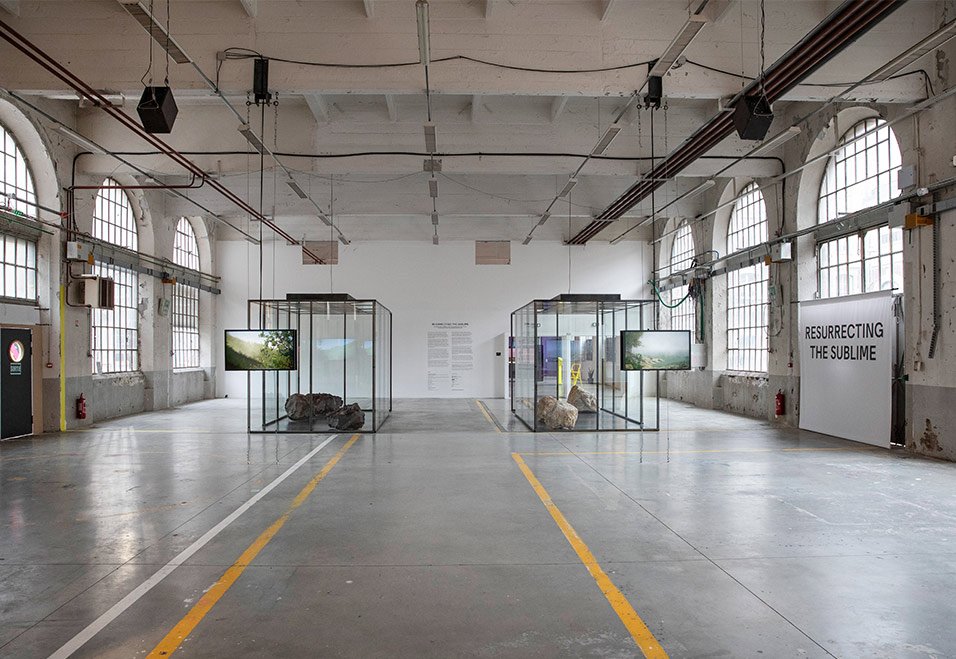
The installation premiered at the Centre Pompidou in Paris in February 2019. The same year it was shown at the Biennale Internationale Design Saint-Étienne and the Vitra Design Museum; in 2020 at the Natural History Museum in Bern; in 2021 at the 17th Venice Architecture Biennale.
In each room there are boulders: lava, limestone, granite, the kinds of stone on which each species grew. Vitrines diffuse the smell of each flower. On the wall, an animation rebuilds the lost landscape. A soft soundscape runs underneath.
Visitors never see a flower. No model, no reconstructed plant. Only stone, smell and the visitor. Ginsberg places the human in the position of a specimen: standing in a landscape, facing something larger than oneself, and facing the destructive power of one's own species.
Why the sublime
The sublime is an old idea in European aesthetics: the feeling of standing before something too vast to grasp. High mountains, stormy seas, an abyss. Nineteenth century landscape painting liked to put a small figure before immense nature.
Ginsberg uses the word in a new way. What cannot be grasped here is not a mountain. It is extinction. We will never know exactly how those flowers smelled. That gap is the work.
The approach sits close to Sissel Tolaas's own path: years spent studying smell as data about the world, to the point where a major exhibition of hers, RE_________, was built out of smell alone.
Resurrecting the Sublime brings nothing back to life. The title is a deliberate paradox. What returns is only an incomplete smell, enough for someone standing in the room to know there was once a flower here.
Olfactory Art