
Essays · Olfactory Art
Jicky. A smell that says nothing of flowers.
A smell stops copying. It becomes an object.
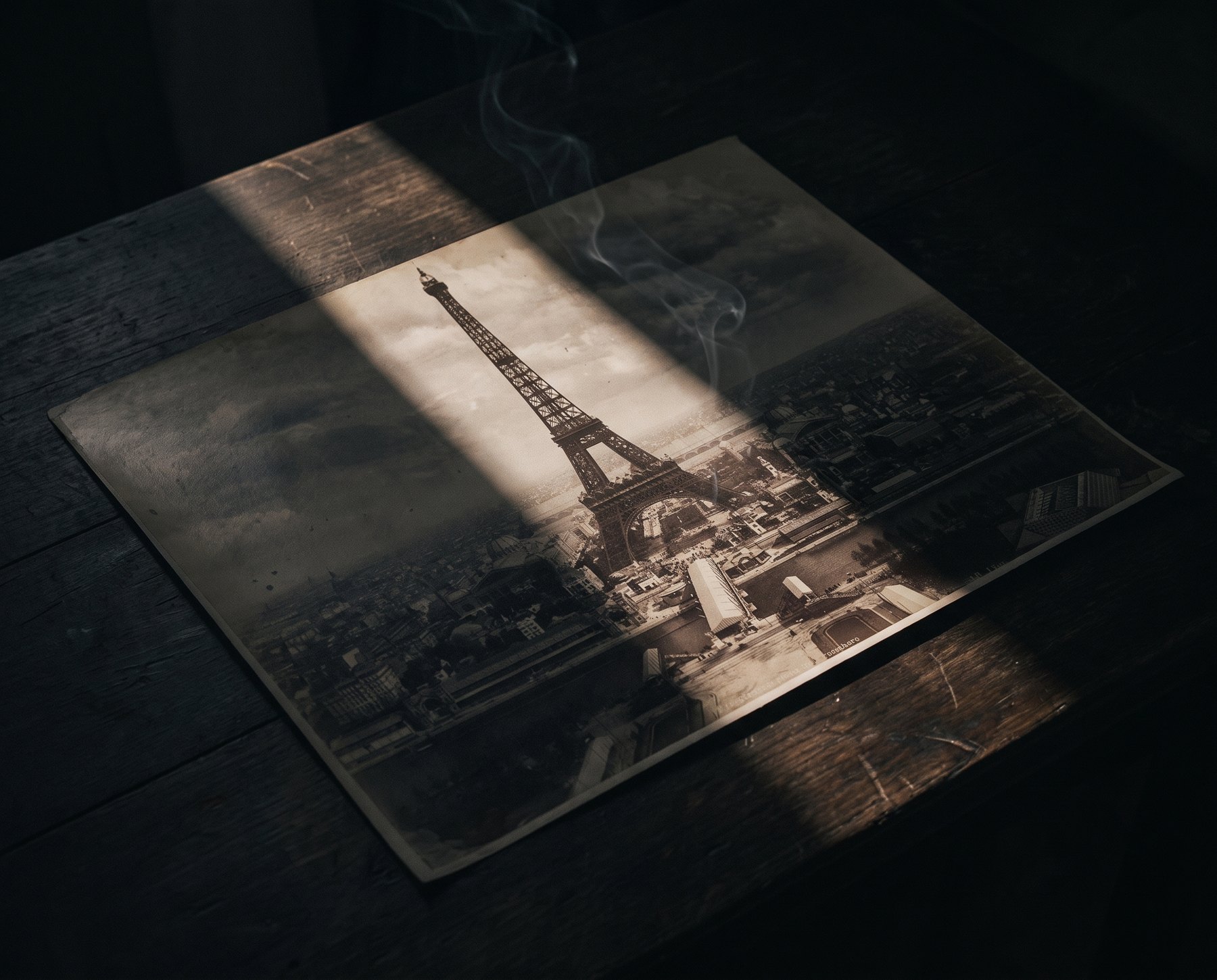
Paris, 1889
In 1889 Paris opened a World's Fair. The Eiffel Tower was built for the occasion, a bare iron frame with none of the old ornament. Many people at the time found it ugly. It rose above everything around it and resembled nothing that had come before.
The same year the house of Guerlain released Jicky, made by Aimé Guerlain. The two objects have nothing to do with each other except one thing: both show that new things can be made from new materials. Iron in place of stone. Synthetic molecules beside essential oils.
There are several stories about the name Jicky, and none is firmly confirmed. What is clearer is that the name points to no flower, no region, no material. It is a short proper name that describes nothing.
From its name on, Jicky said nothing of flowers.
Lavender, coumarin, vanillin
Jicky is built on lavender and bergamot above, then coumarin and synthetic vanillin over a warm resinous base. Lavender and bergamot were familiar materials. Coumarin and vanillin were new.
Coumarin occurs naturally in tonka beans and sweet grasses and smells of hay, almond and sweet tobacco. In 1868 the chemist William Henry Perkin published a way to synthesise it. Vanillin, the main molecule in the smell of vanilla, was synthesised in the 1870s. Both let a perfumer work with large, steady amounts, free of harvests and seasons.
What matters is not only that they were cheaper or easier to get. It is that they belong to no flower. Setting coumarin beside lavender does not rebuild a field. It makes a new smell with a shape of its own.
Jicky sits on the border between two families, Fougère and Amber, and classifications place it differently. That it is hard to place is itself a sign that it stood somewhere new.
Not imitating flowers: the smell as its own object
For most of its history, perfume was a way to keep the smell of something beautiful that already existed: rose, orange blossom, violet. A good bottle was a faithful one. You compared it with the real flower in memory.
Jicky drops that comparison. There is nothing to compare it with. You cannot say it is like or unlike, because it aims at nothing outside itself.
There is something here close to painting. When a picture stops being a window onto the world, it becomes a flat surface with colour and rhythm, worth looking at for itself. A smell that stops copying does the same: it becomes a structure to be smelled, not a reminder of something else.
So when people call Jicky one of the first modern perfumes, they are not talking about its age. They are talking about how it stands: on its own, borrowing no shape from a flower.
A smell still here after more than a century
In 2012 the Museum of Arts and Design in New York opened The Art of Scent, twelve works of scent made between 1889 and 2012. The show's starting year, 1889, is the year of Jicky. The museum chose its works to show turning points in how scents are made, among them the arrival of synthetic molecules in the late nineteenth century.
More than a century is a long time for something invisible. Houses change, cities change, clothes change. Yet Jicky is still made and still smelled.
Perhaps because it is tied to no flower of any season, it does not age with any season. It is tied to an idea: that a smell can be an object that stands by itself.
The idea is now so familiar we no longer see it. But it has a birthday, in Paris, in 1889.
Olfactory Art