
Essays · Olfactory Art
Mitsouko. A name from a novel.
It borrows a story. It keeps the moss and the ripe fruit.
Guerlain, 1919
In 1919 the First World War had just ended. In Paris, Jacques Guerlain released Mitsouko. He was the house's perfumer for several decades, the nephew of Aimé Guerlain, who made Jicky in 1889.
According to Nez magazine, Mitsouko marked a break from the soft, feminine florals of the prewar years. It arrived with the new social position of women in the 1920s. Hair got shorter, skirts got shorter, women worked and drove. Smells changed too.
Mitsouko came two years after Coty's Chypre. It was built on the same frame: bergamot above, oakmoss below. But Jacques Guerlain added something no one had used in that way.
A postwar bottle, named after a character in a novel, with a peach at its centre. Every detail shows an era in change.
Chypre and peach
According to Nez, Mitsouko has bergamot above, rose, jasmine and peach in the middle, and oakmoss, cinnamon, pepper and vetiver below. What sets it apart is the peach.
The peach comes mainly from undecalactone, a molecule discovered in 1908. It smells of peach skin, soft and slightly downy. In the trade it is often called aldehyde C14, though it is a lactone, not an aldehyde. The wrong name has stuck to this day.
Jacques Guerlain used it in large amounts. Nez writes that he perfected Coty's first step and created a new kind of Chypre. In classifications Mitsouko is usually placed in the fruity Chypre branch.
Here the fruit does not replace the moss. The moss stays bitter and damp. The peach softens its sharp edges, like evening light on a stone wall. The two do not merge. They stand side by side.
La Bataille: the name and the story
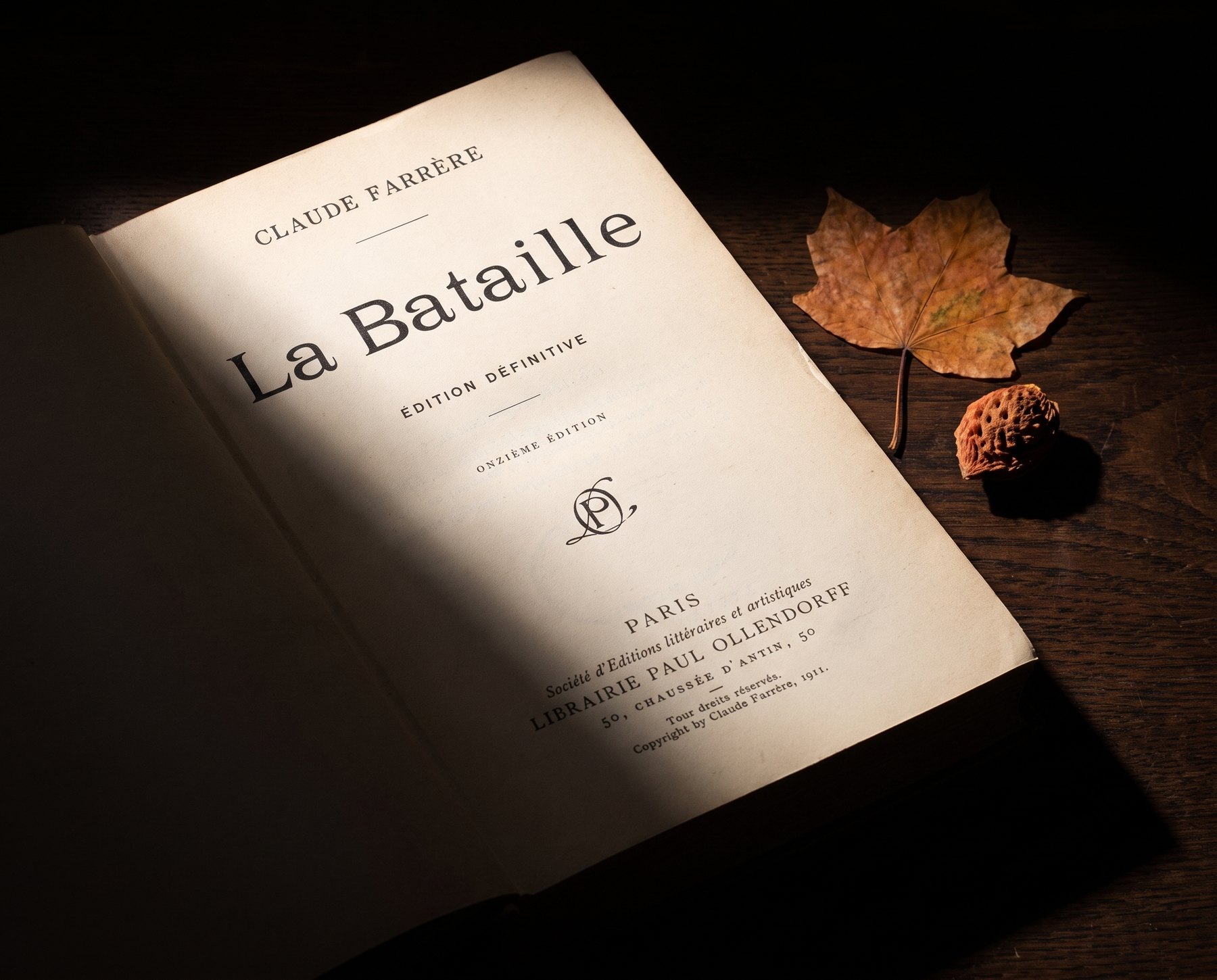
According to Nez, the name Mitsouko comes from the heroine of La Bataille, a novel by the French writer Claude Farrère. The book is set in Japan. Choosing that name reflects Europe's fascination at the time with the Far East.
Penta does not retell the plot here. What Penta notices is that a perfume chose to borrow its name from a book. It describes no flower and no place. It describes a person who never existed.
Europe's view of the East in those years was often an image built from far away rather than an understanding. Mitsouko carries the trace of that view in its name. It is part of the history too, and Penta records it as a fact, not as praise.
Inside the bottle there is nothing of Japan. Only moss from European oak forests, resins, spices and a peach molecule made in a laboratory. The name goes one way. The object goes another.
A smell that carries words
Mitsouko is a clear case of words and smell travelling together, then parting. At first the name helps people approach the smell. It offers a story, a face, a distant place. Later, once the smell is familiar, the name is only a sound.
Some people still keep old bottles of Mitsouko that belonged to a mother or a grandmother, like objects handed on to whoever keeps them next. For them the name does not recall a character in a novel. It recalls a relative, a room, a dressing table.
The oakmoss in today's Mitsouko is different, because of European Union rules on atranol. The formula has been adjusted over the years. But the frame holds: bitter moss, ripe fruit.
A name from a novel, a molecule from a laboratory, a forest from Europe. They meet in one bottle. And what lasts longest is the smell.

Olfactory Art