
Essays · Olfactory Art
Donna Huanca. CUEVA DE COPAL.
The body is absent. Its smell is not.
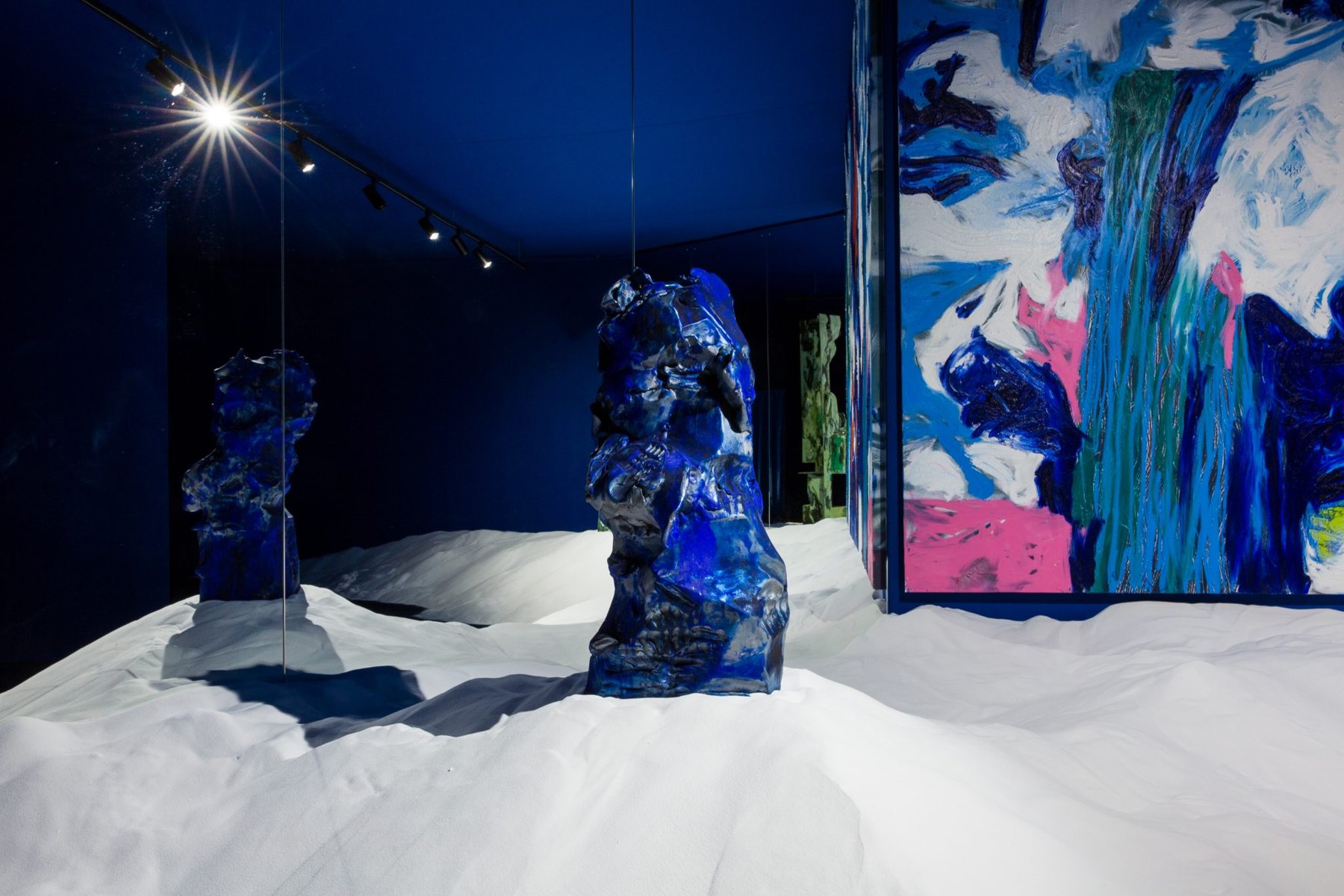
Photo: Lisa Whiting Photography. Courtesy Arnolfini, Bristol · ArtReview
Through a blue curtain
The way into CUEVA DE COPAL is a curtain of electric blue plastic strips. Behind it, a narrow corridor. Then the room opens.
The floor is covered in white sand, white as bone. The sand is what reveals the room's true shape: a triangle. At the far end, facing the entrance, hang four monumental paintings, placed as the focal point of the whole space. They are CUEVA DE COPAL #1 to #4, all from 2021, in oil and sand.
Sound fills the room: sloshing water, passing wind, birdsong. There are no birds and no water. Only sound, coming from somewhere unseen, as if the cave sat beside a stream outside.
And there is smell. A woody scent, made by Donna Huanca herself, spreads through the room. It evokes copal, the tree resin burned in cleansing rituals of many Indigenous cultures of Central and South America. The title translates as Copal Cave.
Bodies under paint
Huanca is a Bolivian American artist. In many earlier installations she brought models into the space, their bodies painted, standing or moving slowly among visitors. The living body was part of the work, like the paintings and sculptures.
CUEVA DE COPAL was installed at Arnolfini, Bristol, and ran until the end of May 2022. Because of pandemic restrictions, there were no performers this time. The room was empty of people.
But the body did not fully disappear. The four large paintings carry photographic traces of the models' bodies, buried under layers of natural pigment. Up close, you see the curve of a shoulder, a patch of skin, then lose it. The paintings do not depict the body. They bury it.
Two figurative sculptures also stand in the room: Vipassana Journal (Ripped Torso) and Arbol de Sapito (Sapito Tree), both from 2021. Behind them are large mirrors. Visitors look at the sculptures and see themselves behind, standing in the sand.
A cave for the senses
A cave was the first human shelter, and also where early rituals took place in the dark. Huanca does not build a cave of stone. She builds it from sand underfoot, sound in the ear and smell in the air. The eye is only one of the senses called on.
Smell has a specific job here. In the cleansing rituals the work refers to, copal smoke marks a threshold: entering a sacred space, leaving the everyday. Huanca does not burn real copal. She makes a woody scent that evokes it. Visitors who know nothing of the ritual can still sense that this room is not like the corridor they just walked through.
Using smell to change the state of a space is not rare in contemporary art. The soft installations of Ernesto Neto in the body that carries me also invite visitors in with the whole body, not only the eyes. What sets Huanca apart is absence: she stages a ritual with no one performing it, and lets a woody scent stand in that place.
Leaving CUEVA DE COPAL, visitors carry a little sand under their shoes and a trace of wood on their clothes. There were no performers, yet every visitor left footprints in the sand. The room changed each day with the people who passed through. The work recorded its own audience.
Olfactory Art