
Essays · Photography
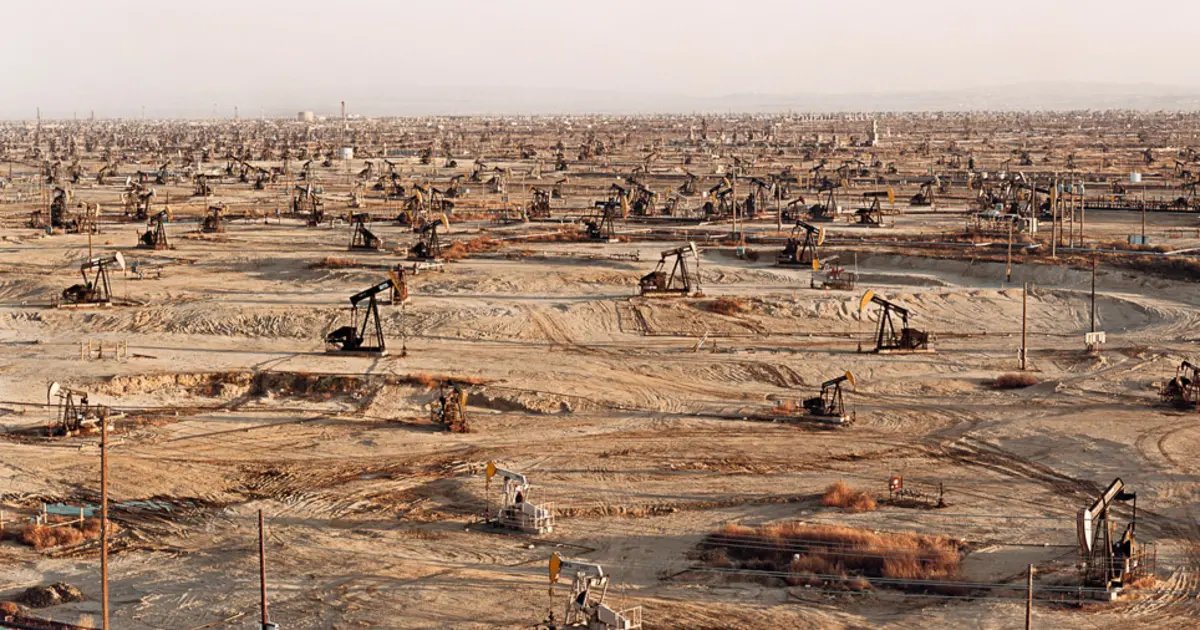
Edward Burtynsky. Oil.
The oil never appears. Only what it leaves behind.
The Photographers' Gallery · The Photographers' Gallery
A realisation in 1997
Edward Burtynsky is a Canadian photographer, born in 1955. Before Oil, he had spent years photographing land altered by people: mines, quarries, scrap yards. These were landscapes no one called beautiful, yet their scale made people stop.
In 1997, by his own account, he suddenly saw what connected those landscapes. The ground being dug, levelled and hauled away was all made possible by one thing: oil. The excavators ran on it. The trucks ran on it. The whole industry he was photographing rested on it.
From then on he decided to follow oil itself. Not as an object, but as a cycle. Where it is taken from, what it is turned into, which roads it travels, and how it ends.
The project ran from 1997 to 2009. Twelve years, many countries, hundreds of times standing before enormous structures waiting for the right light and the right vantage point.
Three stages of a cycle
In 2012, The Photographers' Gallery in London showed Oil from 18 May to 30 June, in collaboration with Huis Marseille in Amsterdam and Gallery Nicholas Metivier in Toronto. The pictures were divided into three parts.
The first was extraction and refinement. Oil fields such as Belridge, California, photographed in 2003: hundreds of pumpjacks repeating to the horizon, the ground around them flat and dry. Then refineries with tangled steel pipes, seen from afar like a city with no people.
The second was transportation and motor culture. Highway interchanges in Los Angeles in 2003, petrol stations and rows of signs at Breezewood, Pennsylvania in 2008. Here oil has become movement. People live inside it almost without thinking about it.
The third was called The End of Oil. Tanker shipbreaking yards, where giant hulls are cut apart sheet by sheet, and places where old vehicles are piled together. The cycle closes there, in fragments.
Distance and detail
Burtynsky works in colour and prints large. He often chooses a high viewpoint, sometimes from an aircraft, sometimes from a raised point on the ground. From that distance people shrink and almost vanish. What remains is the shape of what they have made.
What viewers remember most is the clarity. Every pumpjack, every lane, every patch of rust is sharp, even when the picture covers a vast area. The eye can travel across one print for a long time without running out of detail.
Other photographers of the same period used large formats and sharpness to speak about the scale of industrial life, such as Andreas Gursky with his rows of shelves. In Burtynsky, that scale lies outdoors, on the land.
That is why his pictures resist categories. They are too beautiful to be plain documents, and too exact to be merely scenic. Burtynsky writes no slogans under them. He lets the viewer stand before their scale and feel uneasy, or drawn in, or both.
Some accuse him of making destruction attractive. Others argue that the attraction is what makes people look long enough. The work does not settle the argument. It keeps it open.
Something unseen
Oil is a body of work about a substance that hardly ever appears in the frame. Oil lies underground, flows in pipes, burns in engines. When we do see it, it is usually because it has escaped from where it belongs.
Burtynsky photographs what surrounds it instead. Infrastructure, traces, remains. This shows that oil is not a raw material somewhere far away. It has become the shape of land, of cities, of the roads we use every day.
Seen more than a decade later, the series reads like an inventory. No characters, no plot. Only a chain of places, each one a stage in the life of a black liquid. And the viewer, standing before those large prints, realises that they are inside that chain too.
Photography