
Essays · Photography
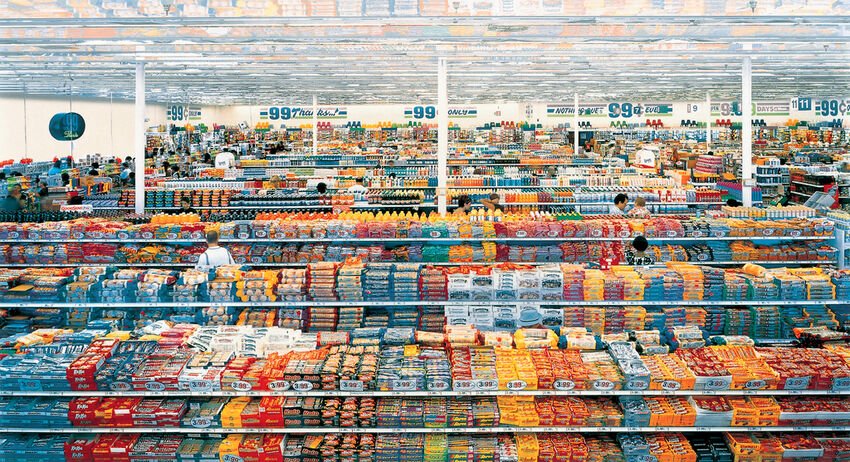
Andreas Gursky. 99 Cent.
Too many things, and none of them seen.
Courtesy Matthew Marks Gallery, New York; © Andreas Gursky / Artists Rights Society (ARS), New York · SFMOMA
A dollar store in Los Angeles
In 1999 Andreas Gursky photographed the interior of a 99 Cent store in Los Angeles, the kind of shop where nearly everything sells at one price. The finished work is a large colour print, about two metres high and over three and a half metres long, face mounted to acrylic.
The print at SFMOMA belongs to the Doris and Donald Fisher Collection and measures 207 by 336.6 centimetres. At that size, one does not look at it as a picture. One stands before it as before a wall.
It shows parallel aisles packed with goods: brightly coloured candy, small plastic toys, disposable things. A glossy ceiling reflects the aisles back, so the colour seems to spill upward. There are a few shoppers, but they are small and sink into the ground.
From photograph to surface
Gursky does not simply press the shutter and print. Since the early 1990s he has used digital processing to rebuild his images: joining, adjusting perspective, making every part of the frame equally sharp. 99 Cent is such a processed image.
The result is a space without a focal point. In an ordinary photograph, what is near is large and clear, what is far is small and soft. Here the item at the end of the aisle is as crisp as the one at the front. The eye has nowhere to rest.
From a distance the picture turns almost abstract: horizontal bands of colour, repeated, like a striped painting. Up close it breaks into thousands of separate packages, each with its label, colour and lettering. Both ways of seeing live on one surface.
Out of the Bechers' class
Andreas Gursky was born in Leipzig in 1955, grew up in Düsseldorf and studied photography with Bernd Becher at the Düsseldorf Art Academy. From his teacher he inherited a frontal, distant, unexclaiming gaze, the gaze behind the Bechers' water towers.
But Gursky turned that gaze on another world. The Bechers photographed vanishing industrial structures in black and white at modest size. Gursky photographs the working places of the global economy: stock exchanges, factories, ports, shops. His pictures are in colour, the size of museum paintings, often seen from above.
What they share is repetition. The Bechers set many water towers side by side to compare them. Gursky finds repetition inside a single frame: rows of people, rows of machines, rows of shelves. In 99 Cent, repetition is the subject.
A picture of consumption
The museum presents the work as a look at consumer culture. The goods are laid out neatly, ready for purchase, and quietly point to a whole chain behind them: factories making things in bulk, containers crossing oceans, warehouses, and only then this shelf.
Gursky offers no comment. No slogans, no ironic caption. The picture is beautiful, even very beautiful. That beauty is what unsettles a little: excess, seen from far enough away, looks like a work of art.
More than twenty five years later, the scene is still familiar. Aisles full of identical goods, things bought and forgotten. 99 Cent does not ask whether we should buy. It simply shows the whole view, and leaves the question to whoever stands before that wall of colour.
Photography