
Essays · Photography
Libraries, Museums and A Theatre.
An empty room still holds its people.
Ben Brown Fine Arts · Ben Brown Fine Arts
An exhibition in London
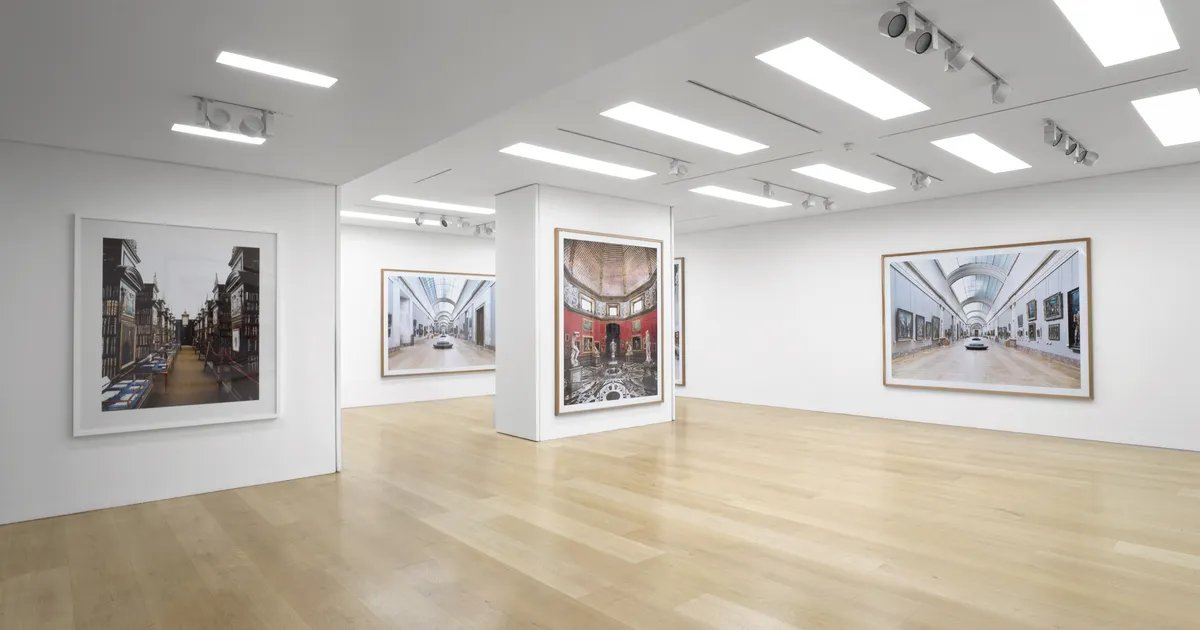
From 22 November 2021 to 25 January 2022, Ben Brown Fine Arts in London showed Candida Höfer's Libraries, Museums and A Theatre. It was her eleventh solo show with the gallery and her eighth at its London space.
The title says almost everything. Libraries. Museums. A theatre. Places people built to hold knowledge, hold objects, hold stories performed again and again. The photographs were taken across Austria, England, France, Germany, Ireland, Italy and Russia.
Among them were two pictures from the Louvre series of 2005, Marsh's Library in Dublin from 2004, the Teatro Olimpico in Vicenza from 2010, the Palazzo Ducale in Mantua from 2011 and the Villa Borghese in Rome from 2012. Each place is centuries old. Each was photographed with its doors closed to the public.
Great rooms, nobody in them
Höfer's approach is familiar to anyone who follows German photography. The camera sits at eye level or slightly above, usually facing the main axis of the room. The composition is balanced. Lines of ceiling, floor and columns run toward a point in the middle.
She uses long exposures and only the light already present. No flash, no added lamps. The light in the picture belongs to the room: from high windows, from chandeliers, bounced off gilded ceilings.
And there are no people. The gallery describes these spaces as stripped of their public status by the absence of people, leaving the viewer with the sense of looking into a moment not meant to be seen. A theatre without an audience. A museum with no one before the paintings. A library where every book lies still on its shelf.
That absence lets the architecture speak. With no one to look at, the eye follows each moulding, each step, each row of spines. The room becomes the only subject.
A student of a method
Candida Höfer was born in 1944. She studied at the Düsseldorf Art Academy in Bernd Becher's photography class, the class that produced what came to be called the Düsseldorf School, alongside Thomas Struth, Andreas Gursky and Thomas Ruff.
From the Bechers they took a calm, frontal, unexclaiming gaze. Thomas Struth photographed museums full of visitors, to watch how people look at art. Höfer went the other way: she photographs museums when no one is looking at anything, so the room itself can speak about looking.
In 2003 she represented Germany at the Venice Biennale. For decades she has returned to the same kinds of space: libraries, theatres, museums, lobbies, reading rooms. Not for lack of subjects, but because such spaces share one trait. They are built for the many, and they reveal themselves most when the many are gone.
The room as a body of memory
The gallery writes that Höfer is concerned with the psychological effect of architecture, and that her pictures preserve cultural memory by carefully recording design detail. Put simply: she photographs places built for remembering, and the photograph becomes a second layer of memory.
The Teatro Olimpico is a clear case. Designed by Andrea Palladio in the late sixteenth century, it has a wooden stage set built as false streets receding into depth. Through Höfer's lens those streets are empty. The stage waits for a play that ended four centuries ago.
Marsh's Library in Dublin opened in the early eighteenth century, its dark wooden shelves still where they were. In the picture, rows of spines form a wall of words. No one is reading. All of it has been read.
The large prints let the viewer stand before the room at nearly life size, as the only person present. Perhaps that is Höfer's aim: to let each of us stand alone, for a moment, in a space that belongs to everyone.

Photography